

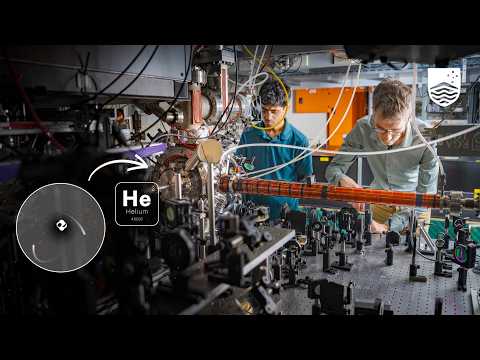
 Yogesh Sridhar and Dr Sean Hodgman (right) working on their quantum experiment. Credit: Nic Vevers/ANU
You can say the universe has a split personality. Or better said, our physical models of the universe are the ones fractured. On the grand scale of stars and galaxies, gravity rules. Albert Einstein’s general relativity beautifully describes their motion. Zoom in closer, however, down to the realm of subatomic particles, and quantum mechanics takes over. There, the rules of reality fracture into a bizarre game of probabilities.
Physicists call this glaring contradiction the problem of quantum gravity. Scientists have hunted for a single framework, often dubbed the Theory of Everything, to bridge the gap between the physics of the massive and the physics of the microscopic.
Now, physicists have taken a major step toward forcing these two incompatible worlds to talk to each other. Researchers at the Australian National University (ANU) have successfully demonstrated quantum entanglement using the physical motion — specifically, the momentum — of massive atoms.
“This result confirms the predictions of over a century ago that matter can be in two locations at once, and it can interfere with itself even in those locations,” says Dr. Sean Hodgman from the ANU Research School of Physics.
Because these atoms have mass, they experience gravity. This breakthrough gives scientists a brand new toolkit to test how the strange rules of quantum mechanics interact with the gravitational fields that shape our universe.
The capacity to entangle subatomic particles so that changes to one instantly affect the other — even over a distance — has been demonstrated many times. However, past experiments relied on massless photons, or internal features of atoms and electrons, such as their spin. Because these earlier demonstrations lacked physical motion or mass, they couldn’t address the critical question of how entanglement interacts with gravity.
Why Mass Matters
Entanglement is the strangest feature of the quantum world. If you entangle two particles, changing the state of one instantly affects the other, no matter how much distance separates them. This is not just abstract theory; scientists have demonstrated quantum entanglement in action many times.
The first experiments in the late 1990s showed that quantum states could be transmitted across short distances, while subsequent research proved it works across increasingly longer distances, even to and from low Earth orbit, as Chinese scientists showed in 2017.
×
Thank you! One more thing…
Please check your inbox and confirm your subscription.
Research labs now routinely do entanglement all the time with photons, which are particles of light. But photons are practically weightless. Because they lack mass, they aren’t ideal for testing the effects of gravity. For the latter task, helium atoms are much better suited. They have mass, so they must feel the tug of gravity.
“Experimentally, it’s extremely hard to demonstrate this,” says lead author and PhD researcher, Yogesh Sridhar. “Several people have tried in the past to show these effects, and they have always come short.”
Colliding Clouds of Super-Cold Atoms
So, how do you entangle the physical motion of two chunky atoms? You make them incredibly cold and smash them together.
The research team chilled clouds of helium atoms down to a fraction of a degree above absolute zero. This extreme freeze created a state of matter called a Bose-Einstein Condensate. They then pushed these ultra-cold atomic clouds toward each other.
When the atoms collided, they scattered — but not in the way you think. In the weird world of quantum physics, instead of bouncing off in definitive directions like billiard balls, the atoms effectively take multiple paths at once. They go left/right and up/down simultaneously.
Because momentum dictates where an object is heading, having multiple momentums means the atom is effectively traveling along multiple physical paths at once. As it falls, the particle is quite literally in two locations simultaneously.
“It’s really weird for us to think that this is how the Universe works,” says Dr Sean Hodgman from the ANU Research School of Physics. “You can read about it in a textbook, but it’s really weird to think that a particle can be in two places at once.”
As the atoms plummeted into the team’s detector, these simultaneous paths overlapped and interfered with each other. Because the atoms were entangled by their initial collision, their final landing spots remained entirely linked. The moment the detector measured the momentum of one atom, it forced that atom to finally pick a definite path. That measurement instantly collapsed the possible paths of its entangled partner, no matter where it was.
Catching Falling Helium
To prove the atoms were actually entangled in their motion, the team let them fall.
As the atoms plummeted, they passed through a device called a Rarity-Tapster interferometer. This system measured their momentum as they crashed onto a detector plate below.
Helium atoms are great for this drop test because they can be trapped in a high-energy excited state. “This means they have high internal energy and release electrons we can measure, allowing us to measure the atoms with full three-dimensional resolution,” Hodgman told IFLScience.
The resulting landing patterns proved the atoms were entangled. The measurements violated Bell’s inequality, a famous mathematical theorem used to prove that quantum non-locality is real. The patterns in the data proved that the helium atoms weren’t carrying what physicists call “hidden variables.” Instead, the state of one atom was genuinely affecting its partner instantly, no matter the distance between them. It confirmed that the spooky, long-distance connection is genuine.
“For two separated atoms that are entangled, if you change one of them, it will instantly affect the other,” Hodgman said. “It’s kind of crazy to think that this is how the world works, but we’ve shown that it’s the nature of reality!”
The Quest for the Theory of Everything
We desperately need a “Theory of Everything” to unite the physics of the massive with the physics of the microscopic. Currently, those two frameworks despise each other.
“Imagine atoms moving through different paths in space; they can experience different gravitational effects,” Hodgman explained. “However, quantum mechanics says atoms can take multiple paths simultaneously. How do you describe such a system in a general relativity framework? What does the space-time curvature for such a system look like? No one really knows, because quantum and gravity don’t match up nicely, although a lot of researchers are working on it.”
By scaling up this experiment, researchers hope to observe exactly what happens to quantum entanglement when gravity pulls at particles.
But there is still a catch. The universe is a bit sneaky.
To fully prove that these atoms aren’t somehow communicating with each other at speeds slower than light, scientists have to close what is called the locality loophole.
“An important aspect in any such future demonstration would be to ensure large space-like separation between the correlated atoms, required for closing the locality loophole,” the authors note.
Specifically, the atoms need to be at least 30 centimeters apart. Right now, the team’s detector is only 8 centimeters wide. Getting there will take time and money. The team “would need a lot more funding to scale up,” and probably years of work reach the scale required to close the locality loophole, Hodgman says.
In the future, the team hopes to entangle completely different isotopes, like Helium-3 and Helium-4. Because these isotopes have different masses, entangling them could allow scientists to test the weak equivalence principle — a core pillar of general relativity — using quantum test masses.
The findings were reported in the journal Nature Communications..