
During the peak of the Last Glacial Maximum, global sea levels were about 120 meters lower than today. By the time of the Younger Dryas, sea levels were still significantly lower, roughly 60 to 80 meters below present levels, before rising rapidly into the Holocene.
What this means is simple but important. The world did not look the same.
Coastlines would have been drastically different. Large areas of land that are now underwater, especially continental shelves, would have been exposed. This includes parts of Southeast Asia, areas around Europe, and potentially sections of the Atlantic margins such as the region near the Azores. Entire landscapes that once may have supported human activity are now submerged and forgotten beneath rising seas.
At the same time, North Africa was not the desert we recognize today. During the African Humid Period, often referred to as the “Green Sahara,” the region supported rivers, lakes, vegetation, and human populations. It was a livable environment, not an empty expanse of sand.
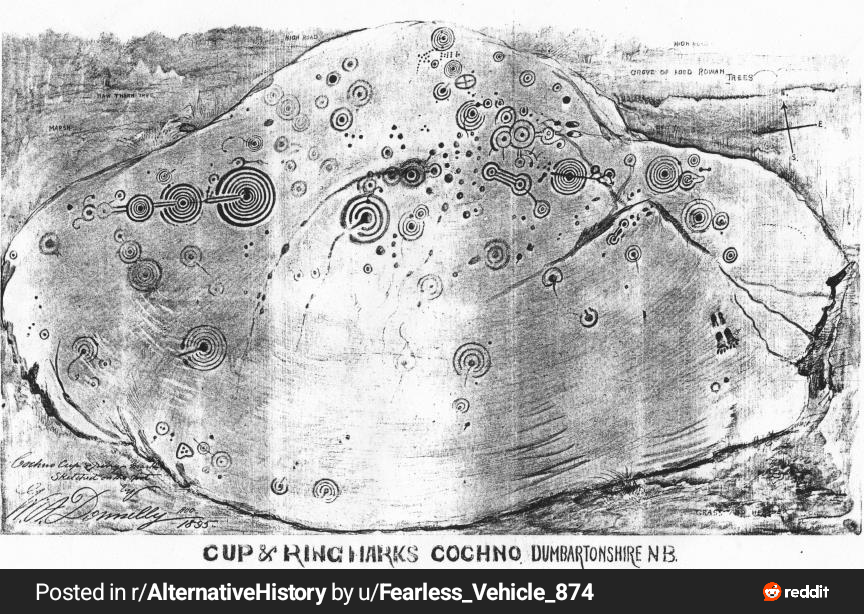
When I look at the Cochno Stone, one detail stands out. There are numerous dots clustered in what could correspond to this region. If interpreted through this lens, those markings could represent settlements, water sources, or important locations from a time when the Sahara was alive and inhabited. It’s not proof, but it’s a pattern worth noticing.
Now consider continental movement. Tectonic plates do shift, but very slowly. On average, they move about 2 to 5 centimeters per year, which over 12,000 years amounts to roughly 240 to 600 meters. That is measurable, but minor compared to the scale of continents.
For example, the distance between Africa and South America today is about 2,800 to 3,000 kilometers across the Atlantic. Over 12,000 years, that distance would have changed by less than a kilometer. In other words, the overall layout of the continents has remained essentially the same.
So what does this imply?
If people in the distant past had a broad awareness of land distribution, even if that knowledge was passed down imperfectly, the general structure of the world would still be recognizable. However, coastlines, proportions, and connections would appear different due to lower sea levels, submerged land, and environmental changes like a greener Sahara.
But there is another factor that matters just as much as geology.
Human memory.
Research by Frederic Bartlett demonstrates that memory is reconstructive rather than exact. People do not store perfect copies of information. Instead, they rebuild memories based on patterns, meaning, and prior understanding. Over long periods of time, especially when information is passed down through generations, details degrade while general structures tend to remain.
This is important.
If geographic knowledge were transmitted across thousands of years, what would survive would not be a precise map. It would be a pattern-based reconstruction. Something shaped by both real environmental changes and the natural limitations of human memory.
And that brings us back to the Cochno Stone.
The distortions we see may not necessarily mean the idea is wrong. They may reflect exactly what we would expect from something preserved across deep time. A world that looked different, remembered imperfectly, and recorded in a symbolic way.
From my perspective, this is where it becomes compelling.
I spend a lot of time looking at maps. When you do that long enough, you start to internalize the structure of the world, not just exact borders, but spatial relationships. And when I look at the Cochno Stone, I don’t see randomness. I see something that feels familiar.
Not exact. Not precise. But structurally recognizable.
The arrangement of dots, rings, and patterns doesn’t look like a modern map, but it resembles the kind of layout someone might produce if they were trying to reconstruct the world from memory. The proportions may be off. The scale may be distorted. But the relationships between elements feel intentional.
That doesn’t prove the Cochno Stone is a world map.
But it does suggest that it may not be just random art either.
It may be something in between. A remembered world.
by Fearless_Vehicle_874