
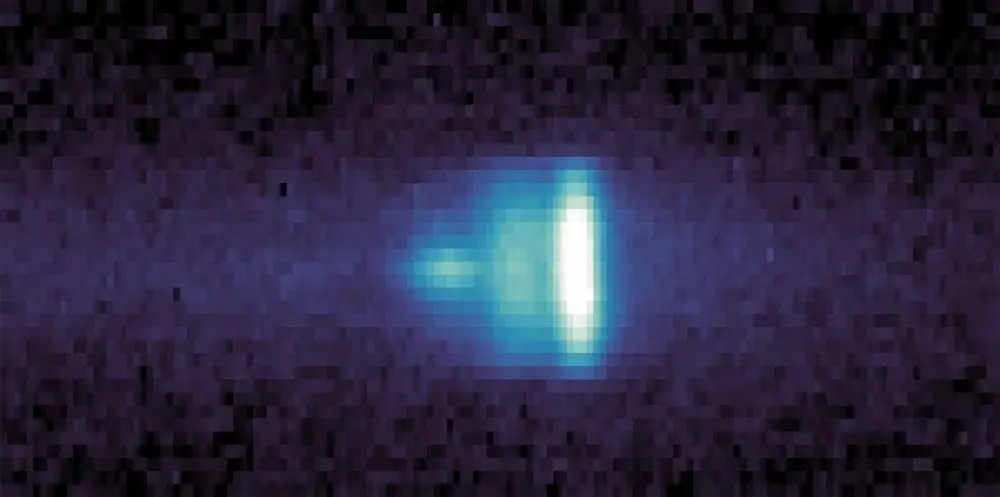
An assessment published this week on the isotopic composition of interstellar comet 3I/ATLAS suggests an intriguing possibility: The comet may be between 10 and 12 billion years old, making it roughly as old as, or even older than, our own Milky Way galaxy.
The paper is available as a pre-print edition awaiting peer review, though the lead authors have all published ample peer-reviewed research in the past. The findings analyze spectrographic data collected by the Near-Infrared Spectrograph on the James Webb Space Telescope.
Specifically, the researchers examined the ratios of the isotopes carbon-12 and carbon-13 in 3I/ATLAS’s plume, along with the hydrogen-to-deuterium ratio in the comet’s water ice.
The carbon ratio can help narrow down the comet’s potential age, as carbon-13 tends to build up over time in the sorts of star-forming clouds that would have originally spit out a comet like 3I/ATLAS. A low 13-to-12 ratio indicates the rough ratio that existed when the comet first formed, and 3I/ATLAS shows a ratio much lower than any observed today.
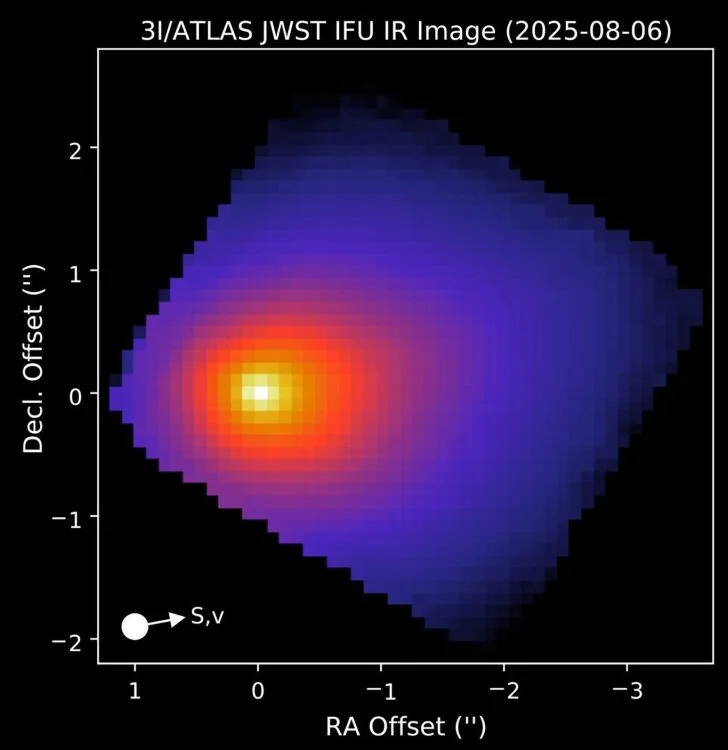
3I/ATLAS webb infrared shot
3I/ATLAS as seen by the Near-Infrared Spectrograph instrument onboard the James Webb Space Telescope. Credit: NASA
The deuterium ratio helps narrow things ever further, with 3I/ATLAS showing high deuterium richness. Deuterium tends to be incorporated in colder environments beyond the “snow line,” where water is always found as ice, not a liquid or vapor. This makes sense for an icy comet, since comets are thought to be formed in cold, icy environments.
The deuterium level in 3I/ATLAS implies that it formed from ice in the early, extremely cold cloud of the still-forming galaxy.
That age has implications for the comet’s physical origins. While our Sun sits in a relatively young band of the Milky Way, nearer to the exterior, the thicker band of gas near the galaxy’s interior is thought to have begun forming around 13 billion years ago.
That means that the 10-12 billion-year-old 3I/ATLAS could be an interstellar traveler carrying information not just from the youth of our galaxy, but from the very heart of its formation. It’s also so old that the star system that formed it may no longer exist; remember that our Sun has an estimated total lifetime of just 10 billion years, which could be less time than 3I/ATLAS has been around, already.
That makes further study of readings from 3I/ATLAS important, since they could help look far, far back into the history of the galaxy. If they’re lucky, astronomers could look into data collected from the comet’s icy tail and see the specifics that reveal how galaxies form and evolve. Within that larger system, they could even start to find real data on just how our own solar system formed.
If these findings are confirmed, Comet 3I/ATLAS could become one of the most important time capsules ever discovered.