
The four astronauts of the Artemis II mission are locked in their seats in the Orion capsule, with technicians performing critical checks to ensure safety.
This is the first time since 1972 that astronauts will fly to the vicinity of the moon if weather conditions remain favorable.
NASA is targeting a two-hour launch window that opened at 6.24 p.m. ET (2224 GMT) today.
The April launch windows for the mission run from today through to April 6, with the potential for a launch on any of those days.
If a launch is not successful in that window, Artemis II would have to wait till April 30 to launch again.
The Artemis II is expected to liftoff from NASA’s Kennedy Space Center in Florida.
Artemis II is the first crewed mission on NASA’s path to establishing a long-term presence at the Moon Image: Joe Skipper/REUTERS
What do we know about the Artemis II mission?
Four astronauts of the Artemis II flight are expected to take off for the moon on Wednesday night, in what would mark NASA’s most ambitious space mission in decades.
The 10-day flight around the moon marks a major step toward returning humans to the lunar surface, taking place before China’s first crewed landing.
It would mark the farthest humans have ever traveled in space, sending them some 252,000 miles (406,000 km).
What does Germany have to do with Artemis II?
A critical component of the Orion spacecraft’s European Service Module (ESM) was built by Airbus in Bremen, Germany, on behalf of the European Space Agency.
Acting as the powerhouse for Artemis moon missions, the ESM provides propulsion, power, thermal control, water, and oxygen, utilizing 33 engines including a repurposed Shuttle orbital maneuvering engine.
Are astronauts going to land on the moon?
Astronauts aren’t going to land on the moon this time, but the Artemis II mission is meant to see whether components of the Artemis space program can send astronauts to the moon and back.
What do we know about the rocket and astronauts?
NASA led the design of the Space Launch System rocket and the Orion capsule and it hired private companies SpaceX and Blue Origin to provide the lunar landers for Artemis missions in the future.
On NASA’s Artemis II test flight, astronauts will take the controls of the Orion spacecraft and periodically fly it manually during the flight around the Moon and back.
The mission provides the first opportunity to ensure the spacecraft operates as designed with humans aboard, ahead of future Artemis missions to the Moon’s surface.
Artemis II rocketImage: Brendan McDermid/REUTERS
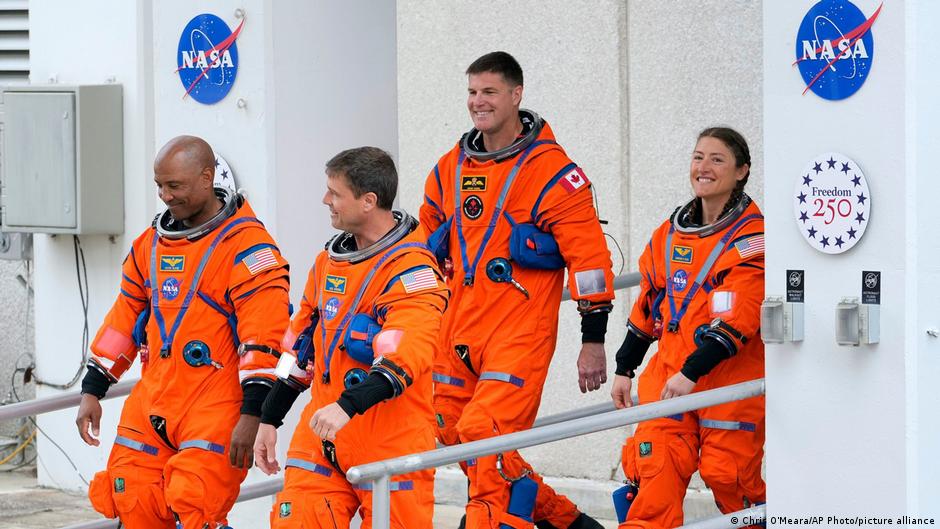
NASA astronauts Christina Koch, Victor Glover and Reid Wiseman and Canadian astronaut Jeremy Hansen, landed in Florida from Houston on Friday after a two-week quarantine leading up to liftoff.
Artemis promises moon base
The astronauts are not expected to land on the moon. Instead, they will travel several thousand miles beyond it, perform a U-turn and return to Earth.
They will not circle around the moon nor perform a moonwalk. But on the flight, they are expected to test critical life-support systems of the Orion capsule, crew interfaces and communications.
The Artemis II mission ultimately represents the opening shot of NASA’s plans for a permanent moon base. The agency hopes for a proper moon landing near the lunar south pole in 2028.
Edited by: Srinivas Mazumdaru, Alex Berry