
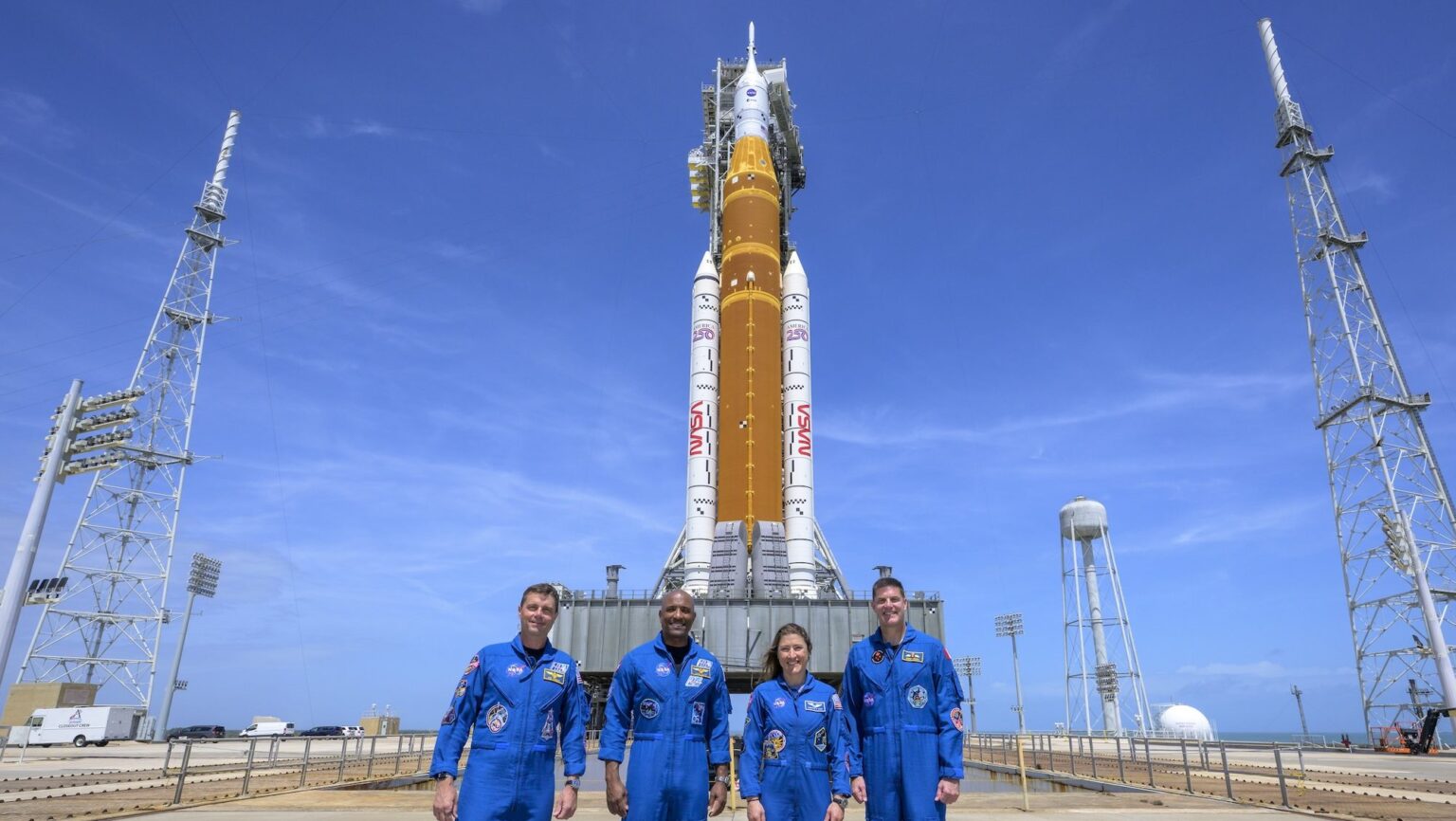
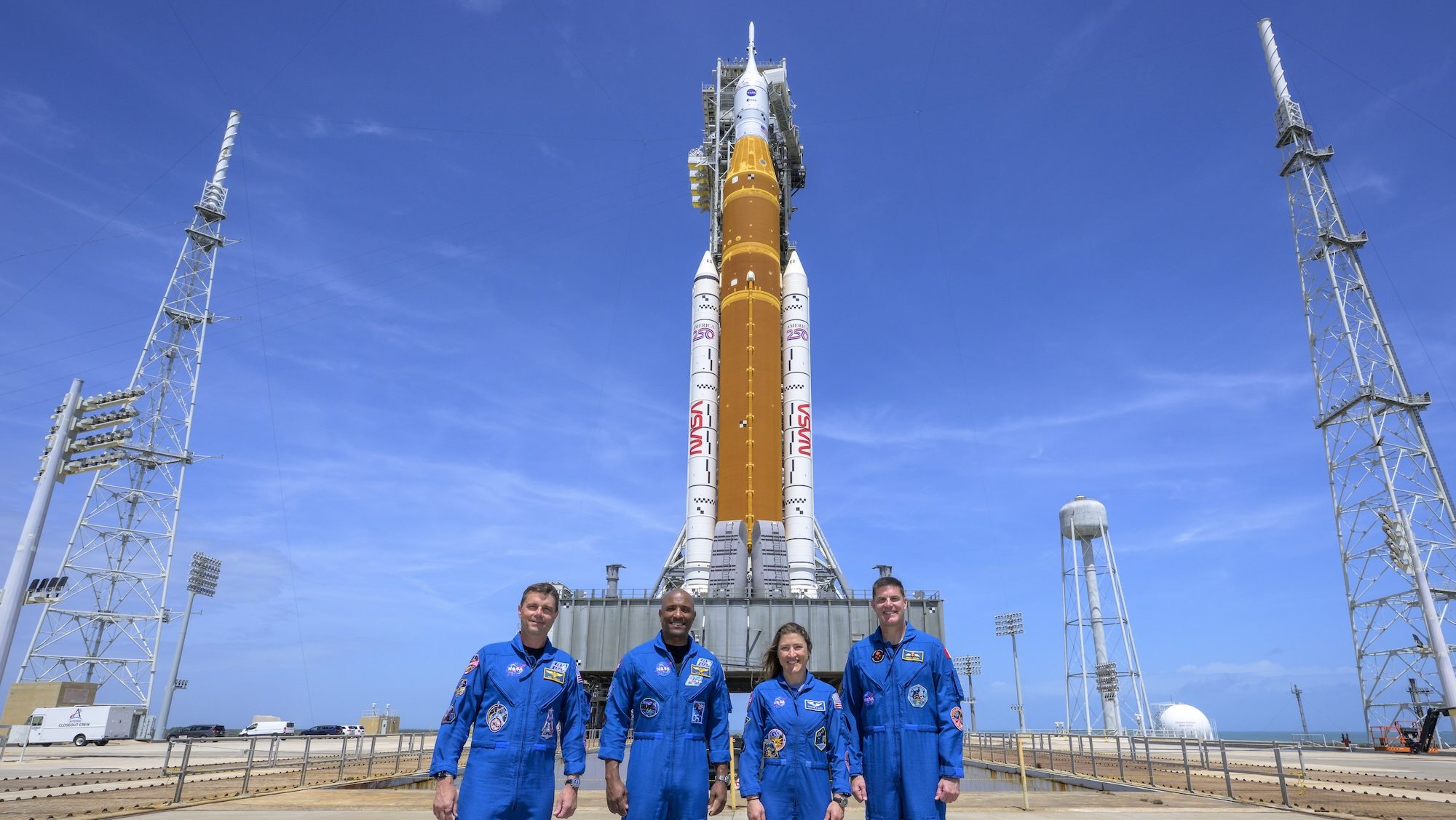
The Artemis II crew (left to right): NASA astronauts Reid Wiseman, Victor Glover, Christina Koch, and Canadian Space Agency astronaut Jeremy Hansen.
Photo by Bill Ingalls/NASA/Getty Images
It’s been nearly 54 years since NASA sent astronauts to the Moon. No humans have set foot on our sole satellite since the Apollo 17 mission of 1972. Since then, space science has made many more giant leaps — we’ve put rovers on Mars, launched probes into interstellar space, and even sent Katy Perry into suborbital space. But we still haven’t been back to the Moon.
If all goes well, that streak ends today, when NASA sends its first crewed mission back to the Moon — a launch many years in the making. Four astronauts — Reid Wiseman, Victor Glover, Christina Koch, and Jeremy Hansen — are scheduled to embark on the ten-day mission on Wednesday, April 1. They will not land on the Moon, but instead loop around it, much like the Apollo 13 astronauts were forced to do in 1970 when their mission went awry. (That’s about the only aspect of the Apollo 13 flight these astronauts will want to replicate.)
Today’s mission also marks some significant milestones for human spaceflight. Glover will become the first person of color to leave low Earth orbit; Koch, the first woman; Wiseman, the oldest; and Hansen, the first non-U.S. citizen to travel beyond low Earth orbit and to the Moon’s vicinity (he is Canadian). The mission also starts another countdown: NASA aims to get humans back on the Moon by 2028.
So, given Miami’s proximity to the launch site at Cape Canaveral, Florida, will locals be able to see the launch? Maybe. Here’s what you need to know.
When does Artemis II Launch?
Artemis II is scheduled to launch on Wednesday, April 1, at 6:24 p.m. EDT. If, for whatever reason, the launch does not occur at exactly that time, the crew has a two-hour window to execute it.
Can You Watch the Launch Online?
Yes, and NASA is already streaming the prep process leading up to it. As of press time, the astronauts have just woken up and begun pre-launch procedures. Stream the launch below.
Can You See the Artemis II Launch from Miami?
Assuming favorable cloud conditions, the rocket will be visible from South Florida, including Miami.
NASA Solar System Ambassador Tony Rice tells New Times that, “Unlike shuttle launches, which were generally chasing the International Space Station and launching more to the northeast, Artemis will be launching nearly due east to take advantage of the Earth’s rotation, which adds a bit of energy to the rocket.” He adds, “The closer you are to a flat horizon, such as a beach along the Atlantic, the better your chances of seeing the rocket.”
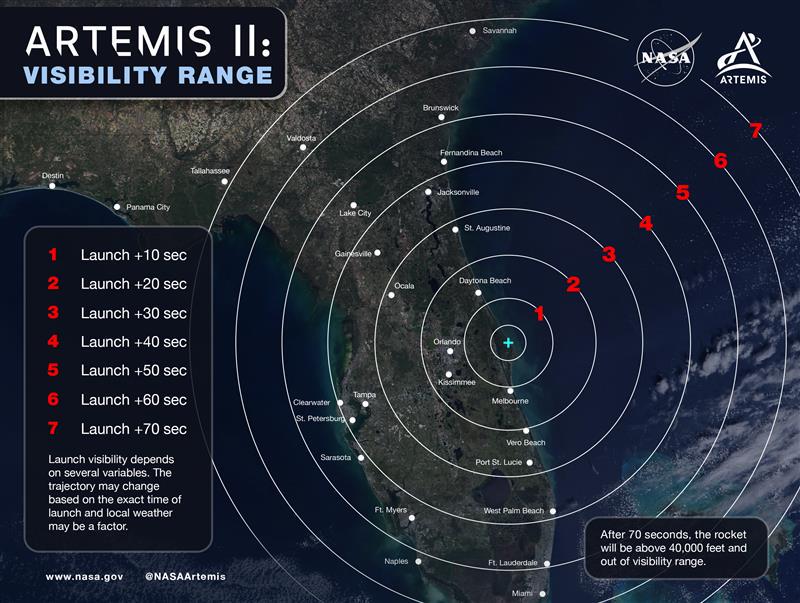 The Artemis II rocket will be visible from Miami about a minute after launch.
NASA’s official visibility map offers a useful visual to help you plan. Weather permitting, South Florida will start to see the rocket about 40 seconds after launch, when it enters West Palm Beach’s visibility range. Fort Lauderdale could see the rocket about 50 seconds after launch, with Miami seeing it shortly thereafter. After 70 seconds, it will be out of visibility range.
One major factor impeding visibility: clouds. Today’s local forecast calls for morning showers and mostly to partly cloudy conditions around launch time.
For what it’s worth, all’s well at Kennedy Space Center so far. Rice tells New Times: “Sitting here at the KSC Press Site right now, there are a few puffy cumulus clouds, and the weather is about the best I’ve ever seen on launch day.”