
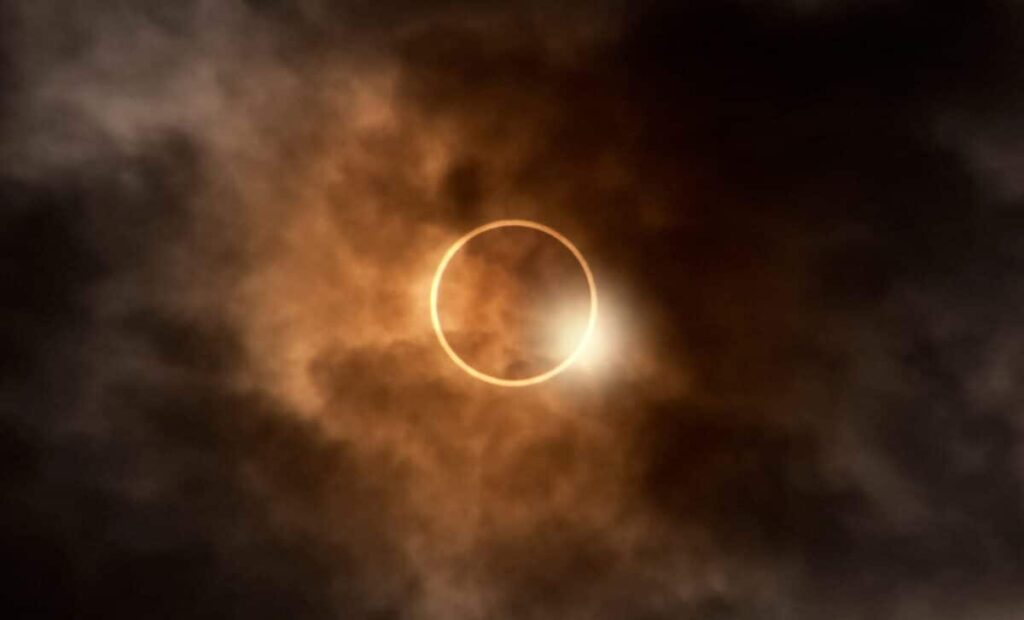
The sudden loss of the Sun would not be felt immediately on Earth, yet within minutes the planet would enter a rapid and irreversible transformation. Darkness would set in, temperatures would drop sharply, and the fundamental systems that sustain life would progressively shut down.
For approximately 4.6 billion years, the Sun has been the central structuring force of Earth’s environment. It maintains the planet in a stable orbit and provides the energy required for climatic and biological balance. Without this input, the conditions necessary for life would quickly deteriorate.
This scenario, regularly examined by scientists, highlights the extent of Earth’s dependence on its star. The consequences of such a disappearance would be both immediate on a human timescale and global at the planetary level.
Eight Minutes of Normal Life Before Total Blackout
At first, no change would be observable. Because sunlight takes about 8 minutes and 20 seconds to reach Earth, the planet would continue to receive light for a brief interval. Once that delay passes, complete darkness would follow.
According to Timothy Cronin of MIT, speaking to Live Science, people on Earth would likely have no warning before the blackout. The Moon would disappear from view since it reflects sunlight, and only distant stars would remain visible in the sky.
At the same time, Earth would lose the gravitational influence of the Sun. As reported by the same source, the planet would no longer follow its orbital path and would instead travel in a straight line through space, along with the rest of the solar system’s bodies.
From Photosynthesis Failure to Food Chain Breakdown
The absence of sunlight would quickly disrupt the foundation of life on Earth. Photosynthesis would stop almost instantly, cutting off the primary energy source for plants and many microorganisms. As explained by Michael Summers of George Mason University, most plants not supported by artificial lighting would die in a relatively short time. As he explained:
Some “might stay dormant for weeks to months, like they do in the wintertime, eventually all photosynthetic organisms would die.”
He added that animals would lose their food, and food chains would begin to collapse. Fungi could get a short-lived boost from all the dead material, but even that wouldn’t last, as temperatures keep dropping.
Temperatures Plunge Toward The Cold Of Deep Space
Without solar energy, Earth would begin cooling rapidly. Initial estimates suggest a drop of about 20°C (36°F) per day, according to data shared with Live Science.
Within a few days, most of the planet would fall below freezing. Small bodies of water would freeze within a week, while larger lakes would take longer. The oceans, due to their depth, could remain partially liquid for years or even decades.
In specific regions such as deep ocean environments heated by geothermal activity, liquid water might persist far longer. These areas could provide limited refuge for certain forms of life.
Over extended periods, Earth would continue cooling until it approached the temperature of the surrounding universe. This baseline is about −270°C (−454°F), set by the cosmic microwave background, a remnant of the Big Bang.
Survival Reduced to Isolated Refuges
As the surface becomes uninhabitable, most life on Earth would disappear. Human survival would depend on access to controlled environments and alternative energy sources.
“It’s conceivable that people could survive underground in caves, sustained by geothermal or nuclear energy, with plants grown under artificial lighting,” Cronin stated, “but this would be an extinction event to make all others look puny.”
At the same time, microbial life in deep ocean ecosystems could continue, supported by internal heat rather than sunlight. These environments already function independently of solar energy.