
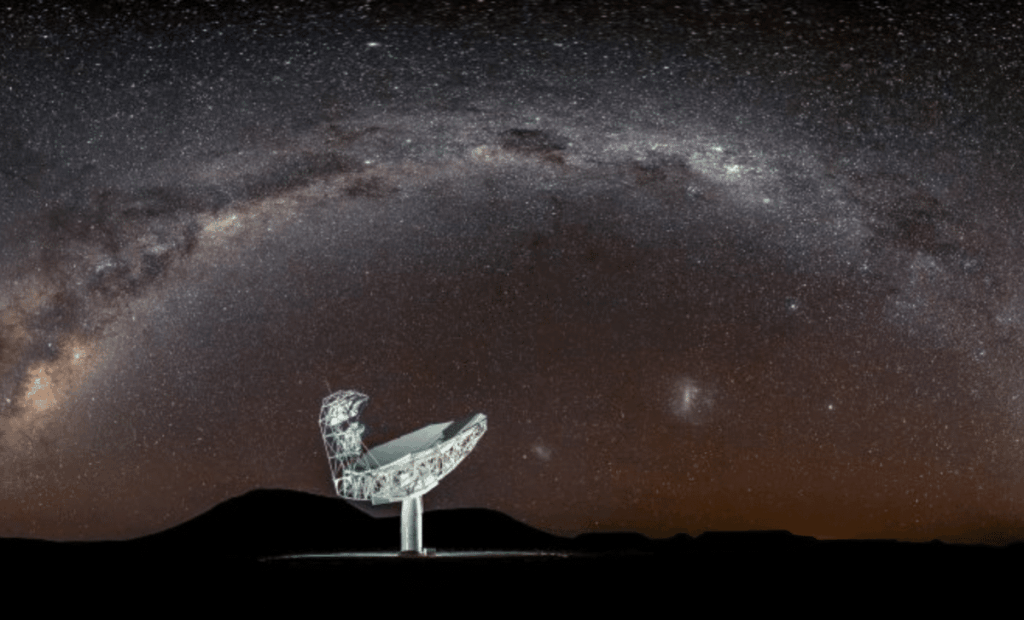
South Africa’s MeerKAT radio telescope has uncovered 60 entirely new cosmic structures previously invisible to scientists. This remarkable achievement marks a leap forward in astronomical research, allowing researchers to explore the unseen and dynamic energy processes taking place between galaxies. The findings, detailed in The Conversation, offer a rare glimpse into the invisible universe, providing crucial insights into the forces that govern the largest cosmic structures.
The Invisible Universe: A New Frontier in Cosmic Exploration
The universe has long fascinated astronomers, who have spent centuries looking at distant galaxies through powerful telescopes. But until now, much of the space between these galaxies remained a mystery. South Africa’s MeerKAT radio telescope, however, has turned that mystery into a window of discovery. By capturing faint radio emissions, MeerKAT has revealed cosmic structures that were once thought to be invisible.
These structures are not just random phenomena; they are key components of galaxy clusters, some of the largest and most important structures in the universe. The newly discovered “diffuse radio emissions” are like faint cosmic fingerprints, scattered across millions of light-years. They represent the energetic processes that occur in the vast, invisible spaces between galaxies when galaxy clusters collide or merge. Understanding these emissions is crucial for piecing together the larger story of cosmic evolution.
 Diffuse radio emissions captured by the MeerKAT telescope spanning millions of light-years.
Visualisation by Konstantinos Kolokythas, CC BY
Unveiling Hidden Structures: What MeerKAT Found
Think of a galaxy cluster not just as a collection of galaxies, but as a bustling city, with galaxies acting like towering skyscrapers. In the past, telescopes have focused on these bright lights, the individual galaxies themselves. However, the spaces between them were largely ignored, believed to be empty or insignificant. What MeerKAT has revealed, however, is that these spaces are far from empty. They are filled with faint but crucial emissions that can only be detected through the power of radio waves.
The emissions come from the Intracluster Medium, a hot, thin gas that permeates galaxy clusters. While the gas itself has been observed by X-ray telescopes, its interaction with magnetic fields and fast-moving electrons had remained hidden until MeerKAT’s sensitive instruments began mapping them. When galaxy clusters collide, forming a cosmic dance of immense proportions, the electrons spiral along magnetic field lines, releasing energy in the form of radio waves. These waves have now been captured and cataloged by the MeerKAT telescope, offering a new way to observe the violent but fascinating processes at work.
In a study led by Konstantinos Kolokythas, a radio astronomer at Rhodes University and the South African Radio Astronomy Observatory (SARAO), researchers mapped 115 galaxy clusters in unprecedented detail. They identified 103 diffuse sources of radio emissions, 60 of which had never been detected before. These findings expand our knowledge of how galaxy clusters evolve and interact, offering new clues about the forces that shape the universe.
The Role of South Africa’s MeerKAT: A Global Leader in Radio Astronomy
South Africa’s MeerKAT telescope is not just another instrument in the growing field of radio astronomy, it is a leader. Located in the Karoo Desert, MeerKAT is one of the most powerful radio telescopes in the world, capable of detecting faint radio emissions that other instruments simply cannot. Its cutting-edge technology allows scientists to study the universe in a way that was once thought impossible.
MeerKAT’s success is part of a broader effort to build the Square Kilometre Array (SKA), a massive global project set to become the world’s largest and most sensitive radio telescope. While MeerKAT has already provided vital insights into cosmic structures, the SKA, set to be fully operational by 2030, will take these discoveries to the next level. The scale and sensitivity of the SKA will enable astronomers to detect thousands of new structures and gain an even deeper understanding of the universe’s hidden energy processes.
This research, detailed in The Conversation, places South Africa at the forefront of radio astronomy and underscores the nation’s growing influence in the global scientific community. As the host of the MeerKAT telescope and the SKA project, South Africa is paving the way for discoveries that will shape our understanding of the cosmos for decades to come.
Cosmic Collisions: What These Findings Mean for Our Understanding of the Universe
The newly discovered structures are not merely a collection of radio signals, they represent the scars left by cosmic collisions. When galaxy clusters merge, they generate shockwaves and turbulence, much like a slow-motion cosmic collision. These events send particles hurtling at nearly the speed of light, creating bursts of energy that are visible as radio emissions.
What MeerKAT has shown is that even galaxy clusters that appear “calm” in traditional observations, such as X-rays, may actually harbor a hidden history of energetic events. These findings are a critical step forward in understanding how energy is processed on a cosmic scale. By mapping these emissions, researchers are essentially charting the energy budgets of galaxy clusters, which will allow them to study the forces that shape the universe at a much larger scale.