
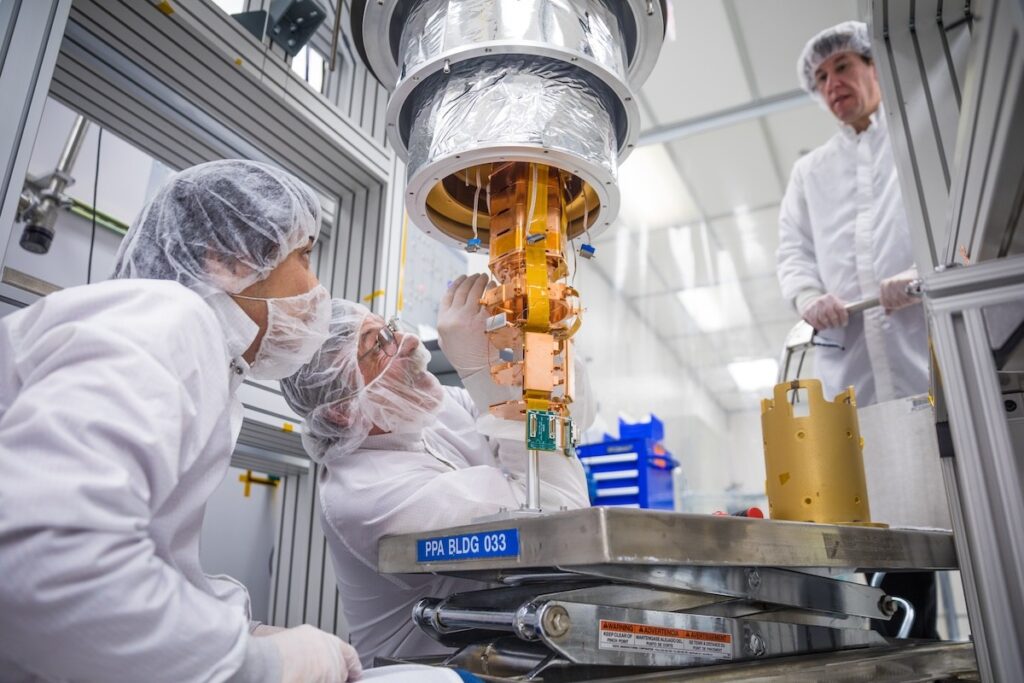
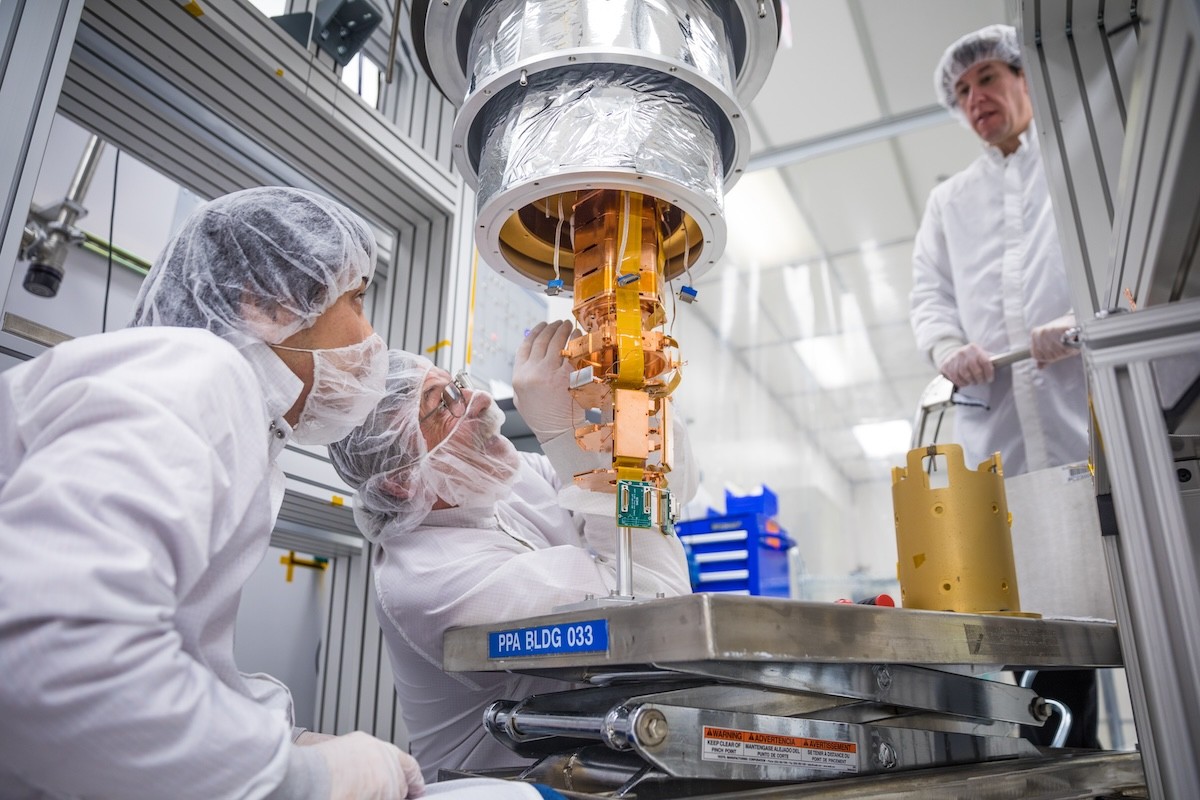
SLAC (Stanford Linear Accelerator Center) scientists and a technician inspect a SuperCDMS detector tower installed at the bottom of the dilution refrigerator used for tower testing.
Credit: Christopher Smith/SLAC National Accelerator Laboratory
Deep underground in a Canadian mine, a refrigerator nearly 1,000 times colder than outer space has just reached its target temperature — a milestone that brings scientists one step closer to potentially detecting dark matter, the invisible material thought to make up most of the mass in the universe.
For researchers at Texas A&M University, the moment is especially meaningful. Their custom‑designed detectors sit at the heart of the Super Cryogenic Dark Matter Search (SuperCDMS), and they only become sensitive enough to detect possible dark‑matter interactions at these extreme temperatures. SuperCDMS is in SNOLAB, an underground research facility in a nickel mine near Sudbury, Ontario.
Scientists there are targeting “light dark matter,” a much lower‑mass form of dark matter that’s even harder to detect.
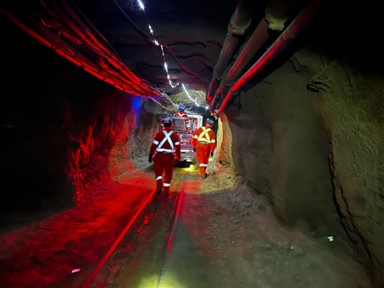
SNOLAB staff escort the SuperCDMS dilution fridge nearly a mile through the mine drift to the lab entrance.
Credit: Mike Whitehouse/SNOLAB
Texas A&M physicist Dr. Rupak Mahapatra and his team designed and fabricated highly advanced semiconductor detectors with cryogenic quantum sensors for this experiment. Mahapatra says the milestone reflects decades of advancement: “We have come a long way from the earlier generation CDMS experiment at Soudan, Minnesota, to this Generation 2 SuperCDMS experiment in SNOLAB, paving the way for incredibly sensitive searches for the elusive dark matter and other new physics.”
Inside one of the coldest places in the universe
Reaching this temperature — just thousandths of a degree above absolute zero — is necessary for the detectors’ superconducting sensors to work properly. Absolute zero is the coldest temperature possible, when atoms are as still as the laws of physics allow. Getting close to it matters because the detectors can only notice the faintest dark‑matter signals when all other sources of natural vibration are nearly frozen out.
“When we reach what we call ‘base temperature,’ it means the system has finally cooled to the point where nothing inside it is warm enough to interfere with the detectors,” Mahapatra said. “Only at that extreme cold do the sensors become quiet and precise enough to work the way they’re meant to.”
Texas A&M physicist Dr. David Toback, a longtime member of the collaboration, underscored how transformative this quietness really is. “Even though it fills the universe, we don’t really understand dark matter,” he said. “The super cold temperatures make the detectors incredibly sensitive to anything new that comes our way.”

(Illustration) If a dark matter particle (white trace) strikes an atom inside the detector’s crystal lattice (gray), it will cause the crystal lattice to vibrate (blue). The collision will also send electrons (red) for an additional detection channel.
Credit: Greg Stewart/SLAC National Accelerator Laboratory
Why the experiment is buried underground
The depth of SNOLAB — about 6,800 feet below the surface — shields it from cosmic rays and other noise that would obscure the faint signals scientists are seeking.
“From decades of astronomical measurements, we know our galaxy is wrapped in a huge cloud of dark matter,” Mahapatra said. “These particles are streaming through Earth constantly, but they interact so rarely that we need an exceptionally quiet, sensitive detector to have any chance of catching one in the act.”
The Texas A&M team specializes in advanced semiconductor detectors coupled with cryogenic quantum sensors, technologies that have pushed the global dark‑matter field forward.
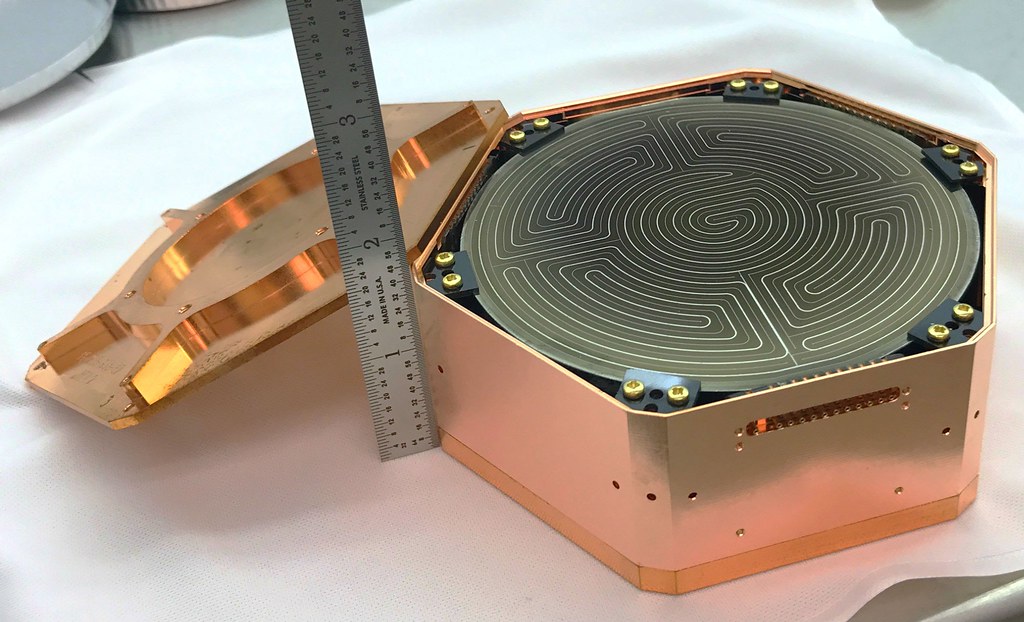
The SuperCDMS germanium iZIP detector fabricated at Texas A&M can identify various types of particle interactions to reduce fake signals as SuperCDMS searches for rarer recoils from dark matter interactions.
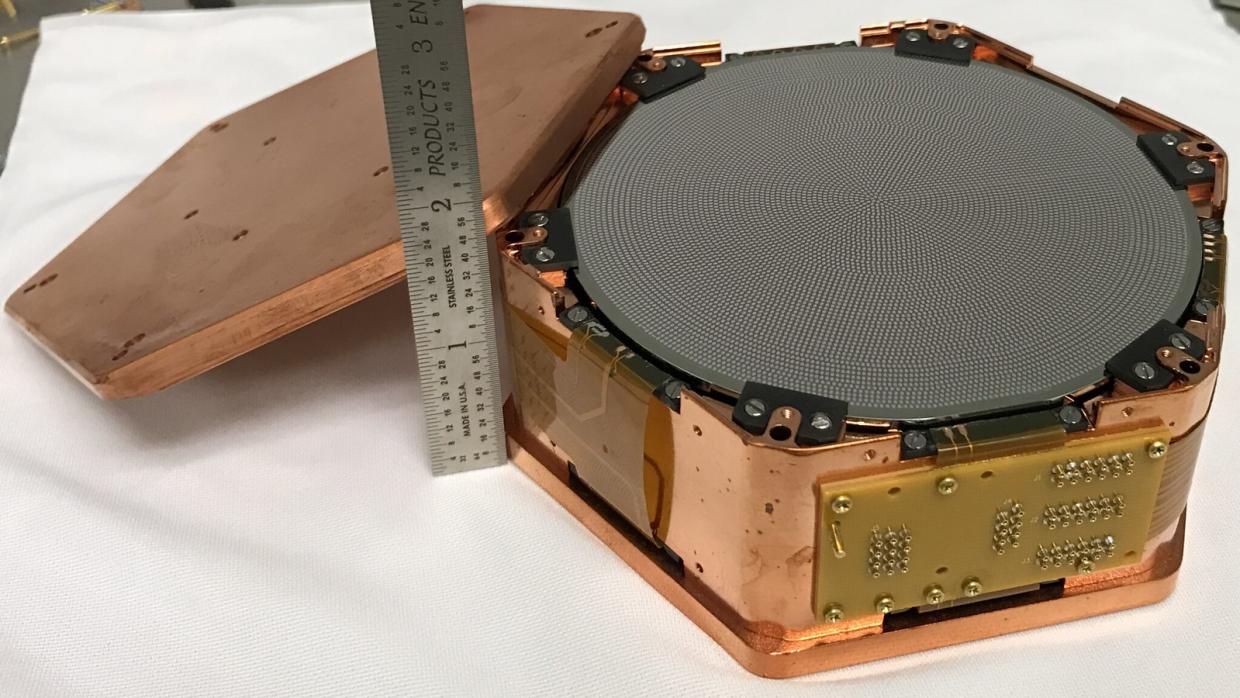
This SuperCDMS silicon high-voltage detector fabricated at Texas A&M can provide much lower energy detection threshold than the iZIP detector, at the expense of losing discrimination capabilities.
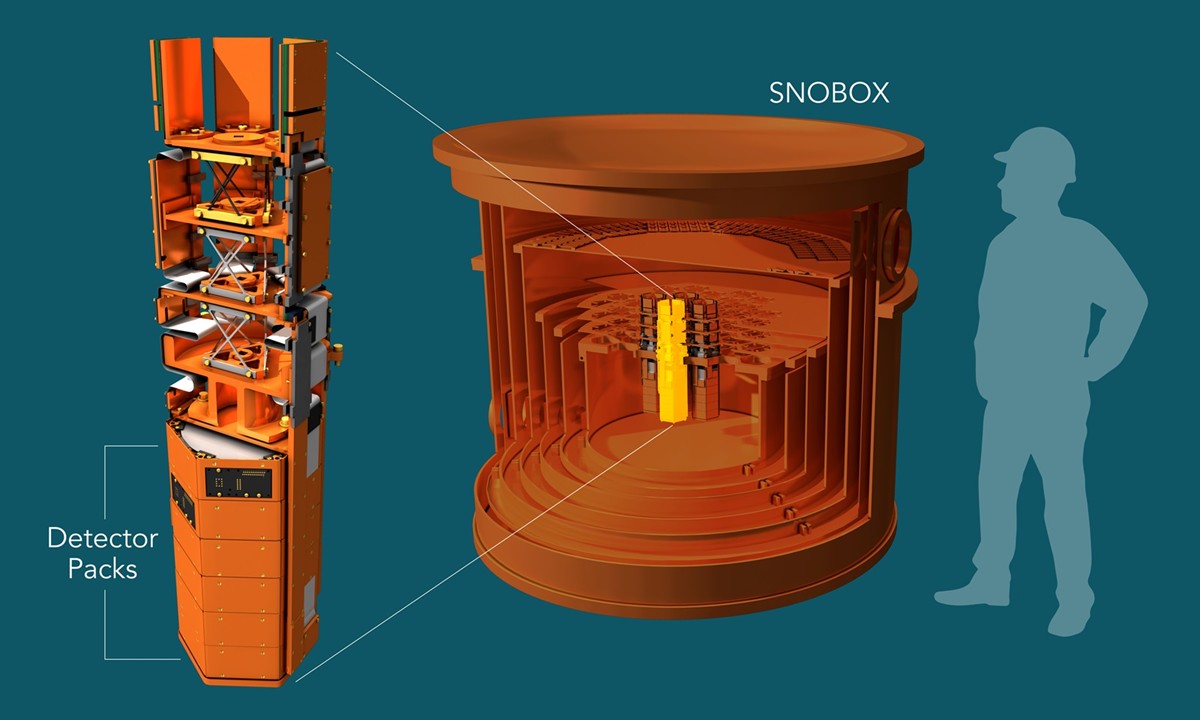
The centerpiece of SuperCDMS is four detector towers (left), each containing six detector packs. The towers will be mounted inside the SNOBOX (right), a vessel in which the detectors will be cooled to almost absolute zero temperature.
The team has contributed not only hardware but also detector‑physics innovations, including methods that significantly improved sensitivity to low‑mass dark matter candidates.
These hockey‑puck‑sized germanium and silicon crystals, outfitted with superconducting sensors, generate tiny vibrations called phonons when struck by a particle — vibrations so small they can only be detected at near‑zero temperatures.
What comes next for the search
With the experiment now cold enough to operate, teams will begin commissioning each of the 24 detectors: turning them on, tuning them and making sure they respond as expected.
Once fully calibrated, SuperCDMS will start collecting data in a science run expected to last about a year. The researchers say beyond dark matter, the experiment will allow scientists to study rare isotopes, probe energies no one has measured before, and if they’re lucky, capture something new.
The SuperCDMS experiment is a joint project of the U.S. Department of Energy Office of Science, the National Science Foundation, the Natural Sciences and Engineering Research Council of Canada and the Canada Foundation for Innovation. For more information about the SuperCDMS experiment and collaboration, visit supercdms.slac.stanford.edu.