
INSIDE THIS REPORT
A sitting Vice President suggests UFOs may not be extraterrestrial—but something far older and more ominous.
A Harvard astrophysicist pushes back, urging science and data over spiritual interpretation.
And now, the public is left to reconcile two competing frameworks—one rooted in faith, the other in physics.
The modern UFO debate has taken a sharp and unexpected turn.
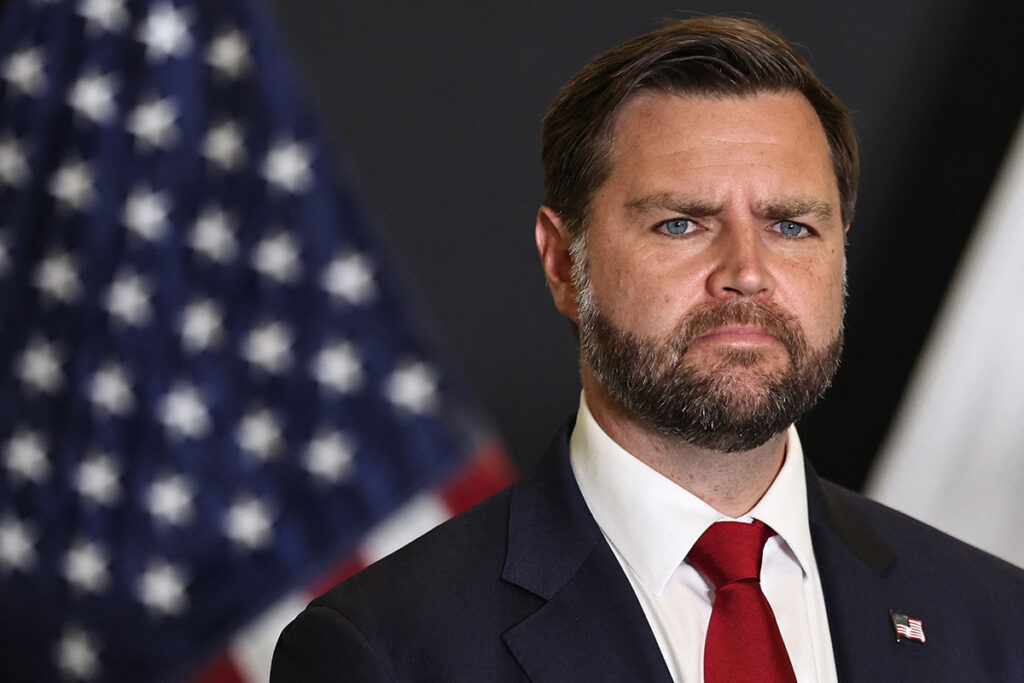
In recent public remarks, Vice President JD Vance suggested that unidentified aerial phenomena may not originate from distant planets, but instead could be something far more unsettling—entities historically described in religious terms as “demons.”
The comments, delivered in the context of ongoing discussions about government transparency and potential disclosure of UFO-related materials, have reignited a long-standing but often sidelined perspective: that unexplained phenomena may not be technological or extraterrestrial—but spiritual in nature.
The timing is significant.
The Trump administration has signaled an increased willingness to revisit UFO disclosure, including the potential release of additional classified materials. At the same time, public interest in UAPs has surged following military encounters, congressional hearings, and independent scientific efforts.
Among those scientific voices is Harvard astrophysicist Avi Loeb, who recently addressed Vance’s remarks in an interview. Loeb emphasized that while religion and science need not conflict, conclusions about UFOs should be grounded in observable data and empirical analysis—not theological interpretation.
Loeb pointed to ongoing efforts through the Galileo Project, which uses AI-driven observatories to identify anomalous objects in Earth’s atmosphere, framing the issue as one of technological discovery rather than spiritual threat.
At this stage, there is no verified evidence confirming either framework.
What remains unclear is whether this is simply a divergence in worldview—or the early signal of a deeper divide in how governments interpret what they know.
Where the Paper Trail Leads
The modern UFO conversation is no longer confined to fringe communities. It now sits at the intersection of government, defense, and scientific research.
Congress has held hearings.
The Pentagon has acknowledged UAP encounters.
And intelligence agencies have produced reports confirming the existence of objects that defy easy explanation.
Yet, despite this growing body of acknowledgment, a critical gap remains—interpretation.
The Disclosure Gap
The government has confirmed the presence of unidentified objects.
It has not confirmed what they are.
This gap creates space.
And in that space, competing narratives emerge.
One narrative, advanced by Loeb and others in the scientific community, frames UAPs as potential extraterrestrial technology—possibly remnants of advanced civilizations or interstellar objects such as 3I/ATLAS, which Loeb has speculated could have released probes during its trajectory.
Another narrative, now echoed at the highest levels of political leadership, suggests that these phenomena may align more closely with historical accounts of non-human entities described in religious texts.
Institutional Incentives
Each framework carries its own implications.
A technological explanation invites innovation, research funding, and scientific advancement.
A spiritual or “demonic” interpretation carries entirely different consequences—implications for public perception, religious institutions, and even national security doctrine.
Governments do not operate in a vacuum.
They must consider not only what is true—but how the truth is interpreted.
LEGAL EXPOSURE ANALYSIS
As a legal analyst, the potential exposure here is not theoretical.
If government officials are operating under differing internal interpretations of UAPs—whether technological or spiritual—it raises serious questions about: