
WHAT MATTERS NOW
There is a line between curiosity and destabilization.
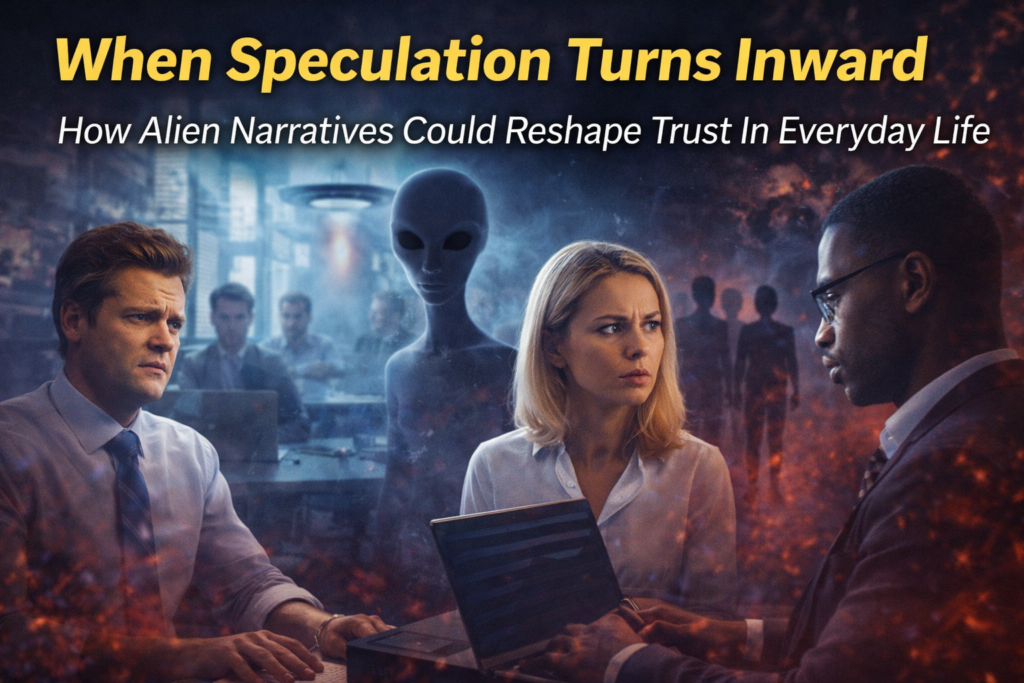
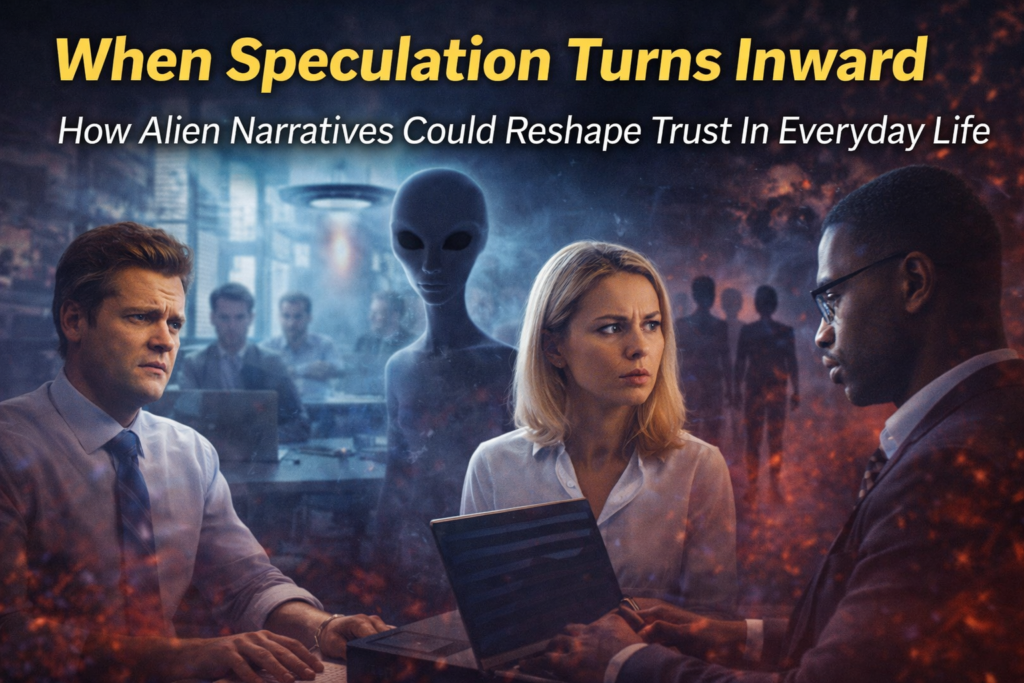
Recent statements circulating in political and online spaces have not just raised questions about extraterrestrial life—they have introduced something far more disruptive: the idea that people may begin questioning each other.
If that shift takes hold, the real impact will not be scientific. It will be psychological, social, and deeply human.
THE REAL RISK IS NOT ALIENS IT IS ERODED TRUST
For decades, discussions about UFOs, UAPs, and non-human intelligence have largely focused outward—into the skies, into space, into unknown technology.
But the recent framing changes the direction of that focus.
It turns inward.
Instead of asking what is out there, people begin asking who is around me.
That shift, if normalized, carries consequences far more immediate than any confirmed extraterrestrial presence.
Because societies do not function on certainty—they function on trust.
You trust your coworkers.
You trust your neighbors.
You trust that the person sitting across from you is who they appear to be.
Once that assumption is destabilized, even hypothetically, the ripple effects can be profound.
WORKPLACE DYNAMICS UNDER PRESSURE
Imagine a workplace environment where even a small percentage of individuals begin entertaining the idea—however unlikely—that not everyone is fully human.
It does not take widespread belief to create disruption.
It only takes enough doubt.
In professional environments, trust is the foundation of:
Team collaboration
Leadership credibility
Communication efficiency
Conflict resolution
Introduce suspicion into that system, and performance begins to fracture.
Not because the claim is true—but because the possibility becomes psychologically present.
This is how destabilization works.
It does not require proof.
It requires repetition and suggestion.
THE PSYCHOLOGY OF UNCERTAINTY
Humans are pattern-seeking by nature.
When presented with ambiguous or provocative information, the brain attempts to resolve it—often by filling in gaps with assumption.
In this case, the suggestion that “some people may not be entirely human” creates a cognitive loop:
Who might that be?
How would I know?
What signs would I look for?
These questions do not lead to answers.
They lead to projection.
And projection, over time, leads to misplaced suspicion.
This is not new.
History shows that when societies adopt vague, unverifiable threats, those threats often become internalized and redirected toward other people.
THE DIFFERENCE BETWEEN INQUIRY AND EXTREMES
There is a clear distinction that must be preserved.
Serious researchers and analysts who study UAPs, unidentified aerial phenomena, and unexplained objects focus on: