
Researchers from the University of Waterloo and the Perimeter Institute have proposed a new theoretical framework that challenges the way the initial expansion of the universe is understood, by successfully reconciling gravity with quantum mechanics without the need to resort to artificially added components.
The work, published in Physical Review Letters, suggests that the violent expansion known as cosmic inflation may have arisen naturally from a deeper and mathematically consistent theory of quantum gravity.
The team, led by Dr. Niayesh Afshordi, professor of physics and astronomy at the University of Waterloo and researcher at the Perimeter Institute, has explored an approach that uses quantum quadratic gravity. This model maintains its mathematical consistency even at the extremely high energy levels that characterized the conditions immediately after the birth of the universe, a regime in which Einstein’s general theory of relativity, despite its success for more than a century, ceases to be applicable.
General relativity has for decades been the pillar for describing the evolution of the cosmos on large scales, but its formulation breaks down at the initial singularity of the Big Bang, where the laws of physics as they are known reach a breaking point. To overcome this obstacle, conventional explanations have tended to complement Einstein’s theory with additional components adjusted by hand. The new approach presented by Afshordi and his collaborators dispenses with these additions, offering a unified picture that connects the first moments of the universe with present-day observable cosmology.
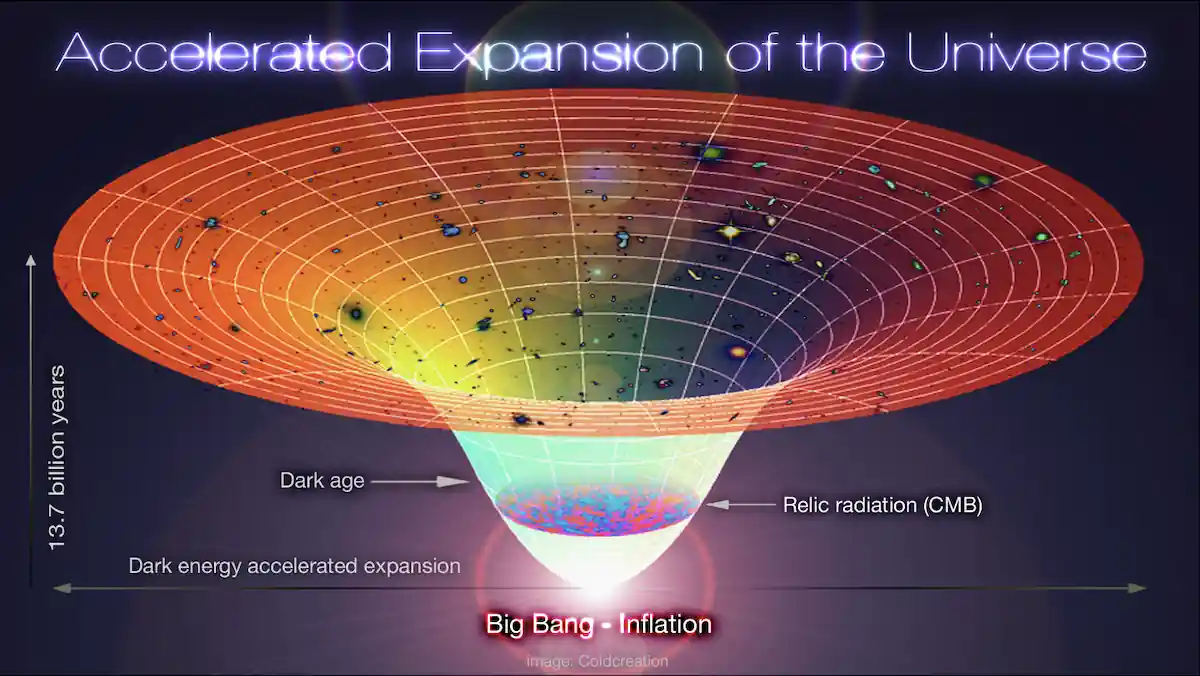 The Accelerated expansion of the Universe. Credit: Coldcreation / Wikimedia Commons
The research demonstrated that the rapid initial expansion, a period that modern cosmology calls inflation and that is fundamental for explaining the uniformity and large-scale structure of the observable universe, can emerge directly from this quantum gravity theory without the need to include external ingredients. This finding implies that the very behavior of gravity at extreme energies would be responsible for triggering the explosive growth of the primordial cosmos.
This work shows that the initial explosive growth of the universe can come directly from a deeper theory of gravity itself, Afshordi stated. Instead of adding new pieces to Einstein’s theory, we found that rapid expansion arises naturally once gravity is treated in a way that remains consistent at extremely high energies.
One of the most notable features of this model is its ability to generate testable predictions. The theoretical framework not only describes a natural mechanism for inflation, but also establishes a minimum amount of primordial gravitational waves that must have been produced.
These waves, which consist of tiny ripples in the geometry of space-time generated in the first moments after the Big Bang, represent one of the most elusive signatures of high-energy physics. The prediction of a minimum threshold for these waves opens the door to their possible detection in experiments currently under development or planned for the near future.

Subscribe to our newsletter
Receive our news and articles in your email for free. You can also support us with a monthly subscription and receive exclusive content.
The researchers themselves were surprised by the degree of empirical testing their proposal allows. Although this model deals with incredibly high energies, it leads to clear predictions that current experiments can actually look for, Afshordi noted. That direct connection between quantum gravity and real data is uncommon and exciting.
The timing of this publication is particularly significant. Cosmology is at a moment of transition toward an era of precision, driven by a new generation of instruments capable of probing the universe with unprecedented accuracy.
Extensive galaxy surveys, experiments aimed at studying the cosmic microwave background radiation, and gravitational wave detectors are reaching levels of sensitivity that will make it possible to test theories that until recently remained in the realm of mathematical speculation.
At the same time, the scientific community has begun to identify limitations in the simplest models of early expansion, increasing the need for alternative approaches that are firmly grounded in the fundamental principles of physics.
Alongside Afshordi, the study included the participation of Ruolin Liu, a doctoral student at the University of Waterloo and the Perimeter Institute, and Dr. Jerome Quintin, currently a professor at the École de technologie supérieure and previously a postdoctoral researcher at both institutions.
The team plans to continue refining their predictions to align them with upcoming experiments, with the aim of exploring the connections between their theoretical framework and particle physics, as well as other unknowns related to the primordial universe. The long-term goal, according to the authors, is to consolidate the bridge between quantum gravity and observational cosmology, thereby bringing the theory of the origins of the cosmos closer to the realm of empirical evidence.