30 years of Landsat images reveal Amistad Reservoir changes and bathymetry
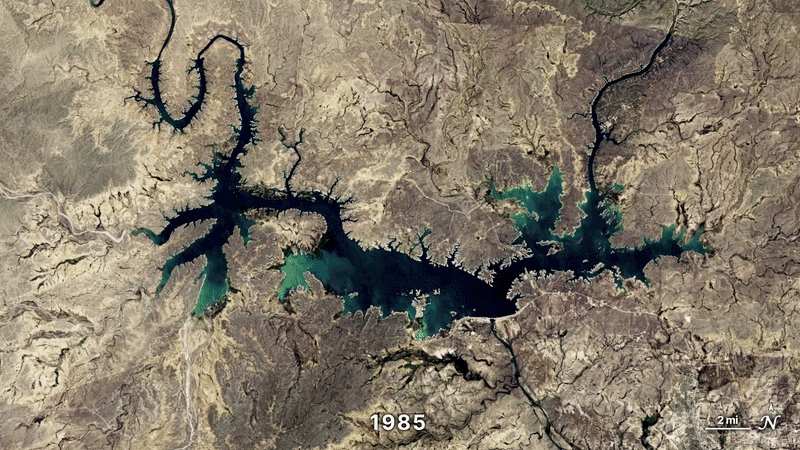
Running from July 31, 1985 to November 10, 2025, this animation shows that the Amistad Reservoir levels fluctuate with the seasons but slowly decline. The time series is composed of images from Landsats 5, 7, 8, and 9. Credit: Ross Walter/NASA
Human communities both shape and are shaped by water. We divert rivers, build reservoirs, and construct artificial islands, while natural forces—storms, meandering rivers, and rising seas—reshape our waterways and coastlines. With satellite data as an important tool to study ecosystem dynamics, researchers have begun to build a more comprehensive global understanding of where water is and how it shifts over time. In their water transitions [study](https://www.nature.com/articles/s41597-025-06013-5), the University of Southampton team focused specifically on permanent changes in lakes, rivers, coastlines, and other water bodies worldwide.
Looking at long-term changes in surface water can help scientists understand drivers of change, said Gustavo Willy Nagel, lead researcher on the paper. Knowing when a lake began receding helps water managers investigate whether drought, irrigation, or other forces caused the decline.
Scientists, policymakers, and water managers can explore the [interactive dataset](https://ee-gustavoonagel.projects.earthengine.app/view/water-change-time-detection) that Nagel and his team created to visualize changes close to home as well as stark global impacts such as the drying of the Aral Sea, the lakes created by melting glaciers in Tibet, and the building of the Palm Islands in Dubai.

1 Comment
Image from this post, text excerpt from post below the link:
[https://science.nasa.gov/missions/landsat/landsat-reveals-reservoir-changes-and-bathymetry/](https://science.nasa.gov/missions/landsat/landsat-reveals-reservoir-changes-and-bathymetry/)
Human communities both shape and are shaped by water. We divert rivers, build reservoirs, and construct artificial islands, while natural forces—storms, meandering rivers, and rising seas—reshape our waterways and coastlines. With satellite data as an important tool to study ecosystem dynamics, researchers have begun to build a more comprehensive global understanding of where water is and how it shifts over time. In their water transitions [study](https://www.nature.com/articles/s41597-025-06013-5), the University of Southampton team focused specifically on permanent changes in lakes, rivers, coastlines, and other water bodies worldwide.
Looking at long-term changes in surface water can help scientists understand drivers of change, said Gustavo Willy Nagel, lead researcher on the paper. Knowing when a lake began receding helps water managers investigate whether drought, irrigation, or other forces caused the decline.
Scientists, policymakers, and water managers can explore the [interactive dataset](https://ee-gustavoonagel.projects.earthengine.app/view/water-change-time-detection) that Nagel and his team created to visualize changes close to home as well as stark global impacts such as the drying of the Aral Sea, the lakes created by melting glaciers in Tibet, and the building of the Palm Islands in Dubai.