
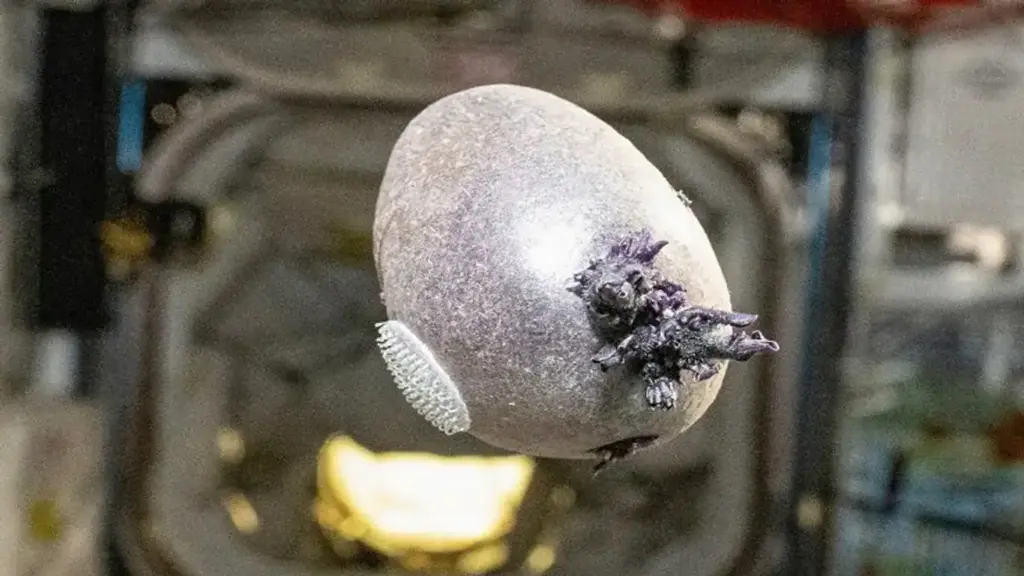
 Image credits: Don Pettit / NASA.
Astronaut Don Pettit recently shared a photo of a tentacled purple object that set social media ablaze. But this is far from an extraterrestrial threat; it’s actually an earthly treat.
The “alien” is actually a potato. Specifically, it is a purple tuber nicknamed Spudnik-1, grown and photographed by Pettit. While the photo looks like a sci-fi horror prop, it actually represents the front line of human survival: a proof-of-concept for a journey to Mars.
Spudnik 1
Don Pettit, NASA’s oldest active astronaut and a veteran of four space missions, has spent a total of 590 days in orbit. While his day job involves high-stakes maintenance and research for Expedition 72, his space garden has become a key side project.
Pettit’s choice of crop isn’t accidental. As popularized by Andy Weir’s The Martian, potatoes are one of the most efficient sources of nutrition relative to their total plant mass. In a post on X, Pettit discussed the importance of potatoes for future exploration, but also emphasized that the space garden was an off-duty project.
“Spudnik-1, an orbiting potato on the International Space Station. I flew potatoes on Expedition 72 for my space garden, an activity I did in my off-duty time. This is an early purple potato, complete with a spot of hook Velcro to anchor it in my improvised grow light terrarium,” Pettit said.
The appearance of the potato (which Pettit himself also shared on Instagram and Reddit) also spurred discussions.
The potato’s “tentacles” are simply sprouts reaching out for nutrients. On Earth, gravity tells roots to go down and stems to go up. In space, they are confused. They grow in wild, spindly directions, reaching for any light source they can find. Pettit used a hydroponic system, which means the potato grew in nutrient-rich water instead of dirt.
This isn’t Pettit’s first rodeo with space greens. Pettit famously wrote a blog called Diary of a Space Zucchini during a previous mission. He has also grown sunflowers, broccoli, and even peanuts. He once even used earplugs as makeshift soil to sprout basil and tomato seedlings. Why? Because Pettit knows what every explorer since Columbus has known: you can only go as far as your food will take you.
×
Thank you! One more thing…
Please check your inbox and confirm your subscription.
Is It Easy to Grow Food in Space?
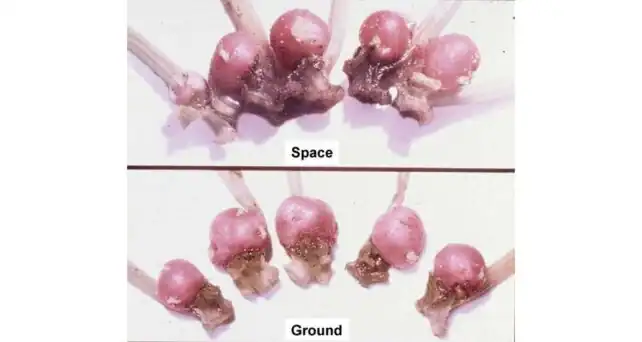 Potatoes grown in space and on the ground. (Raymond Wheeler, Advances in Potato Chemistry and Technology, 2009).
Growing food on Earth is simple and we’ve done it for thousands of years. But in space, things aren’t nearly as simple.
Currently, every calorie an astronaut eats has to be launched from Earth. Shipping a gallon of water or a pound of beef to the ISS is expensive. Shipping it to Mars is astronomical. A mission to the Red Planet will take roughly three years and you just can’t pack enough food. It would simply be too heavy and bulky.
To live on the Moon or Mars, we must become farmers. In addition to their nutritional value, these potatoes have another important benefit. The purple color comes from high levels of anthocyanins — the same antioxidants found in blueberries. In space, radiation is a constant threat to human DNA. Eating antioxidants like these provide a natural internal shield for astronauts. The purple potato is essentially a delicious, edible medicine.
Interestingly, Pettit observed no noticeable effect from radiation on the potatoes themselves. This is a massive win for long-duration missions. If crops can withstand the cosmic rays that bombard the ISS, it simplifies the shielding requirements for future Martian greenhouses. Basically, the ISS is a stepping stone for growing stuff on Mars.
The Psychology of a Space Garden
In addition to eating the potatoes, there’s another benefit; a very human one.
The ISS is an engineered living space. It smells like ozone, stale air, and antiseptic. It sounds like the constant hum of fans and pumps. There is no wind, no rain, and no smell of earth. Astronauts often report a deep, aching hunger for the nature. Psychologically, long space trips can be extremely taxing.
Gardening provides a psychological anchor to Earth. It reduces stress and gives astronauts a sense of stewardship, something to care for in a place where everything else is cold and mechanical. It’s not much, but growing a vegetable in space feels like more than just growing a vegetable. It feels like a connection to home.
The challenges remain significant. Research shows that plants grow slower in microgravity. They experience stress, much like humans do. Their root systems struggle to breathe in water that doesn’t drain and they have to fight off higher levels of radiation. But every space-grown spud brings us closer to trading vacuum-sealed rations for a fresh Martian harvest.