
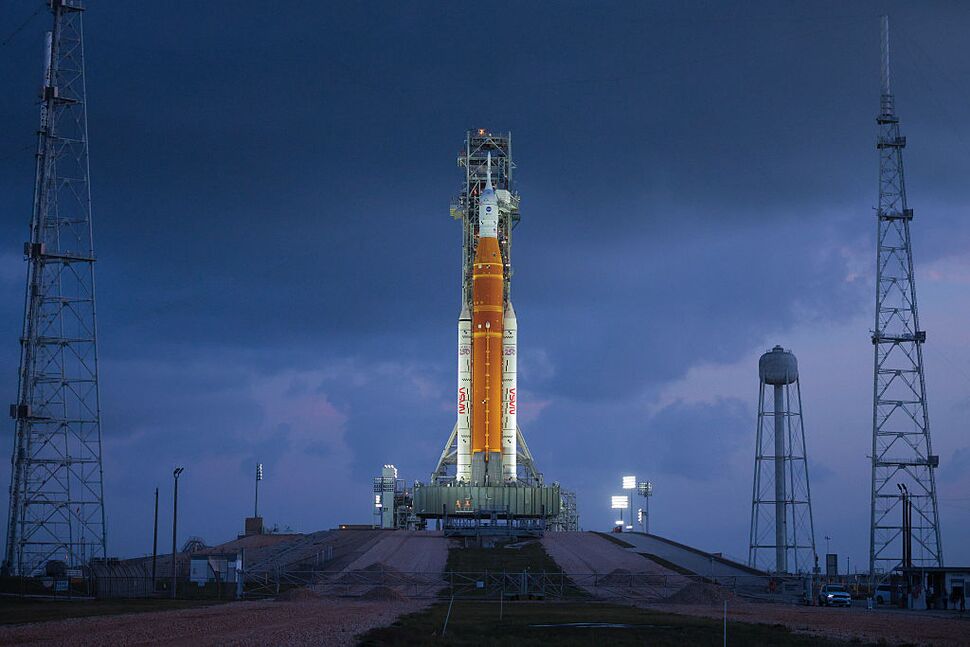
NASA on Wednesday aims to launch its first crewed lunar flyby in over 50 years.
The historic test flight known as Artemis II will not land on the moon but instead fly astronauts around it and come back to Earth.
NASA says the mission’s goal is to “confirm the systems necessary to support astronauts in deep space exploration and prepare to establish a sustained presence on the moon.”
It would be the agency’s first crewed flight test of the massive, 32-story Space Launch System rocket and the Orion spacecraft that will carry four astronauts around the moon and back. It would also be the first lunar flyby with humans since Apollo 17 in 1972.
When Is the Artemis II Launch?
A two-hour launch window begins at 6:24 p.m. on Wednesday.
Who Are The Astronauts?
Among the crew are the first woman, first person of color and first Canadian on a lunar mission.
The Artemis II crew are NASA astronauts Reid Wiseman, Victor Glover and Christina Koch and Canadian Space Agency astronaut Jeremy Hansen.
The four astronauts began to quarantine on March 18 to ensure they stay healthy ahead of the launch. They also took part in some training activities and reviewed plans for the 10-day mission.
Part of their goal is to prove the spacecraft’s life support systems are ready to sustain crew on future missions. They will also be able to practice operations that will be essential to the success of Artemis III, which will test the rendezvous and docking capabilities between Orion and the commercial spacecraft needed to land astronauts on the moon as soon as next year.

Sign Up for U.S. News Decision Points
Your trusted source for breaking down the latest news from Washington and beyond, delivered weekdays.
By clicking “Sign Up”, you will receive the latest updates, including emails, from U.S. News & World Report and our trusted partners and sponsors, and you agree to our Terms and Conditions & Privacy Policy.
How Does Weather Look for Launch?
The weather forecast shows an 80% chance of favorable weather for Wednesday. The main concerns are cloud coverage and the potential for high winds in the area.
It’s also possible a few showers will roll in Wednesday evening, but NASA should be able to shoot the gap during the two-hour launch window.
Space weather is also a concern.
NASA is keeping an eye on solar flares after the sun recently emitted a strong blast of energy. While that flare is not anticipated to impact the mission, the agency is keeping an eye out for any additional solar flares that might.
If the launch slips back a day, Thursday evening would have more weather to deal with than Wednesday. Friday’s chance for launch would be similar to Wednesday’s.
NASA has the first six days of April to launch before standing down until the end of the month.
When Do the Artemis II Astronauts Return to Earth?
After traveling about 4,600 miles beyond the far side of the moon, the astronauts will conclude their 10-day mission by splashing down into the Pacific Ocean. If the crew launches on Wednesday, they would return to Earth on April 10.
The Orion spacecraft will deploy parachutes after reentering the Earth’s atmosphere to slow its descent to the ocean, where five orange airbags will inflate and flip the capsule upright so that the crew can be recovered with the help of the Navy.
What Is the Artemis Program?
The Artemis program, named after the twin sister of Apollo, aims to learn how to live on the moon so that the U.S. can safely send people to Mars.
“Through Artemis, NASA will explore more of the moon than ever before and create an enduring presence in deep space, while simultaneously preparing to land the first astronaut – an American – on Mars,” according to the agency.