
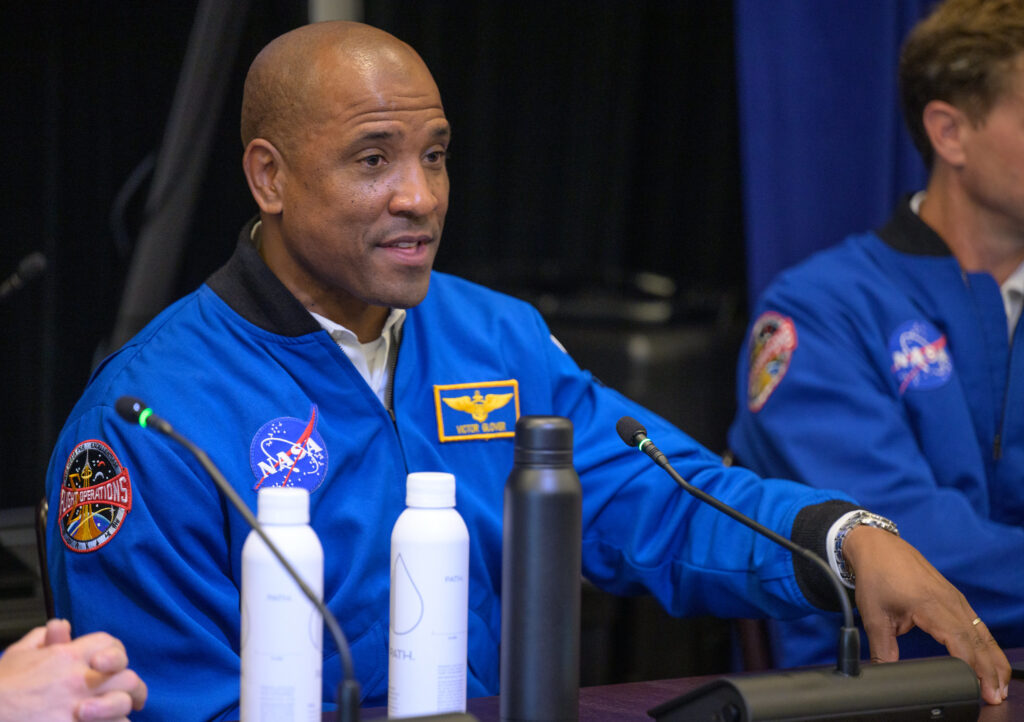
Cal Poly alumnus Victor Glover will pilot NASA’s mission to explore the moon’s surface for the first time in 50 years. The mission is set to launch on Wednesday, April 1, with a targeted launch time of 3:24 p.m Pacific time, according to NASA.
Victor Glover, along with three crew members, will embark on their 10-day journey to Earth’s moon through NASA’s Artemis II mission. Glover graduated from Cal Poly in 1999 with a Bachelor of Science in general engineering. He was one of the first students to graduate from the general engineering program, according to a Cal Poly Magazine article.
The weather for launch on April 1 is 80% favorable, meaning there is a high chance the launch will be able to run on Wednesday. The main forces that could affect these chances are clouds, ground winds and solar weather, according to NASA.
 From left to right: Artemis II astronauts Reid Wiseman, Victor Glover, Christina Koch and Jeremy Hansen as they visited the mission’s rocket and spacecraft on Monday, March 30. Credit: Bill Ingalls / Courtesy of NASA
Artemis II represents the first human-crewed test of the Space Launch System (SLS) and Orion spacecraft in a mission circling the moon. Along with Glover, the flight crew consists of NASA astronauts, Reid Wiseman and Christina Koch, as well as Canadian Space Agency astronaut, Jeremy Hansen.
The goal of the mission is to prepare astronauts for future Artemis missions to land on the moon’s south polar region, the side that is never visible from Earth. The Artemis II crew will be performing a flyby of the moon’s southern polar region in the Orion capsule for a 3-hour period.
While there, the crew will be photographing and analyzing the moon’s geological features, and a NASA team of scientists specializing in impact craters, tectonism, lunar ice and more will be relaying information from NASA’s Johnson Space Center in Houston, according to NASA.
In Feb. 2026, NASA teams found an issue with helium flowing to the rocket’s upper stage during a wet dress rehearsal, leading to the launch being delayed. A wet dress rehearsal is a final launch test run that entails that the crew had fueled the spacecraft up, readying for launch.
The Orion spacecraft’s technical issues were found and repaired, and on March 20, the spacecraft was rolled back out to the launch pad for final checks, according to NASA.
After launch, the crew will be in space within eight and a half minutes and from there they will spend the first part of the mission testing Orion’s systems in Earth’s orbit. They will then perform crucial engine burns throughout the trip, which help further launch the crew towards the moon, according to NASA.
Throughout the trip, the crew will be performing spacesuit checks, system maintenance and health evaluations of the astronauts. Orion will splash down in the Pacific Ocean off the coast of San Diego where NASA officials and the U.S. Navy will be waiting for them.
In a Cal Poly Magazine interview, Glover gives credit to Cal Poly’s Learn by Doing philosophy for his ability to remain adaptable and lean on teamwork.
“Everything I was doing gave me a chance to work with a high-performing team with a lot of skilled people from a lot of different places, doing very challenging things in very challenging circumstances,” Glover told Cal Poly Magazine. “Fast forward to this job — there’s no cookie-cutter setup for this job. And Cal Poly was just an indelible part of preparing me for that.”