
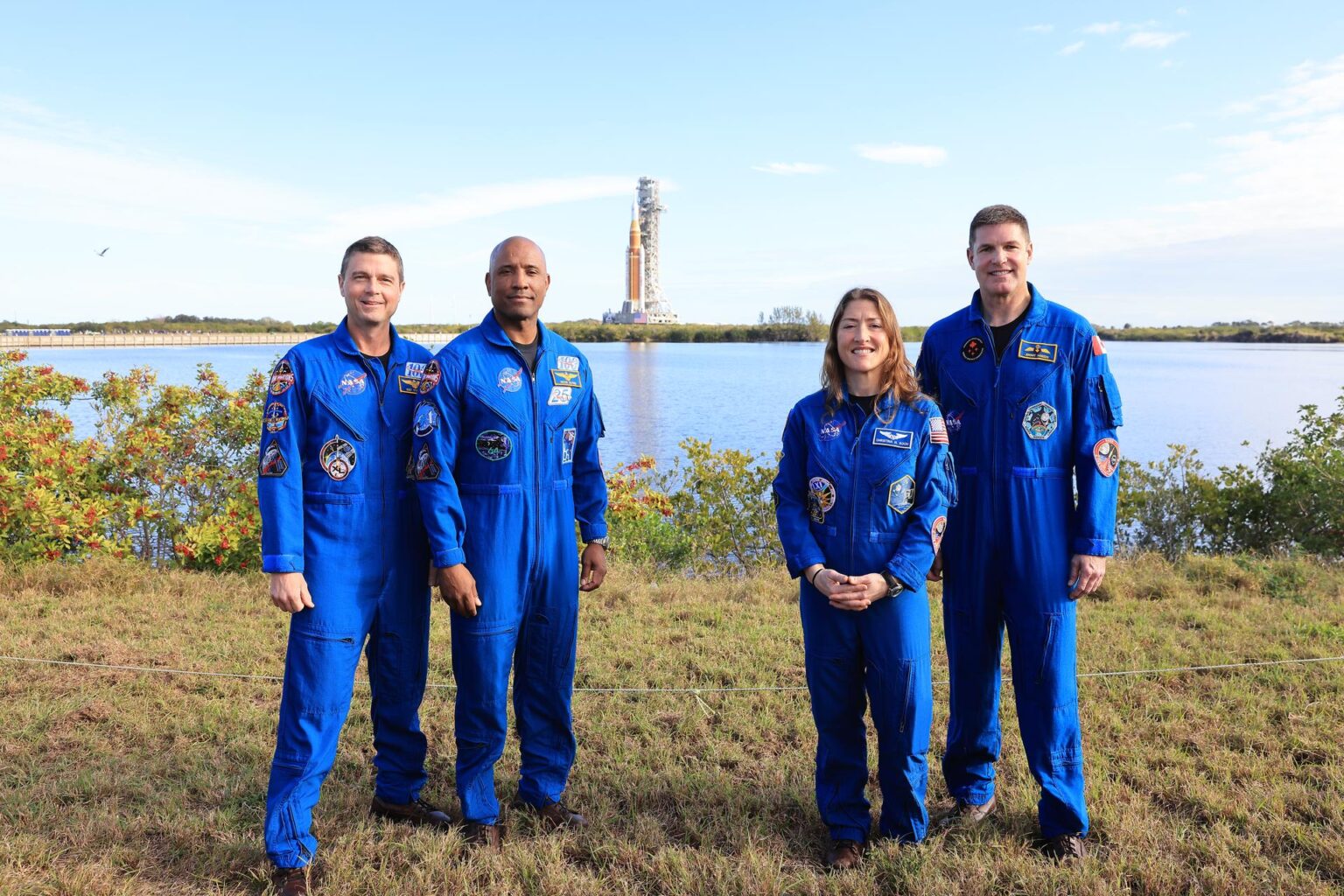
 From left to right, Artemis II astronauts Reid Wiseman, Victor Glover, Christina Koch and Jeremy Hansen pose for a photograph during rollout of the Space Launch System rocket and Orion spacecraft at NASA’s Kennedy Space Center in Florida. Courtesy Kim Shiflett/NASA.
This week, astronauts plan to embark on a journey that will take them farther into space than any human has ever traveled.
The upcoming NASA expedition, known widely as Artemis II, is expected to lay the groundwork for getting people back onto the moon for the first time in over 50 years. Artemis II involves sending four astronauts on an approximately 10-day voyage around the moon to test the systems and hardware that could be used for future lunar landings.
The plan is to launch on Wednesday, April 1, assuming weather conditions are favorable. As of a Sunday news conference, everything from the crew to the rocket to the spaceship were ready to go, NASA official Shawn Quinn said.
Researchers, scientists and engineers have been working on Artemis II – NASA’s first crewed mission as part of the campaign to get people back onto the moon – since even before Artemis I launched in 2022, NASA Ames Research Center Director Eugene Tu told the Voice. Some of the key work to prepare for the journey happened right here in Mountain View, where technicians tested the spacecraft’s heat shield in what’s called the Arc Jet Complex and used wind tunnels to assess its ability to withstand a high-pressure environment.
In doing so, they were able to identify flaws in the original systems and create solutions to improve the spacecraft ahead of the upcoming launch, Tu said. For example, to decrease the amount of vibration the rocket experiences as it moves through the atmosphere, they added metal plates to the side of it.
As someone who grew up on the Peninsula and has worked at NASA for four decades, Tu said that seeing the local involvement in Artemis II has been particularly exciting.
“It’s been an incredible journey, and I love to see how the Bay Area is contributing,” Tu said.
While the astronauts are up in space, scientists from Ames are expected to help guide their lunar observations and will continue working on analysis even after their return.
The four-member crew, consisting of NASA astronauts Reid Wiseman, Victor Glover and Christina Koch, as well as Canadian Space Agency astronaut Jeremy Hansen, plan to travel around the far side of the moon and see parts of the celestial body that no other humans have laid eyes on.
Because the moon turns on its own axis at the same rate as it orbits the Earth, people on this planet only ever see the same side of it when they look up into the sky. The astronauts on Artemis II will have the opportunity to observe new portions of the moon, take pictures of it and look for a potential future landing site — all while working in real time with scientists on the ground at NASA Ames, Tu said.
When the astronauts finish their space adventure and splash down into the ocean off the coast of San Diego, a team of Ames experts will be waiting aboard a recovery ship. They will take a first look at the spacecraft’s heat shield to see how it fared compared to the predictions that had been previously made at the research center and conduct analysis on areas for improvement.
Looking ahead, NASA’s Artemis III mission is expected to launch next year, with preparations for it already underway, Tu said. The plan is for astronauts to conduct in-space testing of a docking maneuver with either one or both of the commercial human lander vehicles made by SpaceX and Blue Origin.
NASA doesn’t currently intend to get humans onto the moon until the Artemis IV mission, which is anticipated to take off in 2028. The ultimate goal of the Artemis program is to get people back to the moon and to establish a human presence there, Tu said.
“There’s desire for American leadership in space, and the moon is that next destination – again – for humans, especially for a sustained presence,” Tu told the Voice.
This achievement would meet multiple agency objectives, he added, including learning how to live and operate on another planetary surface, advancing research on the lunar surface, potentially creating an opportunity for commercial capabilities, and boosting the possibility of sending humans to Mars.
“I think we’re going to get to that stage where space and space exploration and leveraging space for benefit here on Earth is part of everybody’s everyday life,” Tu said.
Most Popular