
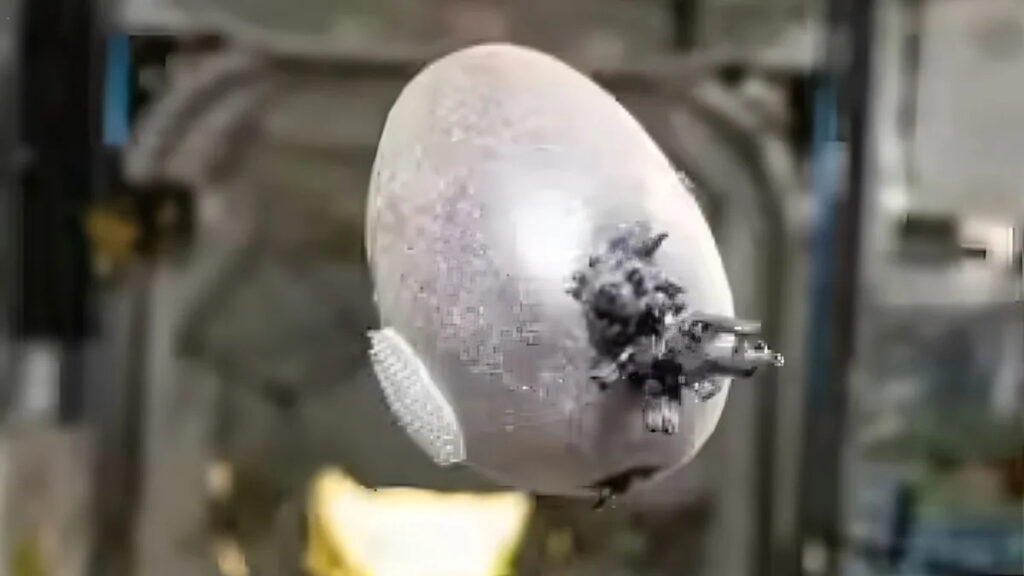
NASA sparked a wave of chatter after an astronaut shared an image of what many users quickly dubbed an “alien space egg” floating aboard the International Space Station—before revealing it was something far more familiar.
The viral photo, posted by astronaut Don Pettit on March 25, showed a purple, egg-shaped object with string-like tendrils extending outward in microgravity. Social media users immediately flooded the comments with reactions ranging from alarm to humor, with some jokingly urging him to “kill it with fire,” while others compared the object to sci-fi creatures.
Pettit later clarified that the so-called “alien space egg” was actually a potato he had been growing as part of a personal space gardening experiment during Expedition 72 aboard the International Space Station.
He referred to it as “Spudnik-1,” explaining that the plant was anchored using Velcro inside a small, improvised growing setup. The tendrils visible in the image were early growth formations, exaggerated by the lack of gravity.
“I flew potatoes on Expedition 72 for my space garden,” Pettit said, per Fox Weather, noting that the project was inspired in part by the film The Martian, where potatoes are used as a survival crop.
He added that potatoes are among the most efficient plants in terms of edible nutrition relative to total plant mass, making them a strong candidate for future long-duration missions.
The viral moment arrives as NASA continues to emphasize the importance of growing food in space, especially as missions extend beyond low Earth orbit. Scientists have spent years testing crops in microgravity, successfully cultivating varieties such as lettuce, kale, mustard greens, and even flowers.
Ongoing research, including experiments such as Plant Habitat-07, focuses on understanding how water levels, light exposure, and genetics affect plant growth in space environments.
Those efforts are directly tied to the agency’s broader exploration goals, including upcoming missions under the Artemis program. As NASA prepares for crewed lunar missions and long-term plans for a sustained presence on the Moon, developing reliable food sources in space has become a critical challenge.
Transporting enough food for extended missions is impractical, and stored supplies can degrade over time, making on-site cultivation a key solution.
Related News
NASA Rolls Out Artemis II Rocket as Astronauts Enter Quarantine
,
NASA Is Getting Serious About Building a Moon Base
,
NASA’s Van Allen Probe A Set to Re-Enter Earth’s Atmosphere Tonight
Related News