
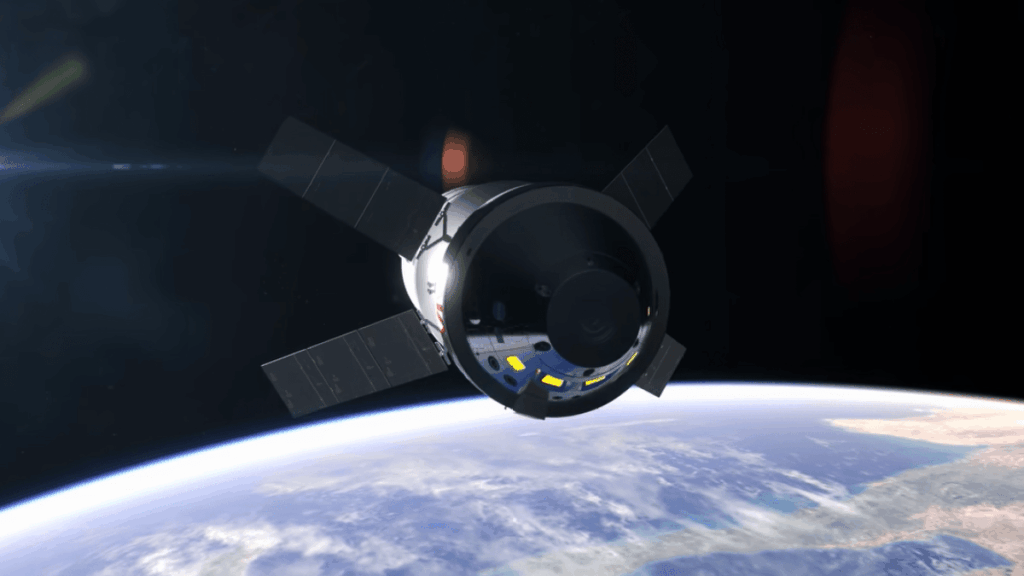
Th Artemis II mission will take four astronauts thousands of miles beyond the moon before the Orion spacecraft makes a U-turn and heads back to Earth on an approximately 10-day journey.
The launch countdown is already underway at Kennedy Space Center in Florida, where engineers are checking communications, starting flight hardware and preparing the Space Launch System (SLS) for a fueling sequence involves thousands of gallons of super-cooled liquid hydrogen and liquid oxygen.
Liftoff is scheduled for 3:24 p.m. California time Wednesday.
So, what happens next? The NASA video below shows an animation of the launch and out-and-back voyage that will follow.
The critical post-launch sequence includes the release of the towering booster rockets about two minutes later. Four robust RS-25 engines, built at L3Harris Technologies in Canoga Park, will then propel NASA astronauts Reid Wiseman, Victor Glover, and Christina Koch, and CSA (Canadian Space Agency) astronaut Jeremy Hansendeeper into space.
About eight minutes after launch, the SLS core stage separates from the Orion capsule. There is a 24-hour systems check window while the craft is still relatively close to Earth.
Once that crucial checklist is complete, the spacecraft will separate from the upper stage and use it as a target for docking practice high above Earth. The crew will maneuver Orion around the upper stage, relying on their eyes, not instruments, to judge the distance and coming no closer that about 30 feet.
A Canoga Park company will provide the power behind the Artemis II mission. John Cádiz Klemack reports for Today in LA on Monday March 30, 2026.
Then, Orion’s main engine will hurl the capsule out of Earth orbit for an approximately four-day trip to the moon about 244,000 miles away. The spacecraft will fly about 4,600 miles beyond the moon, making the crew the first people to lay eyes on its far side in more than 50 years.
The craft is expected to reach is greatest distance from Earth on Day 6, passing Apollo 13’s distance record and marking the first time in about 50 years that human eyes will see the far side of the moon.
A communications blackout with mission control will follow before Orion begins the four-day return home aided by Earth’s gravity. Before entering Earth’s atmosphere, the crew module will separate from the service module.
The capsule will enter Earth’s atmosphere at about 25,000 mph and use a series of parachute deployments to slow and stabilize for splashdown off the California coast. The crew will be met by a recovery team after the approximately 595,000-mile round trip.