
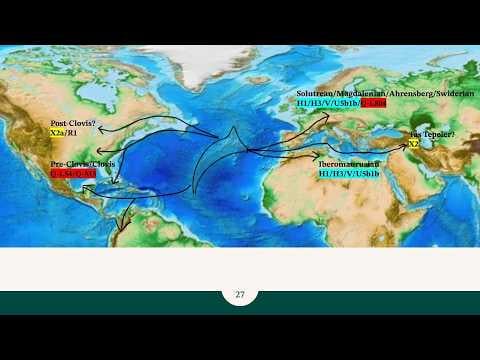
Hey everyone I did some research and noticed that certain maternal mtDNA haplogroups (H1, H3, H5, V, U5b1b) seem to have spread from west to east in Europe and North Africa, supposedly from out of the Iberian glacial refugium in waves, between 13,000 – 7,000 BC.
This overlaps with the date given in the Platonic dialogues for the Atlantean invasion of Europe and Africa around 9,600 BC. Although its curious that its only maternal haplogroups following this dispersal pattern and not paternal ones.
These haplogroups are found in the Saami of Scandinavia, the Basque of Iberia, and the Tuareg and other Berber/Amazigh peoples of Africa.
Maybe Atlantis was itself a glacial refugium and Iberia was just the first stop when they traveled east
I present my sources and research in the video linked below, please let me know what you guys think, thanks
by Novel-Engine-8737
1 Comment
Claim: mtDNA haplogroups spreading from Iberia after the Ice Age may represent an Atlantean invasion described by .
Assessment: unsupported. The genetics cited already has a well-established explanation in population genetics and archaeology.
1. What the haplogroups actually represent
The post mentions mtDNA haplogroups H1, H3, H5, V, U5b1b.
These are common European maternal lineages. They expanded after the .
Key mechanism:
Humans survived the ice age in southern refugia.
Major refugia included Iberia, Italy, and the Balkans.
When ice sheets retreated, populations expanded north and east.
This process is called post-glacial recolonization. It is widely documented in genetic studies.
No unknown civilization required.
2. Why Iberia appears as a source
During the ice age, northern Europe was largely uninhabitable.
The acted as a major refugium.
When the climate warmed (~15,000–10,000 BCE):
people migrated north into France, Britain, and Scandinavia
their maternal lineages spread with them
This explains the west-to-east pattern.
3. The “9600 BC Atlantis” overlap
The date comes from the Atlantis story in and .
Problems:
The story is philosophical fiction used to illustrate political ideas.
No archaeological evidence of a trans-Atlantic civilization at that time.
The genetic expansion began earlier and lasted thousands of years.
The timeline match is coincidence.
4. Why only maternal markers appear
The author claims it is “curious” that the pattern involves mtDNA but not Y-DNA.
Reality:
mtDNA tracks maternal lines only.
Y-DNA tracks paternal lines only.
Migration and population bottlenecks can affect them differently.
This is common in genetic history studies.
Example: founder effects or sex-biased migration.
5. Populations mentioned
The post cites:
These groups share some ancient lineages because they descend partly from Ice Age populations that moved out of Iberian refugia.
This reflects deep prehistoric migration. Not a single invasion event.
6. Evidence required for an Atlantean hypothesis
To support the claim, one would need:
archaeological remains of a civilization in the Atlantic dated ~9600 BCE
distinctive genetic markers not present in earlier humans
cultural artifacts spreading from a single Atlantic source
None exist.
Conclusion:
The genetic pattern described is real. Its cause is standard post-glacial population expansion. The Atlantis interpretation is speculative and not supported by genetics, archaeology, or history.
If you want, a deeper question exists here: why the Iberian refugium produced such dominant maternal haplogroups in Europe. The answer involves population bottlenecks after the Ice Age.