
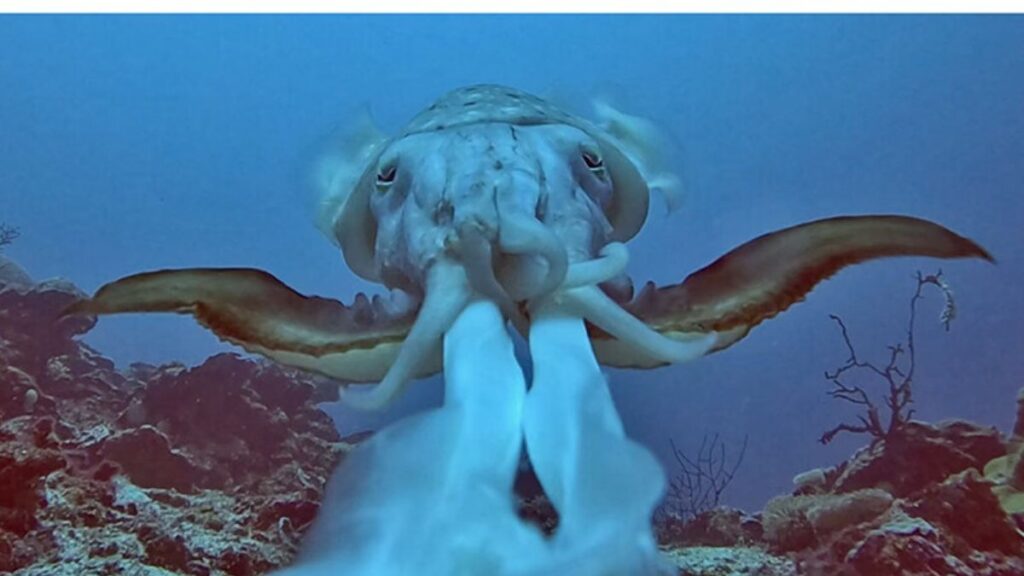
A cuttlefish that hunts like an unidentified foreign object (UFO) has stunned scientists.
Researchers have discovered that the broadclub cuttlefish (Sepia latimanus) uses a hypnotic light-and-stripe display, eerily similar to a glowing spacecraft hovering over a reef, to render itself invisible to crabs while closing in for the kill.
The study, published in Science Advances by the University of Bristol, is the first time any animal has been found using this exact form of motion camouflage during a hunt.
This is the first documented case of motion camouflage used during a hunt in any animal. (Photo: Science Advances)
Read Full Story
The researchers filmed 28 hunts involving at least 17 cuttlefish in the coral reefs of Raja Ampat, Indonesia, in the Pacific Ocean, using high-speed cameras shooting at 240 frames per second. What they captured was unlike anything documented before.
WHAT DOES THE CUTTLEFISH’S UFO-LIKE DISPLAY ACTUALLY DO?
In the final stretch of a hunt, the cuttlefish turns ghostly pale and begins rippling bold, dark stripes downward across its head and arms.
Six arms extend forward in a tight cone. Two splay out flat to the sides. The whole body pulses at an average of 2.2 times per second.
To a human observer, it looks exactly like a glowing spacecraft gliding silently along the reef. To a crab, it registers as effectively nothing.
(A) From above, it looks like a UFO gliding over the reef. (B) From the crab’s eyes, it looks like almost nothing. (C to E) These sequential frames tell the full story: a broadclub cuttlefish rippling dark stripes across its pale body as it closes in, its motion camouflage so effective that the crab’s brain never sounds the alarm. (Photo: Science Advances)
The downward motion of the stripes generates such powerful visual noise that it completely overwhelms the crab’s ability to detect an incoming predator.
Crabs are hardwired to flee from shapes that expand toward them, the classic visual cue of a looming threat. The cuttlefish’s rippling stripes drown that signal out entirely.
Lead author Dr Matteo Santon described it as exploiting strong dynamic motion cues from the rhythmic passing stripes to deceive the prey.
HOW DID SCIENTISTS PROVE THE CUTTLEFISH TRICKS ITS PREY?
In laboratory experiments, shore crabs were placed on a treadmill and shown three different visuals on a screen: a plain expanding grey disc, a disc with static stripes, and a disc with moving downward stripes mimicking the cuttlefish’s display.
The results were stark. Crabs were four times less likely to react to the moving stripe version, even when contrast was cranked to its maximum.
The broadclub cuttlefish seen performing leaf-mimicry. (Photo: Matteo Santon/University of Bristol)
Their response probability collapsed from roughly 0.8 with a plain disc to just 0.2 with moving stripes.
Computer modelling of crab vision confirmed that the moving stripes produced 34 times more visual noise than static stripes and nine times more than the cuttlefish’s alternate leaf-mimicry display.
WHERE IN INDIA CAN YOU FIND THE BROADCLUB CUTTLEFISH?
Here is the India connection. Sepia latimanus is not confined to Indonesian reefs. This species is found across the Andaman Sea, the Gulf of Mannar, and the waters around Lakshadweep.
Indian marine biologists now have compelling reasons to study local cuttlefish populations for similar behaviours. The findings could also inspire biomimicry research, from stealth drone design to optical camouflage technology.
The broadclub cuttlefish seen attacking its prey. (Photo: Matteo Santon/University of Bristol)
Senior author Dr Martin How noted that, due to their fast colour-changing skin, cuttlefish have a wider range of camouflage options while moving than almost any other animal on Earth.
The broadclub cuttlefish, a few minutes after catching its prey. (Photo: Matteo Santon/University of Bristol)
The broadclub cuttlefish is not trying to look terrifying. It is trying to look like nothing at all, and it is very, very good at it.
– Ends
Published By:
Radifah Kabir
Published On:
Mar 31, 2026 15:46 IST