
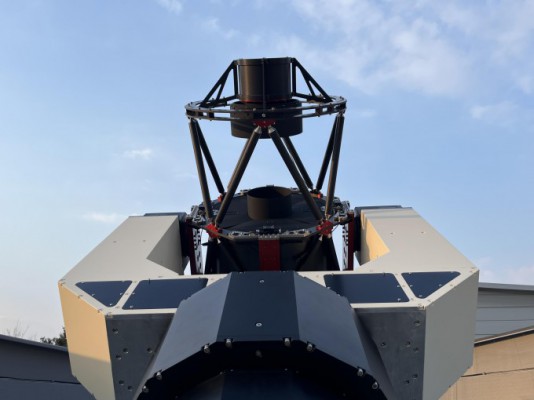
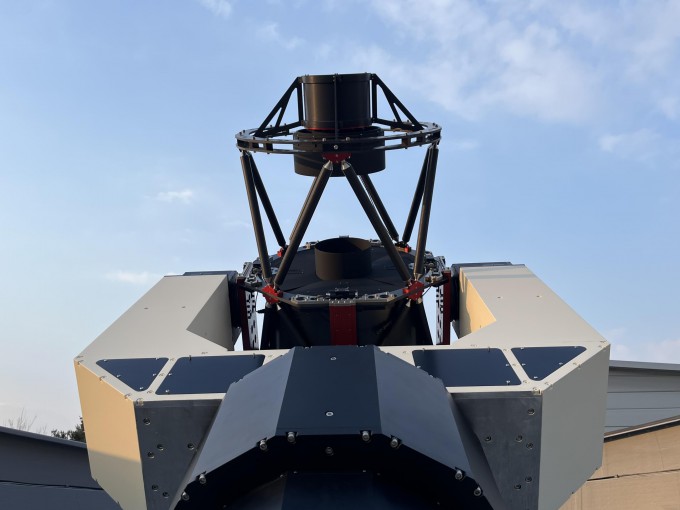
An 80cm-class optical telescope installed at the pre-verification facility for BRAHE, the medium-high orbit optical surveillance system. Photo by KASI.
As more countries and companies utilize space for military and commercial purposes, Earth’s orbit is becoming increasingly congested. Amid the growing risk of satellite and space debris collisions and re-entry, the optical surveillance system ‘BRAHE’, designed to protect assets in medium and high Earth orbit, has begun test operations.
The Korea Astronomy and Space Science Institute (KASI) announced on the 31st that it has commenced trial operations of the BRAHE pre-verification facility, which was built at its headquarters.
BRAHE is an optical surveillance system that tracks and collects orbital information of objects in medium and high Earth orbits. It is being carried out as part of the ‘Project for the Establishment of a Space Risk Response System’ with a government budget of 14 billion KRW from 2024 to 2027.
The goal of BRAHE is to establish a continuous observation system by installing two 80cm-class optical telescopes at partner observatories in Australia. The planned installation sites are the Siding Spring Observatory and the Zadko Observatory.
Siding Spring Observatory, located in New South Wales, Australia, is an optical observatory with a high concentration of telescope infrastructure, fostering active international research collaborations. Zadko Observatory, a research and educational facility near Perth, Western Australia, is equipped with optical instruments, including a 1-meter class telescope, and is used for monitoring small solar system bodies like asteroids and comets, as well as for space debris tracking research.
The pre-verification facility is a domestic site for inspecting the dome, optical telescope, and automation equipment in an environment that simulates the actual operating conditions before their installation at the Australian observatories.
After the construction of the Australian observatories is completed next year, the facility will maintain an identical system environment to continue verifying maintenance technology for unmanned operations and testing new equipment. The domestically established pre-verification facility will also serve as a key part of the medium-high orbit space surveillance network, in conjunction with the two observatories in Australia.
KASI designed and manufactured the entire system in collaboration with private domestic companies, successfully completing the pre-verification facility in two years since its launch in April 2024.
“This is an achievement resulting from KASI’s 40 years of accumulated space surveillance technology, continuous government investment, and the steady efforts of domestic private companies,” said Principal Researcher Joong-Hyun Jo. “We hope BRAHE will establish itself as a key observation instrument for Korea’s space industry.”
Copyright ⓒ DongA Science. All rights reserved.