
Topline
April opens with one of spring’s most photogenic sights: a full “Pink Moon” rising at sunset — and it just might be accompanied by a NASA rocket launch to the moon. Over the following nights, it glides past Spica, one of the sky’s brightest stars, as Venus gleams. By week’s end, a comet’s tail may appear just after sunset. Here’s everything you need to know about stargazing and astronomy this week from North America.
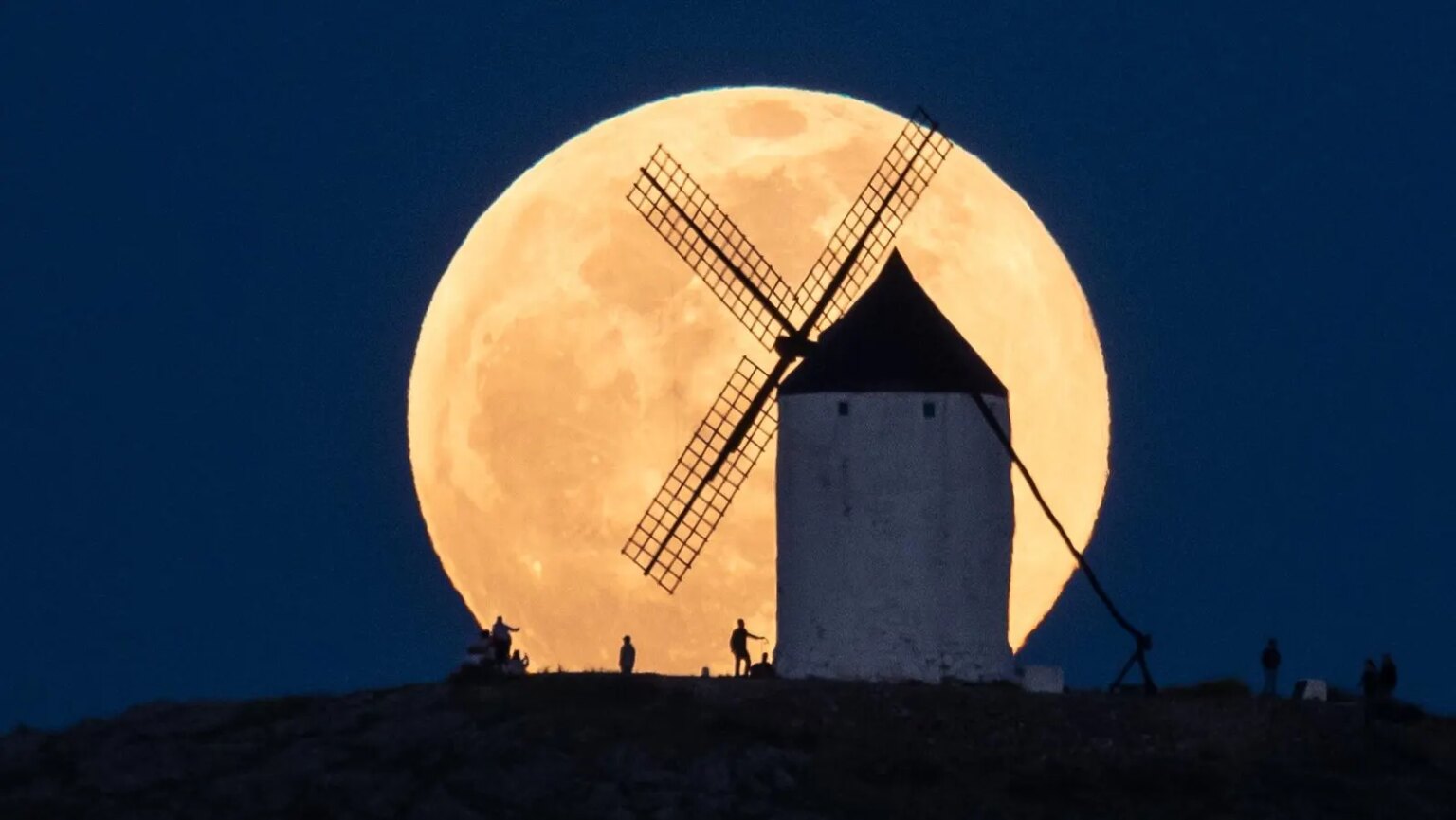
The full moon rises over a windmill in Consuegra, Toledo, Spain. (Photo by Marcos del Mazo/LightRocket via Getty Images)
LightRocket via Getty ImagesTimeline
Wednesday, April 1Full “Pink Moon” rises and NASA’s Artemis II mission launches — the first crewed mission to the moon since 1972.
Thursday, April 2The waning gibbous moon appears close to bright stars Spica.
Friday, April 3-Sunday, April 5Comet MAPS (C/2026/A1) may appear in the post-sunset sky.
Wednesday, April 1: Full ‘pink Moon’ And A Moon Rocket Launch
April’s full moon reaches its peak at 10:11 p.m. EDT, but the best moment to watch it is at moonrise in your location — which occurs close to sunset across North America. As it lifts above the eastern horizon, it may glow orange or even coppery thanks to Earth’s atmosphere scattering blue light. Also lifting above the horizon may be NASA’s Artemis II crew, which is due to launch on a SLS rocket from the Kennedy Space Center between 6:24 and 10:24 p.m. EDT. That’s either side of moonrise in Orlando, which will occur around 7:36 p.m. EDT.
Thursday, April 2: Moon And Spica In Conjunction
One night later, the moon is technically waning gibbous, though it still appears full to the eye. After dark, it hangs high in the southeast with Spica less than two degrees away — roughly the width of your thumb held at arm’s length. About 250 light-years away, Spica is actually a pair of massive blue-white stars orbiting each other every 4 days, whose combined light is more than 10,000 times that of the sun.
If the skies are clear about an hour after sunset, glance west for brilliant Venus low on the horizon before it sets.
Friday, April 3-Sunday, April 5: Comet Maps (c/2026 A1)
Early April may bring an unpredictable visitor: Comet MAPS (C/2026 A1), a Kreutz sungrazer. These icy fragments pass extraordinarily close to the sun. MAPS reaches perihelion on April 4, skimming less than 800,000 kilometers above the solar surface. That’s an order n comets can flare dramatically — or disintegrate entirely. If it survives, look very low in the western twilight during the first week of April. A clear, flat horizon and transparent skies are essential — as is patience and good celestial luck because this is one comet that could well break up. However, even if it does, its fragments could create a bright tail after sunset from about April 9.
Draco constellation featuring labeled stars in a glowing, star filled night sky.
gettyConstellation Of The Week: Draco
Winding between the Big and Little Dippers in the northern night sky in Spring, Draco the Dragon coils around the north celestial pole. It’s circumpolar for mid-northern latitudes and visible all year, though spring evenings offer a comfortable time to trace its long, faint body.
One of its stars, Thuban, was Earth’s North Star around 2700 BCE, when the ancient Egyptians were building pyramids. Though Draco lacks very bright stars, its sinuous shape is rewarding to follow under dark skies.
The times and dates given apply to mid-northern latitudes. For the most accurate location-specific information, consult online planetariums like Stellarium.
Further reading
ForbesComplete Guide To NASA’s Epic Artemis II Mission — Launching This WeekBy Jamie CarterForbesThat Bright ‘Star’ In The Sky After Sunset Isn’t What You ThinkBy Jamie CarterForbesComet Alert: A Sungrazer May Soon Blaze After Sunset — Or Break ApartBy Jamie CarterForbesYour Ultimate Guide To Stargazing And Astronomy In 2026By Jamie CarterForbesYour Full Moon Guide For 2026 — All 13 Dates For Your DiaryBy Jamie Carter