
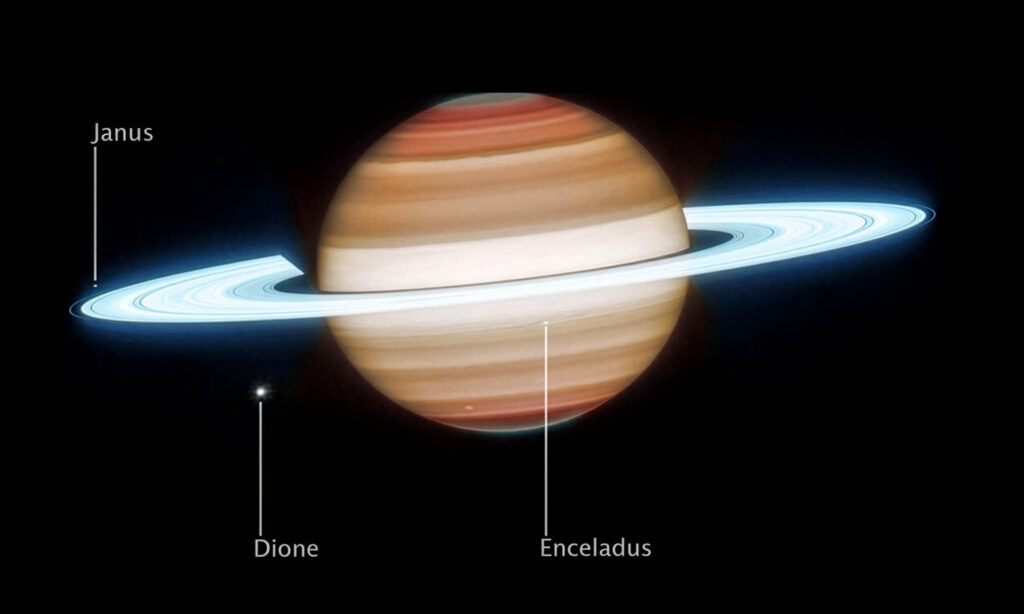
Saturn has always stood out in the night sky. Its rings catch the eye, but the real action happens in the thick layers of gas wrapped around the planet.
Now, two powerful space telescopes have taken fresh images that show Saturn in ways we have never quite seen before.

These views do not just look different – they reveal how the planet actually works. One image shows color and detail we can see with our eyes.
The other goes deeper, pulling out hidden layers and movements inside the atmosphere. Put them together, and Saturn starts to feel less like a distant object and more like a system in motion.
Two telescopes, one story
The images come from two well-known observatories: the James Webb Space Telescope and the Hubble Space Telescope. They observed Saturn just weeks apart in 2024, each using a different kind of light.
Hubble focuses on visible light, which shows the planet’s soft bands and subtle color shifts. Webb looks in infrared, which can pass through haze and reveal structures at different depths.
Scientists describe this combined view as a way to “slice” through Saturn’s atmosphere, layer by layer.
What’s moving inside Saturn
The new images highlight just how active Saturn’s atmosphere really is. In Webb’s view, a long, winding feature called the “ribbon wave” stretches across the northern part of the planet. It shifts and bends, shaped by waves that are not easy to detect in visible light.
Below that sits a small spot tied to a past event known as the “Great Springtime Storm” from 2010 to 2012.
Even years later, traces of that storm are still visible. Several other storms appear across the southern half of the planet, each shaped by strong winds deep below the cloud tops.
These patterns are not random. Saturn acts like a natural lab where scientists can study how fluids move under extreme pressure and speed.
The behavior of these clouds helps explain weather not just on other planets, but also on Earth in a broader sense.
The strange hexagon at the pole
Near Saturn’s north pole sits one of the oddest weather patterns in the solar system. It is a six-sided jet stream that forms a near-perfect hexagon. First spotted in 1981, it has held its shape for decades.
Both telescopes caught faint views of this feature again. Its long life suggests that some large-scale patterns on giant planets remain stable for a very long time. That stability raises new questions about how energy moves through Saturn’s atmosphere.
There is also a sense of timing here. Scientists expect this may be the last clear look at the hexagon for years. The northern pole is heading into winter, and it will be in darkness for about 15 years.
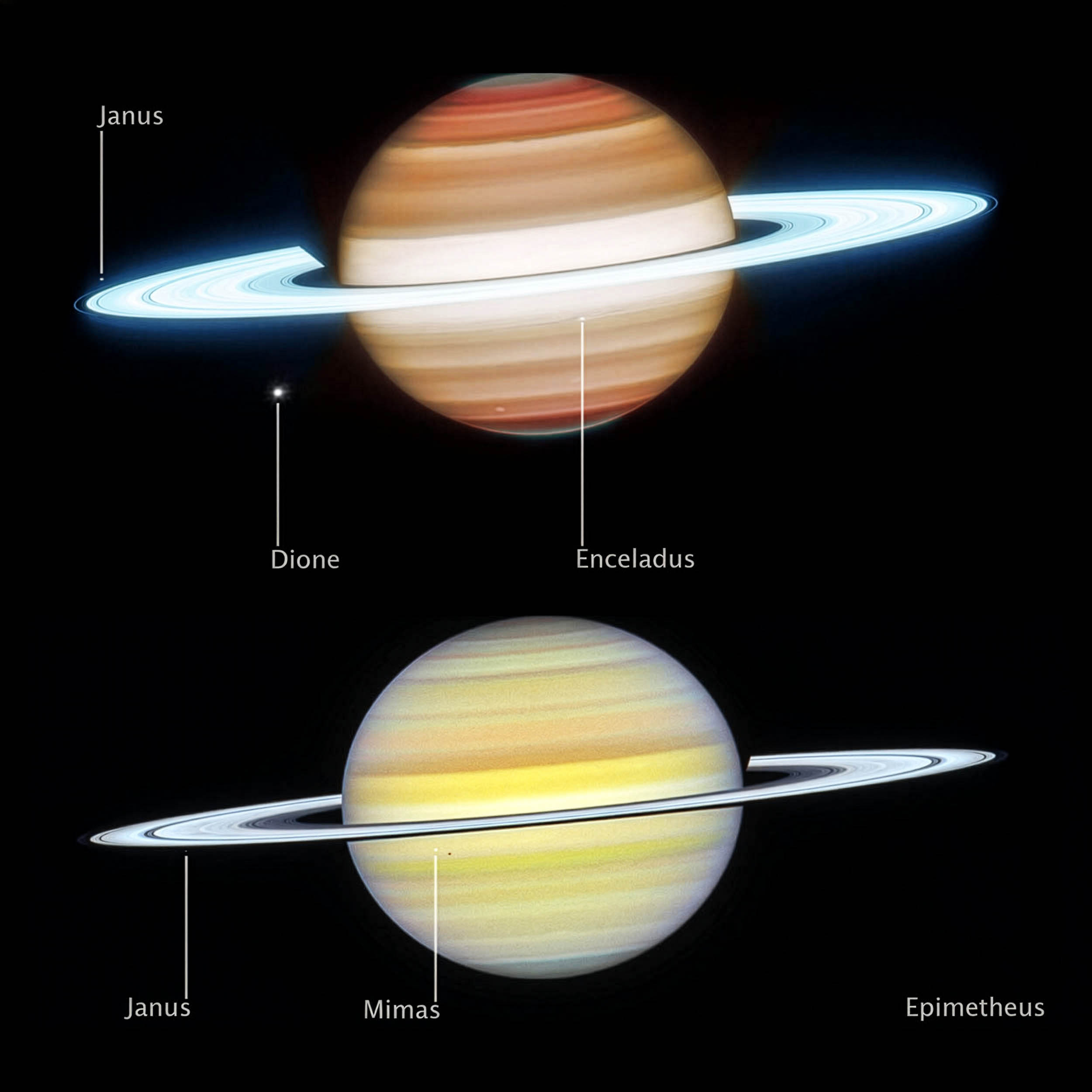 Complementary views of Saturn from NASA’s James Webb Space Telescope and Hubble Space Telescope show a dynamic planet with atmospheric features, orbiting moons, and bright rings. Image credit: NASA, ESA, CSA, STScI, Amy Simon (NASA-GSFC), Michael Wong (UC Berkeley); Image Processing: Joseph DePasquale (STScI). Click image to enlarge.A closer look at the poles
Webb’s infrared images reveal something unusual at Saturn’s poles. They appear in a gray-green tone, linked to light at about 4.3 microns.
This color shift could come from a layer of tiny particles high in the atmosphere that scatter light in a different way.
Another possibility involves auroras. These glowing displays happen when charged particles interact with a planet’s magnetic field.
Saturn has them, just like Earth. Observations like these also connect to similar findings on Jupiter, Uranus, and even Neptune.
Rings that shine in a new light
Saturn’s rings look very different depending on how you view them. In infrared, they shine brightly because they are made mostly of reflective water ice.
Webb’s images make them stand out sharply, especially the thin outer F ring.
Hubble shows the rings in a softer way, with shadows falling across the planet beneath them. Subtle details, like faint streaks and structures inside the thick B ring, appear differently in each image. Together, they give a fuller picture of how the rings are built and how they change over time.
Saturn through the seasons
Saturn is not standing still. Its position, along with Earth’s movement around the Sun, changes how we see it from year to year.
The 2024 images were taken about 14 weeks apart, during a shift from northern summer toward the 2025 equinox.
As the seasons change, different parts of the planet come into view. The southern hemisphere will become easier to study in the coming years, especially as it moves toward summer in the 2030s.
Building a long-term record
Hubble has been watching Saturn for decades through a program that tracks changes year by year. This steady record shows how storms form, fade, and sometimes return in new ways.
Webb adds a deeper layer to that record. Its ability to see into the atmosphere helps scientists measure things they could not track before. Together, the two telescopes turn snapshots into a long-term story about how Saturn evolves.
Saturn may look calm from a distance, but these new images make one thing clear. Beneath that smooth appearance, the planet is constantly shifting, driven by forces that are still not fully understood.
Details for this report were provided by NASA, ESA, CSA, STScI, Amy Simon (NASA-GSFC), Michael Wong (UC Berkeley); Image Processing: Joseph DePasquale (STScI)
—–
Like what you read? Subscribe to our newsletter for engaging articles, exclusive content, and the latest updates.
Check us out on EarthSnap, a free app brought to you by Eric Ralls and Earth.com.
—–