
There are currently about 10,000 Starlink satellites in Earth’s orbit. Their distinctive “trains” in the sky no longer surprise anyone. However, SpaceX’s recent announcement of plans to launch another million satellites—which will serve as orbital data centers for AI—confronts humanity with the reality that the night sky may change forever.
 Because of Starlink, the starry night sky may soon be a thing of the past unless we stop the uncontrolled “pollution” of Earth’s orbit now. Illustrative photo: Unsplash
In a perfectly dark sky, the human eye can detect less than 4,500 stars. Simulating a scenario with a million satellites provides a shocking result: there will be more artificial points in the sky than real stars.
 Starlink train in the sky. Source: vitotechnology.com
The new satellites are planned to be placed in higher orbits. This means they will reflect sunlight for much longer during the night than the current versions of Starlink. According to astrophysicist Jonathan McDowell’s projections, the number of satellites visible to the naked eye will reach tens of thousands. The stars that humanity has gazed upon for millennia will simply be “overshadowed” by artificial twinkling.
Orbital “crematorium”
SpaceX is promoting the move of data centers into space as a “green” initiative that will supposedly save water and energy on Earth. However, scientists call this manipulative PR, pointing out the downside:
Air pollution. Satellites have a limited lifespan. When thousands of spacecraft burn up in the atmosphere each year, they will leave behind chemical traces and fine particles, the effects of which on the climate and the ozone layer have not yet been fully studied.
Risk of collisions. The incredible density of objects in orbit increases the likelihood of a “Kessler syndrome,” in which a single collision triggers a chain reaction of destruction.
Dangerous debris. If a device does not burn up completely, its remains may fall to the ground, posing a real threat to people.
Technological impasse
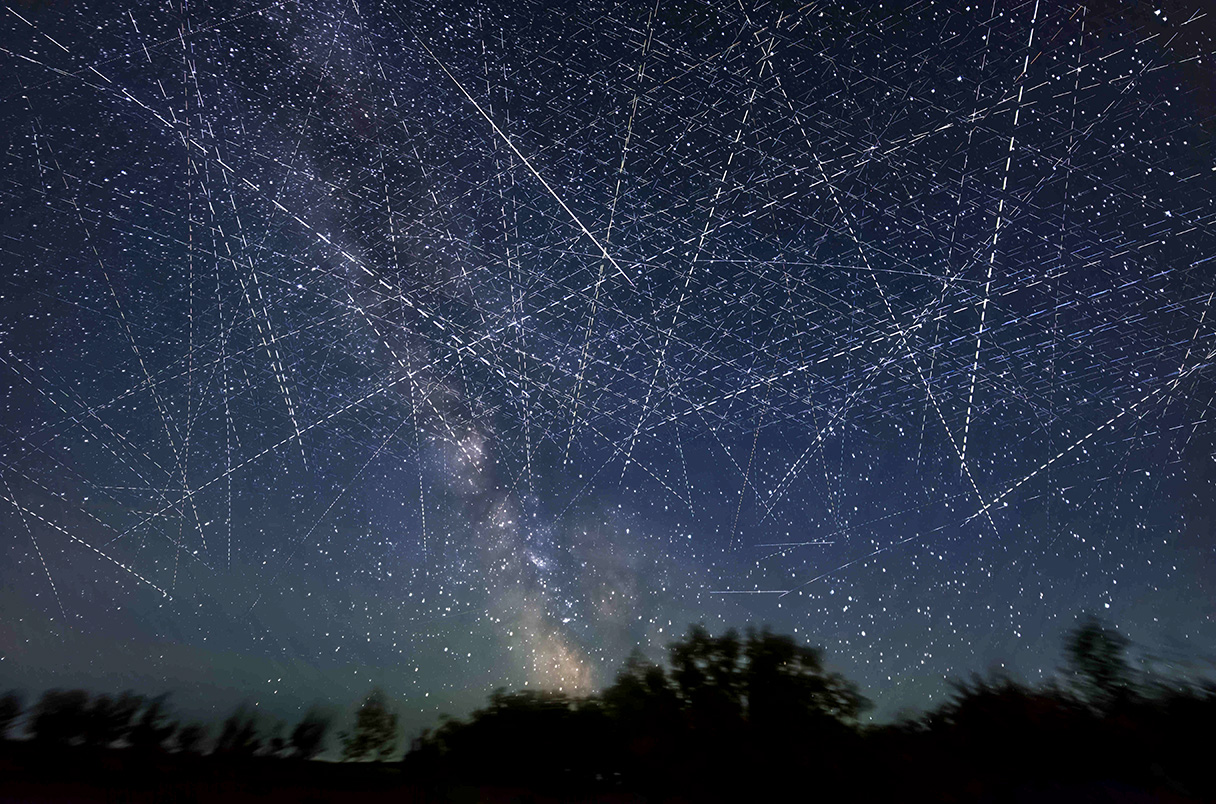 Source: Alan Dyer/VWPics via Redux
One of the biggest technical challenges of the design is heat dissipation. Data centers generate an enormous amount of heat. There is no air in space to cool things down, so the only way to get rid of heat is through radiation.
This creates a circular problem: to prevent the satellite from burning up, it should be light-colored, but then it becomes too bright for astronomers. Previous attempts by SpaceX to paint its satellites black ended in failure—the electronics simply overheated.
A blow to science
The astronomical community views this proposal as a slap in the face after many years of collaboration. While scientists have been trying to reach a compromise regarding the brightness of Starlink, the new application for a million satellites effectively ignores all previous agreements on dark sky protection.
The U.S. Federal Communications Commission (FCC) accepted SpaceX’s filing, allowing only four weeks for public comment. By comparison, serious scientific studies of the impact of such systems can take years.
Orbital space is a finite resource. We cannot allow a single corporation to alter the sky for the entire planet without a detailed analysis and international regulation.
We previously reported that the risk of satellite collisions in orbit increased tenfold.
According to Phys