
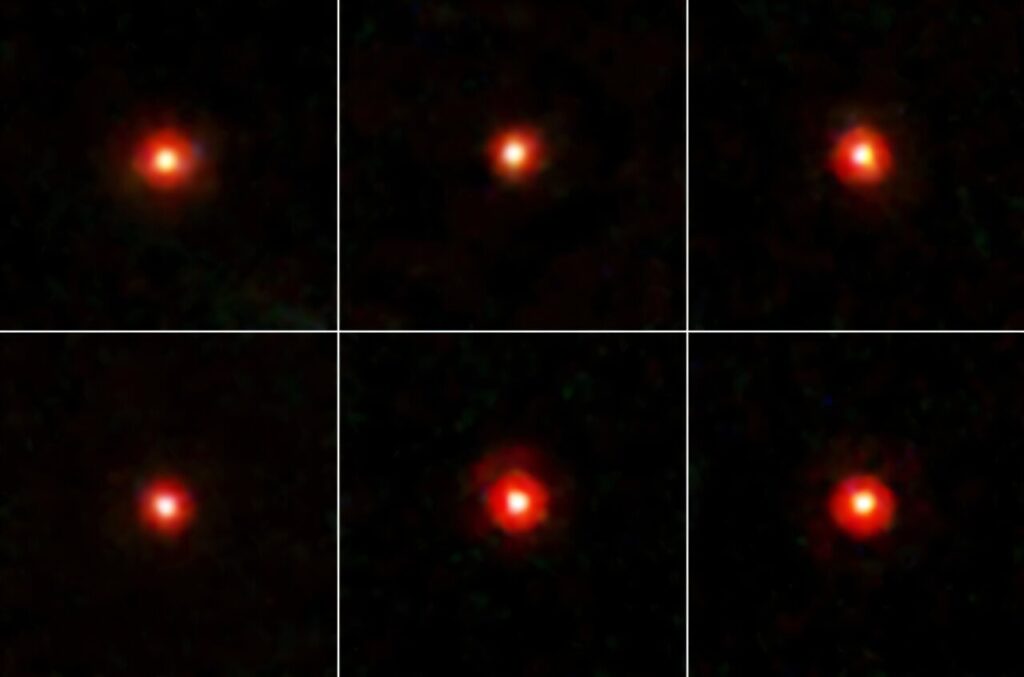
The James Webb Space Telescope studied a pair of dwarf galaxies and discovered them to contain supermassive black holes. This challenges current understanding of how star systems evolve.
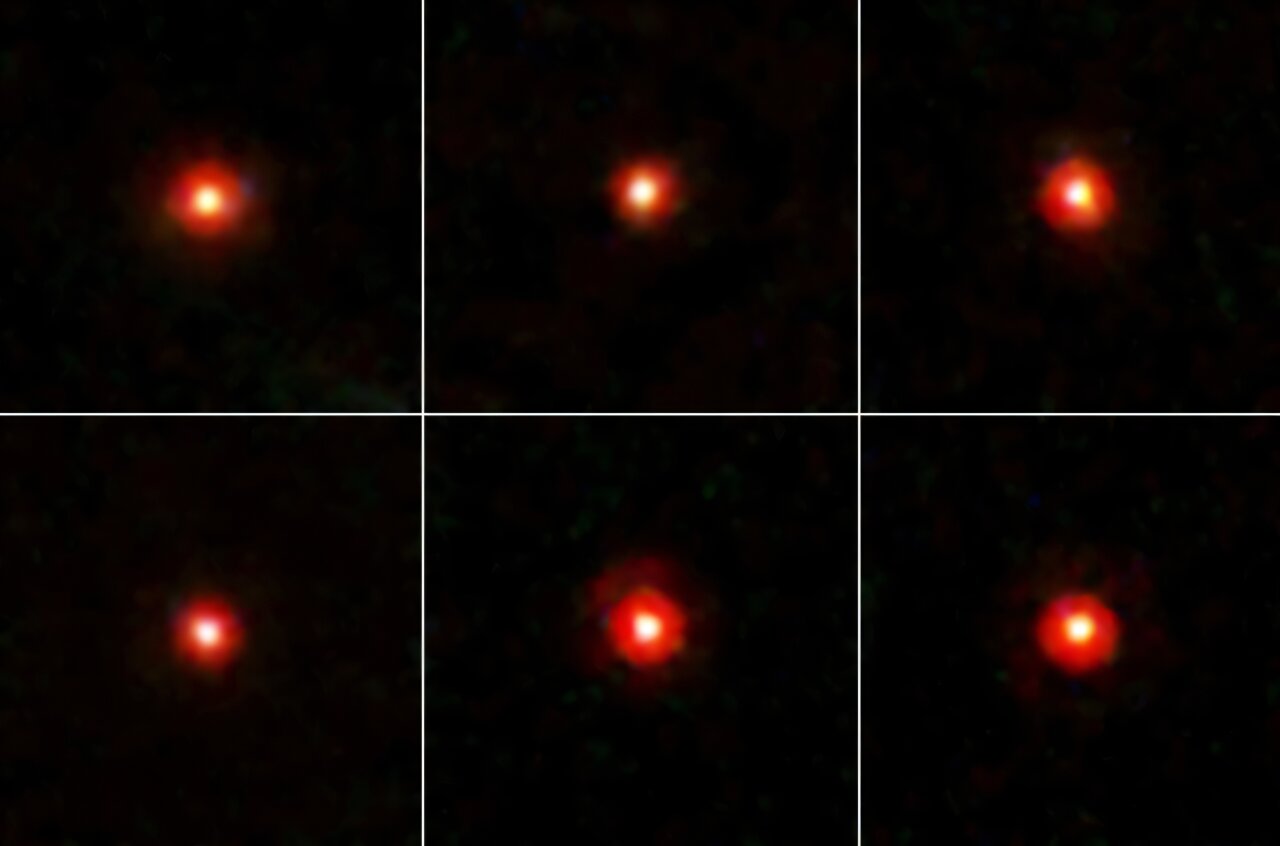 Dwarf galaxy. Source: phys.org
Supermassive black holes in dwarf galaxies
A group of scientists recently published a study in the journal Astronomy and Astrophysics on a pair of dwarf galaxies observed using the James Webb Space Telescope. They discovered a pair of supermassive black holes there, prompting them to reconsider just how accurately we understand the processes of stellar system evolution.
In fact, supermassive black holes have continued to be found not only in large star systems like the Milky Way, but also in dwarf galaxies. However, they were relatively small, so it was thought that it might be possible to find intermediate-mass objects there, but that it was unlikely to find anything larger.
In general, the masses of a galaxy and the black hole at its center should be comparable, because they evolve in close association with one another. Therefore, the mass of the second object should be between 0.1% and 0.5% of the mass of the first. However, James Webb had already refuted these arguments based on its data.
Hot dwarf galaxies
However, in recent years, when the most advanced space telescopes have discovered something that has revolutionized astronomy, it has almost always been found at the edge of the known Universe. And even those galaxies in which supermassive black holes have already been discovered, we observed as they were during the first billion years of the Universe’s existence.
But this new study focuses on closer objects. Their redshift is only 0.7. That’s not quite beyond our reach. But not on the other side of the Universe either. And most interestingly, at first the dwarf galaxies named Pelias and Neleus looked just like ordinary bright blue systems.
They were considered dwarf galaxies with little dust and active star formation. This went on until an infrared camera on the James Webb Space Telescope was pointed at them. Then scientists realized that there really was a lot of dust and that there were indeed massive black holes inside.
Their mass can account for up to 60% of the dwarf galaxy’s total mass. And, as usual in such cases, scientists have no explanation for this. They simply haven’t observed these objects for long enough to understand how they grow.
Another interesting feature of Pelias and Neleus is the absence of X-ray emission from their centers. What should that indicate? That there are no accretion disks around black holes, or that for some reason we cannot see them. Scientists hope to find the answer to this question.
According to phys.org