
Science & Exploration
02/02/2026
237 views
3 likes
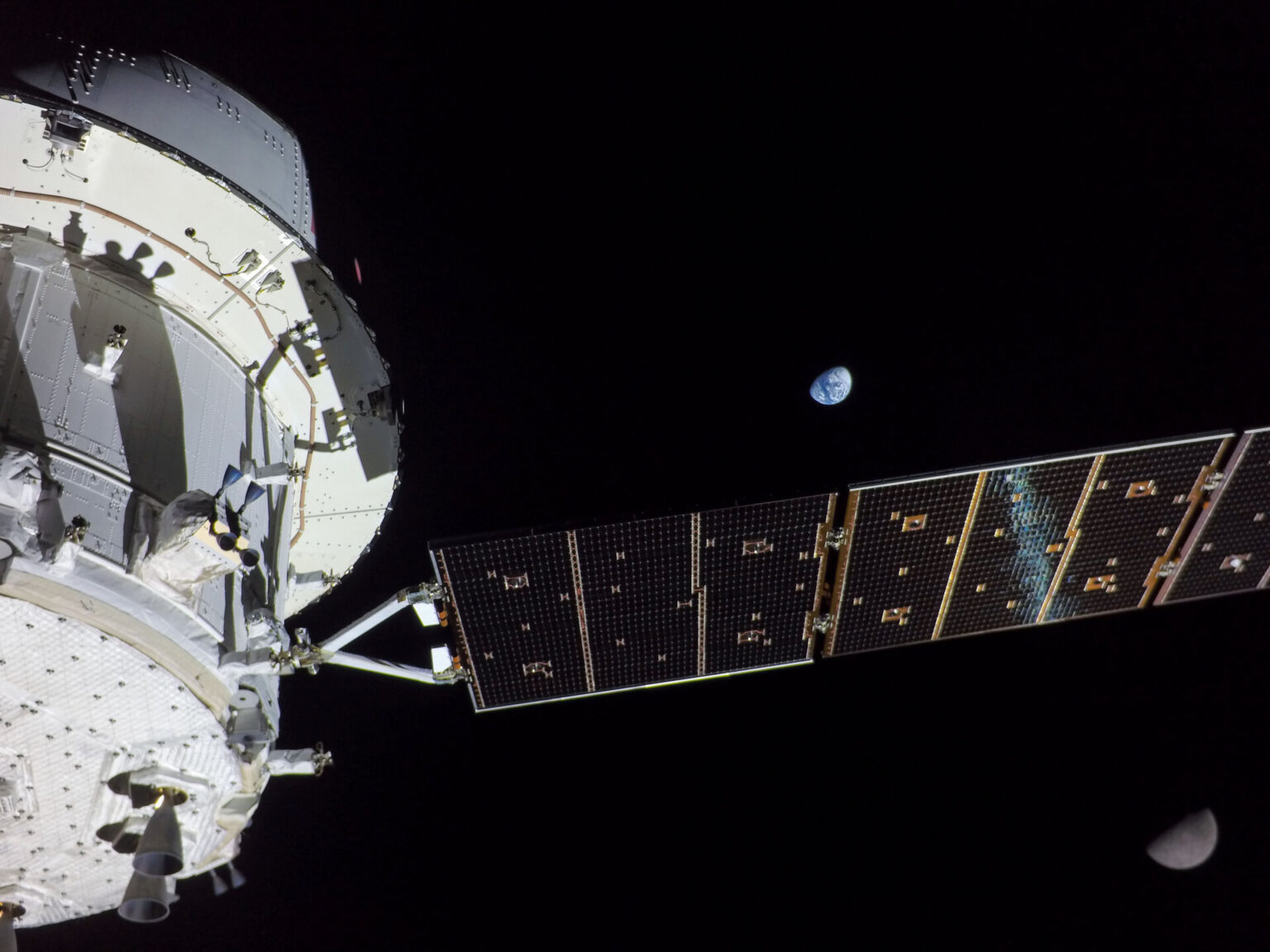
When Artemis II carries astronauts beyond Earth orbit for the first time in 50 years, Europe will be providing the power that makes the journey possible. Built by European industry, ESA’s European Service Module is the propulsion heart of the Orion spacecraft, carrying 33 engines that guide, steer and propel the crew safely towards the Moon and back.
The engines
A rendering of Orion during an Artemis mission, with the European Service Module’s engines visible
The European Service Module has three types of engines that work together, each with a specific role during the mission. A single main engine delivers the large changes in speed needed to send Orion towards the Moon. It is supported by eight auxiliary engines, which are used for orbital corrections and can back up the main engine if needed. For precise control, 24 smaller reaction control system engines, arranged in six pods, are used to rotate and orient the spacecraft. Firing individually or in combination, they allow Orion to adjust its position with exceptional accuracy.
The main engine is no stranger to space – it is a repurposed Space Shuttle orbital manoeuvering system engine which has already flown on six missions between 2000 and 2002. Now fully tested, refurbished and integrated into Orion, it brings years of proven performance to a new era of human exploration.
The mission
The Artemis II mission trajectory
Artemis II will put our European engines to work almost immediately after launch.
On the first day of the mission, Orion will remain in Earth orbit while the crew checks spacecraft systems. After separating from the rocket’s upper stage, the astronauts will take manual control of Orion and use the reaction control system engines to practise “proximity operations” – docking manoeuvres essential for future Artemis missions.
On the second day, once mission controllers give the go-ahead, the European Service Module’s main engine will ignite for one of the most critical moments of the mission: the trans-lunar injection burn. This powerful manoeuvre will accelerate Orion out of Earth orbit and send the crew on a four-day journey towards the Moon.
Throughout the flight, additional engine firings will fine-tune Orion’s trajectory, ensuring the spacecraft and its astronauts remain precisely on course.
The people
The combined Mission Evaluation Room team at NASA’s Johnson Space Center in Houston, USA
These complex operations are supported by European expertise on both sides of the Atlantic. Engineers at ESA’s technical centre, ESTEC, in the Netherlands will work alongside colleagues in the Mission Evaluation Room at NASA’s Johnson Space Center in Houston, monitoring the European Service Module and providing in-depth knowledge of its systems around the clock.
Artemis II is the second mission to fly with a European Service Module. The first performed above expectations on the uncrewed Artemis I mission, highlighting the value of Europe’s contribution to the programme. With the third and fourth European Service Modules already delivered and undergoing testing for future missions, Europe continues to deliver the hardware that brings humankind safely towards the Moon and back home.
Like