

NASA’s first human Moon mission in more than 50 years is just days away, and when the Artemis II crew blast off from the agency’s Kennedy Space Center in Florida, a former NASA scientist has explained they will experience a feeling of ‘pressure’.
If you’re currently thinking, “uh, duh? Of course there’s pressure when you’re the first astronauts to blast off to the moon in half a century,” then you have a fair point – but we’re not talking about societal pressure here.
Instead, the crew made up of NASA astronauts Reid Wiseman, Victor Glover, Christina Koch, and Canadian Space Agency (CSA) astronaut Jeremy Hansen, will feel a physical pressure – one directly related to the experience of jetting off into space.
 The four astronauts are set to spend 10 days in space (Joe Raedle/Getty Images)What will the Artemis II crew experience as they take off?
While most of us will never experience space travel, former NASA scientist Dr. John DeWitt, who spent 20 years at the NASA Johnson Space Center, offered insight into what the crew will feel at the start of their mission.
We all know that a lack of gravity is an expected part of space travel, but Dr. DeWitt told UNILAD that the movement of the rocket leaving Earth will create a feeling almost opposite to weightlessness.
He described how the astronauts will ‘feel pressure as the rocket ascends to the sky’, due to the acceleration of the engine as they take off.
Onboard the Orion spacecraft, the crew will be launched using NASA’s Space Launch System (SLS), which the agency describes as ‘part of NASA’s backbone for deep space exploration and Artemis’.
The rocket is the only one that can send Orion, astronauts, and all the cargo directly to the Moon in a single launch, NASA explains, thanks to the fact it offers more payload mass, volume, and departure energy than any other single rocket.
Once the launch is underway, however, Dr. DeWitt has assured the pressure feeling won’t last long.
“Once they reach space orbit, that pressure will disappear,” Dr. DeWitt explained.
“The sophisticated engineering design of the Orion capsule will maintain the environment, such as oxygen, humidity, and temperature, to be similar to being on Earth,” he added.
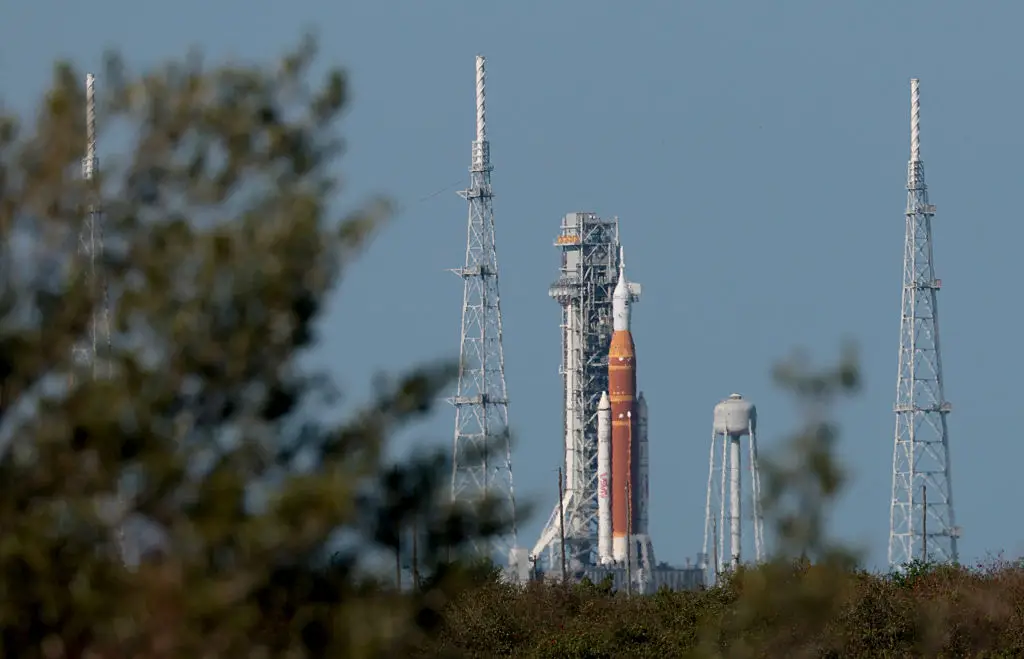 The mission will test if the Orion spacecraft can operate in deep space (Joe Raedle/Getty Images)What is the goal of Artemis II?
Given that NASA hadn’t been back to the moon for decades, you might have thought that we’d seen all there was to see on the big rock that officially isn’t made of cheese.
However, by taking another trip towards the moon, Artemis II will test that the Orion spacecraft can operate as designed in the deep space environment, and pave the way for astronauts to explore the Moon for scientific discovery and economic benefits, as well as creating stepping stones for the first crewed missions to Mars.
NASA has listed five main priorities for Artemis II, specifically:
Crew: Demonstrate the ability of systems and teams to sustain the flight crew in the flight environment, and through their return to Earth.Systems: Demonstrate systems and operations essential to a crewed lunar campaign. This ranges from ground systems to hardware in space, and operations spanning from development to launch, flight, and recovery.Hardware and Data: Retrieve flight hardware and data, assessing performance for future missions.Emergency Operations: Demonstrate emergency system capabilities and validate associated operations to the extent practical, such as abort operations and rescue procedures, as needed.Data and Subsystems: Complete additional objectives to verify subsystems and validate data.
The Artemis II mission is set to last 10 days following takeoff, which will take place no earlier than Wednesday (April 1).