
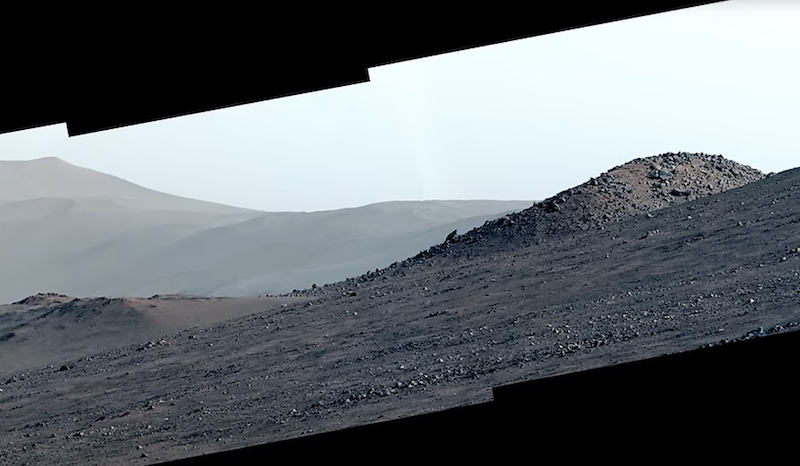
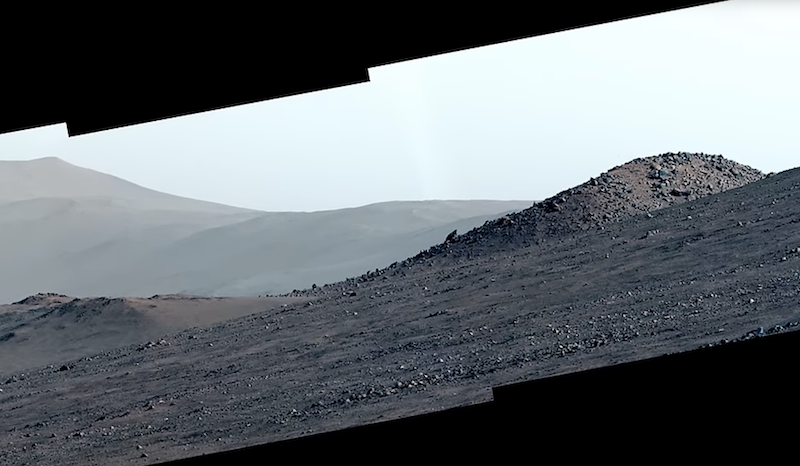
 View larger. | The Perseverance rover captured this view as it ascended up the to the rim of Jezero Crater on December 5, 2024. Now the rover has found rubies on Mars, or perhaps sapphires, in tiny pebbles on the outside of the crater rim. Still image from video via NASA/ JPL-Caltech/ ASU/ MSSS.
NASA’s Perseverance rover has found tiny gemstones in Martian pebbles. They are composed of corundum.
The gems are likely rubies or maybe sapphires, the rover’s analysis suggests. The gems were in a region outside the rim of Jezero Crater.
Meteorite impacts likely formed the gems. On Earth, tectonic activity forms these gemstones.
Rubies on Mars?
NASA’s Perseverance rover has found something never seen before on Mars: fluorescent gems like rubies, or perhaps sapphires. The tiny gem grains are inside pebbles near the rim of Jezero Crater. Ann Ollila at Los Alamos National Laboratory in New Mexico led the research team. The researchers said that the gem grains are composed of corundum. On Earth, corundum is also known as the minerals ruby or sapphire. The difference depends on the trace metals inside it. It is also usually associated with tectonic activity.
Leah Crane wrote about the new discovery in New Scientist on March 18, 2026.
Ollila presented the results at the Lunar and Planetary Science Conference (LPSC 2026) in Texas on March 16, 2026. The two conference papers are available here and here.
The Perseverance rover has found tiny crystals that seem to be rubies or sapphires inside pebbles on Mars, where they have never been seen before
— New Scientist (@newscientist.com) 2026-03-18T22:09:28.131Z
Perseverance finds fluorescent gems on Mars
Perseverance found the first gems inside a small rock called Hampden River. Later, it found similar gems in two more pebbles, Coffee Cove and Smiths Harbour. These pebbles are on the outside of Jezero Crater, near the rim. These gem grains are tiny, only about 0.008 inches (0.2 mm) across.
The rover used its SuperCam instrument to analyze the rocks, using two different lasers. The lasers can analyze the composition of the pebbles. They can also be used to create luminescence – the emission of optical radiation (ultraviolet, visible or infrared) by a substance due to a process other than heating – if the rocks contain luminescent materials. And indeed they did … the resulting luminescent light showed that the rocks contain corundum.
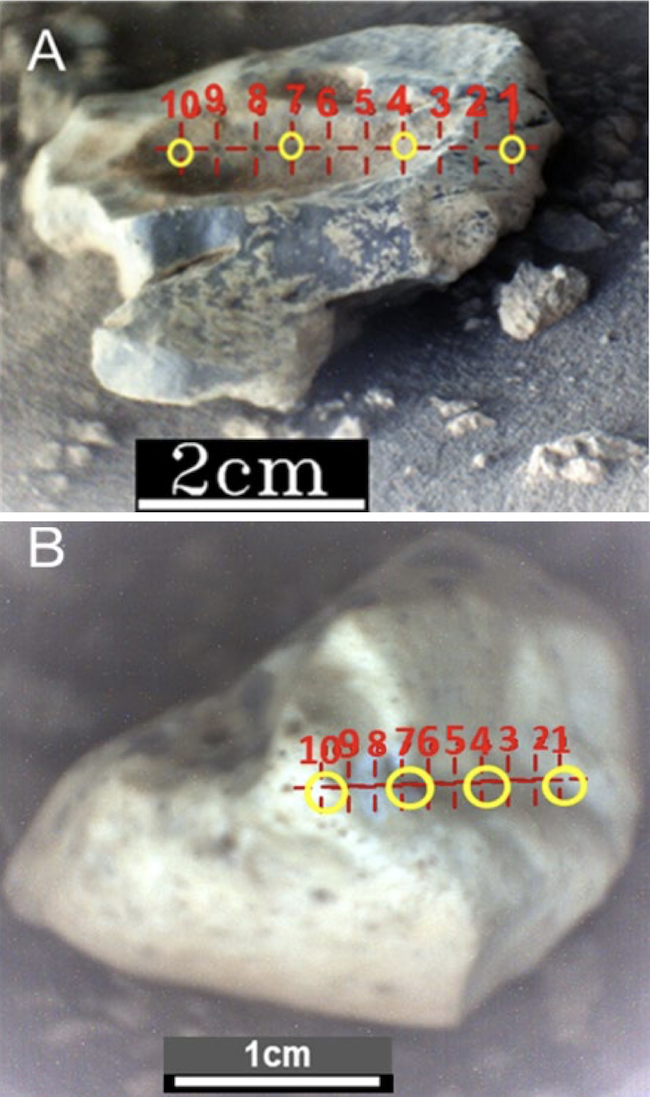 Remote Micro-Imager (RMI) images of the pebbles Hampden River (top) and Coffee Cove (bottom). The red crosses mark the observations by the Laser Induced Breakdown Spectroscopy (LIBS) instrument. Meanwhile, the yellow circles mark the observations by luminescence spectroscopy. Image via NASA/ Sharma et al./ LPSC.
Did meteorite impacts form the rubies on Mars?
On Earth, rubies and sapphires usually form from tectonic activity. But what about Mars? The planet does have some residual tectonic processes now, and it had much more activity in the past. It’s probably not enough to account for the gems, however. And Mars never had plate tectonics, the way Earth does. As Ollila explained to New Scientist:
[Corundum] usually is associated, on Earth, with tectonism. It’s a very specific environment; you have to have a very silica-poor environment, very aluminum-rich.
Instead, the researchers said that meteorites impacting the Martian surface likely formed the corundum. Allan Treiman at the Lunar and Planetary Institute in Texas said:
I was very surprised. In retrospect, one might not have been, because there are aluminum-rich outcrops elsewhere on the planet and there are impacts, but I thought it was very shocking to see this.
Ollila added:
I would love to be able to pick one of those up and analyze it and see if it looks red. It’s pretty disappointing that all you can see is this white pebble.
 Ann Ollila at Los Alamo National Laboratory led the research team studying the fluorescent gems that Perseverance found. Image via Loop.
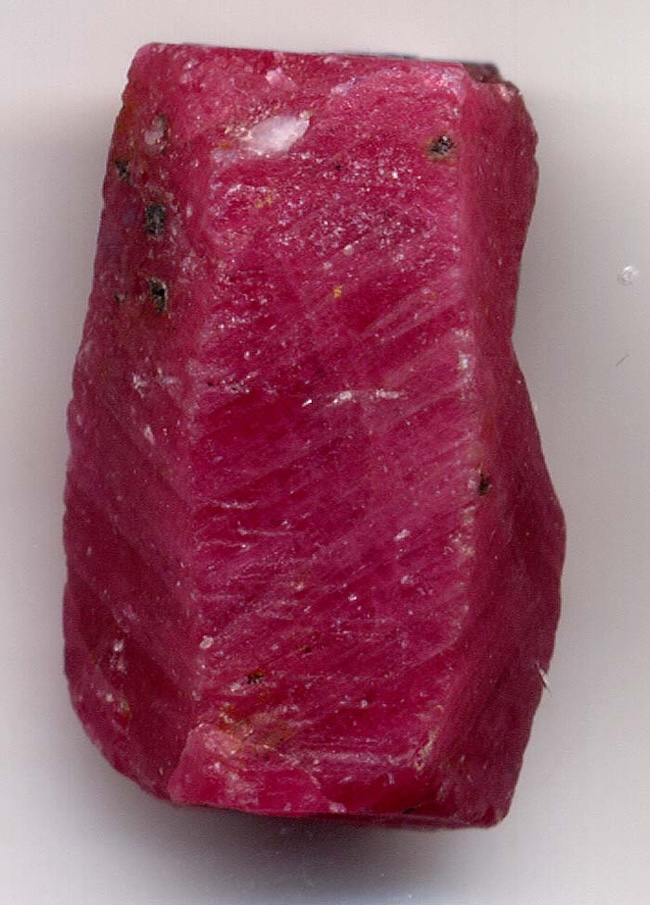 View larger. | A naturally occurring ruby crystal on Earth. Image via Adrian Pingstone/ Wikimedia Commons.
Rubies on Earth
On our planet, rubies are red gemstones composed of transparent red corundum, a mineral form of aluminum oxide. And the color of rubies can vary from deep cochineal to pale rose red. Plus, in some cases there is a tinge of purple in rubies. The most valued color of a ruby is a pigeon-blood red.
In addition, it is also possible to produce rubies artificially. These synthetic rubies can possess the physical characteristics of natural corundum. However, they may be distinguished by microscopic bubbles and striae.
In 2023, scientists reported that NASA’s Curiosity rover also found opal on Mars. Opal is another clue pointing to past water in the region and habitable conditions in the past.
Bottom line: Are there rubies on Mars? NASA’s Perseverance rover has found tiny fluorescent gems in pebbles that appear to be rubies or sapphires.
Read more: Discovery of opal on Mars boosts chances for life
Read more: Corals on Mars? NASA rover finds more remarkably weird rocks
Paul Scott Anderson
View Articles
About the Author:
Paul Scott Anderson has had a passion for space exploration that began when he was a child when he watched Carl Sagan’s Cosmos. He studied English, writing, art and computer/publication design in high school and college. He later started his blog The Meridiani Journal in 2005, which was later renamed Planetaria. He also later started the blog Fermi Paradoxica, about the search for life elsewhere in the universe.
While interested in all aspects of space exploration, his primary passion is planetary science and SETI. In 2011, he started writing about space on a freelance basis with Universe Today. He has also written for SpaceFlight Insider and AmericaSpace and has also been published in The Mars Quarterly. He also did some supplementary writing for the iOS app Exoplanet.
He has been writing for EarthSky since 2018, and also assists with proofing and social media.