
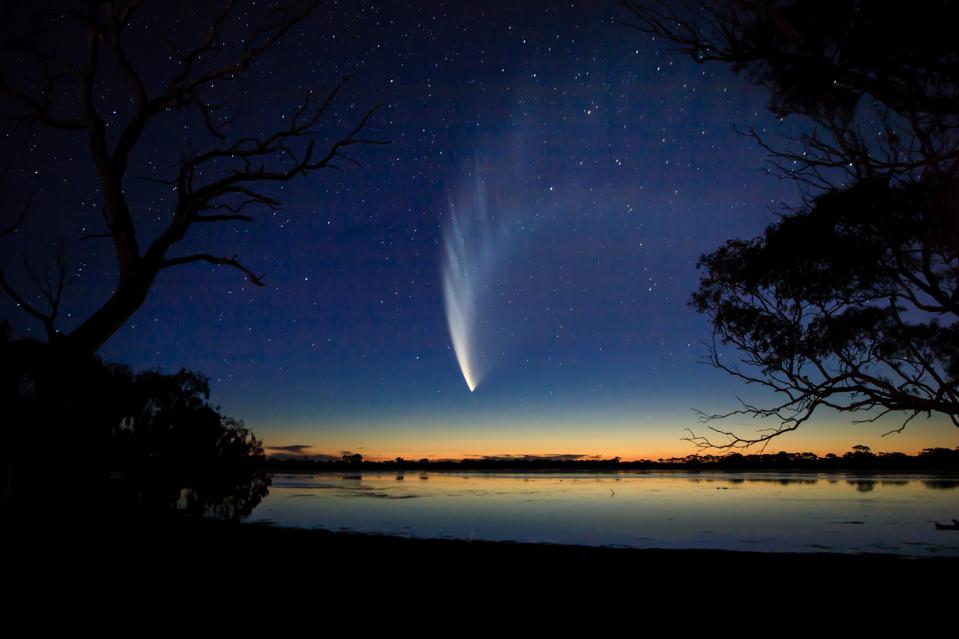
Two comets could become visible in the night sky in April 2026, but whether they become dazzling spectacles or remain faint smudges remains to be seen.
Comets C/2026 A1 (MAPS) and C/2025 R3 (PanSTARRS) are both approaching the inner solar system, offering skywatchers a rare double opportunity — but with very different odds of success.
Comet MAPS: A High-Risk Sungrazer
First up is Comet C/2026 A1 (MAPS), a so-called Kreutz sungrazer that will pass extraordinarily close to the Sun—just 487,000 miles (784,000 km) from its surface around April 4–5. That’s orders of magnitude closer than most comets. Its proximity could make it spectacularly bright. However, it also means the comet may not survive.
Kreutz comets are fragments of a much larger object that broke apart centuries ago, and many disintegrate when exposed to the sun’s intense heat and the gravitational forces of the sun. Found in January, MAPS, with a relatively small nucleus estimated at around 400 meters, is beginning to appear particularly fragile.
If it holds together, it could briefly flare into view in early April, potentially becoming visible to the naked eye — or even producing a bright tail visible in twilight. If it breaks apart, however, it may vanish entirely before becoming visible.
When, Where And How To See Comet MAPS
Observing MAPS will be challenging. The best chance will come 30-45 minutes after sunset, looking very low in the western sky from mid-northern latitudes.
As it approaches the sun, it will brighten, but also become harder to see against the glare. By the time it potentially peaks in brightness around April 4–5, it may be so close to the horizon that only its tail is visible. Even in the best-case scenario, binoculars will likely be required.
According to the British Astronomical Association, it’s likely to fragment before April 4-5, but if it holds on a little longer, we may see a bright tail in twilight around April 9. The latter scenario could well prove to be our best hope of something rather spectacular.
Comet PanSTARRS: A More Predictable Visitor
In contrast to MAPS, Comet C/2025 R3 (PanSTARRS) offers a more stable, if less dramatic, viewing opportunity later in the month.
The comet will reach perihelion (its closest point to the sun) on April 20, and make its closest approach to Earth on April 27.
It could become one of the brightest comets of the year, but predictions vary widely. Some estimates suggest it will reach magnitude 8, meaning it would be visible only through binoculars. Or it could reach magnitude 2.5, making it easily visible to the naked eye under dark skies.
When, Where And How To See Comet PanSTARRS
PanSTARRS will be best seen in the predawn sky in late April from the Northern Hemisphere, and after sunset in early May from the Southern Hemisphere.
It will pass through the constellation Pisces, near the Great Square of Pegasus. It could benefit from a phenomenon called forward scattering, where sunlight reflecting off its tail enhances its brightness as seen from Earth.
A new moon on April 17 will provide darker skies, improving viewing conditions around its peak — a happy coincidence for skywatchers.
Two Very Different Comets
MAPS and PanSTARRS are two very different comets
. MAPS may blaze brilliantly or be destroyed entirely during its close solar encounter, while PanSTARRS is more predictable. Both are still subject to the inherent unpredictability of comet brightness.
For skywatchers willing to look up in April, the reward could be extraordinary — or there could be nothing to see.
Wishing you clear skies and wide eyes.