
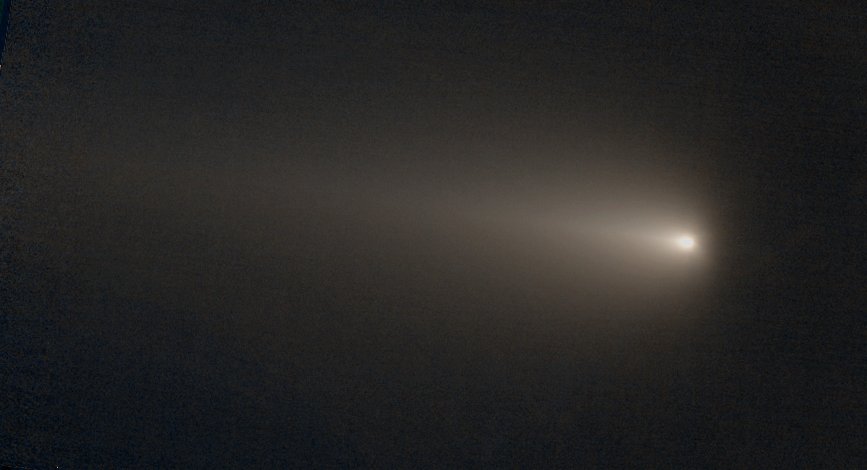
There’s a comet blazing through our solar system this month.
Starting around April 5, Comet C/2026 A1 MAPS will be roughly 89 million miles from Earth, making its closest approach to the sun. That’s close enough that the comet could be visible to the naked eye in New York City.
This month’s astronomical agenda also includes the first manned moon launch in 50 years, weather permitting. April will be capped with the Lyrids meteor shower.
“April is a busy month for the night sky,” said Bart Fried, member of the American Astronomical Society. “”You got a lot of cool stuff happening this month.”
The comet is just over a mile in diameter. It’s considered a sun grazer, meaning it comes very close to the sun (nearly a half-million miles). The comet’s proximity to the sun means it gets a hefty dose of radiation that makes it appear brighter, with a long tail. There’s a chance the comet could break up when it gets close to the sun and fizzles out.
The best way for New Yorkers to spot the comet it is to look southwest, where the sun is setting at dusk. The comet will be very high in the sky from April 5 to 8, after it has completed its closest approach to the sun.
“Comets are notoriously fickle,” said Jackie Faherty, astrophysicist at the American Museum of Natural History. “As exciting as they might be, sometimes they just peter out on us, but it’s got a lot of potential. It could be as bright as Venus.”
Odds are also increasing that NASA will give the green light to its first manned lunar mission in a half-century. The earliest liftoff for Artemis II is 6:24 p.m. on April 1. Alternate dates run through April 6.
Coverage of the launch and daily conversations with the crew during the mission will be livestreamed on NASA+. The 10-day mission will have a figure-eight flight path that will orbit the Earth and the moon without landing. The purpose is to test the space launch system for the next phase, Artemis III, which will send humans to land on the moon by 2028.
“NASA, from everything that I’ve been hearing and reading and seeing, they seem fairly confident that we’re gonna get an April launch,” Faherty said.
The date of takeoff from Kennedy Space Center in Florida depends on weather and safety checks.
From April 14-30, the Lyrids meteor shower will light up the sky with shooting stars. The peak is April 21 and 22, when up to 20 meteors will appear per hour, traveling at more than 100,000 miles per hour. The best viewing time is after 10 p.m.
With the arrival of warmer nights, free stargazing events are happening across the city. The Amateur Astronomers Association hosts weekly events with telescopes across the five boroughs, including an event on April 24 on the flight deck of the Intrepid Museum docked on the Hudson River.