
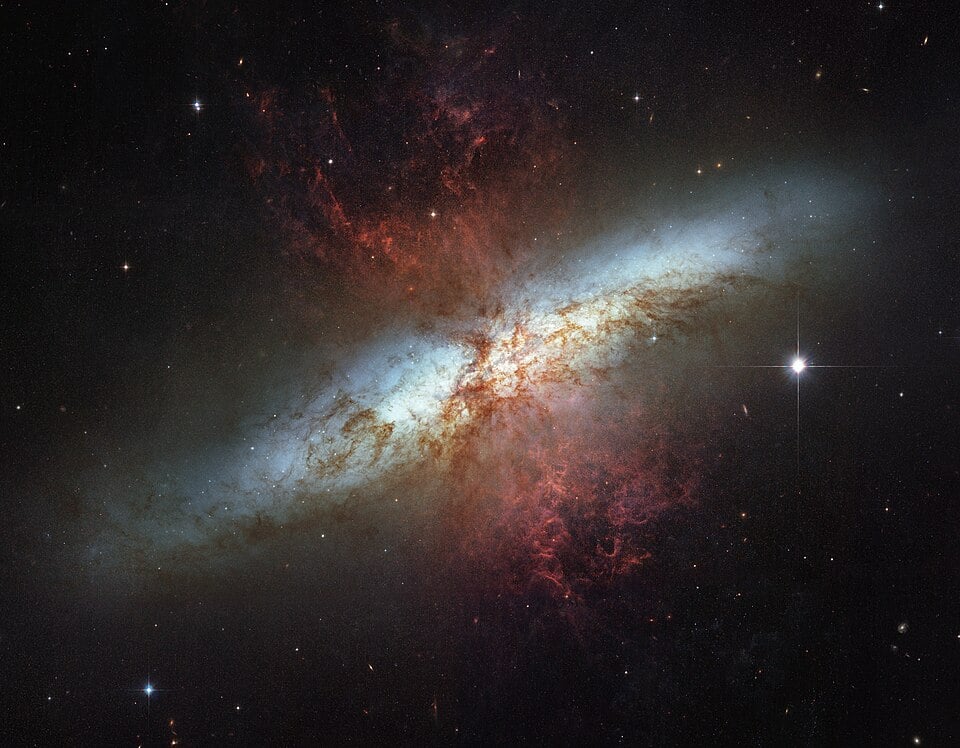
The universe is full of galaxies quietly going about their business, steadily converting gas into stars at a gentle, sustainable rate. And then there are the others, the ones that throw caution to the wind and burn through their reserves in a furious, all consuming burst of creation.
Understanding what happens inside those galaxies, and what they do to everything around them, has been one of astronomy’s great unsolved challenges. Now, at last, we’re getting some answers.
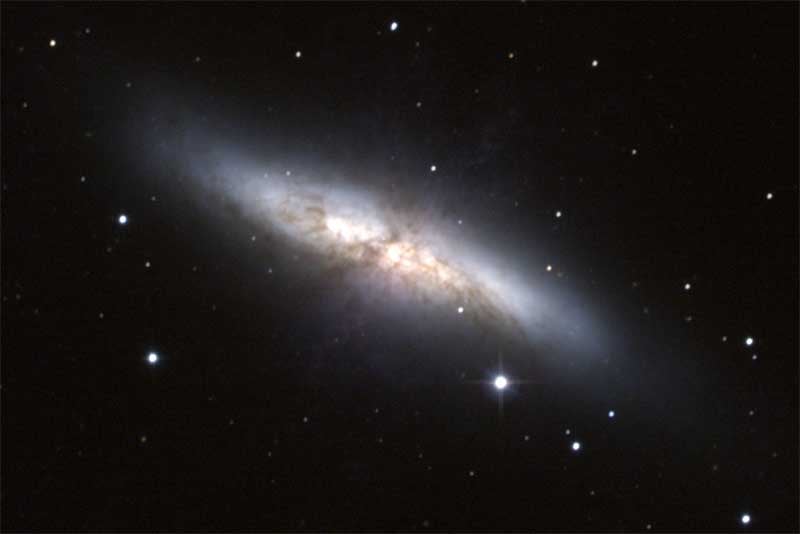 Hubble capture of M82, the Cigar Galaxy which is creating stars at a staggering rate (Credit : N.A. Sharp/AURA/NOAO/NSF)
Some galaxies burn bright and hard, pouring energy into a frenzy of star birth that reshapes everything around them. M82, the Cigar Galaxy, is one of them. Sitting 12 million light years away in the constellation Ursa Major, it forms stars roughly ten times faster than the Milky Way, and the consequences of that stellar factory are written across the sky in a vast plume of gas stretching 40,000 light years from its core.
Astronomers have studied this outflow for decades, but didn’t know how fast the hot gas at the heart of it all actually moving? Now, thanks to the XRISM spacecraft, a joint mission between NASA and the Japan Aerospace Exploration Agency, they finally have an answer.
The Resolve instrument aboard XRISM locked onto X-ray emissions from superheated iron at M82’s centre, and what it found was extraordinary. The gas is hurtling outward at more than 3.2 million kilometres per hour. The temperature of that material sits at around 25 million degrees Celsius, hot enough to exert enormous pressure on surrounding gas, pushing it relentlessly outward like a pressure valve releasing a build up of steam.
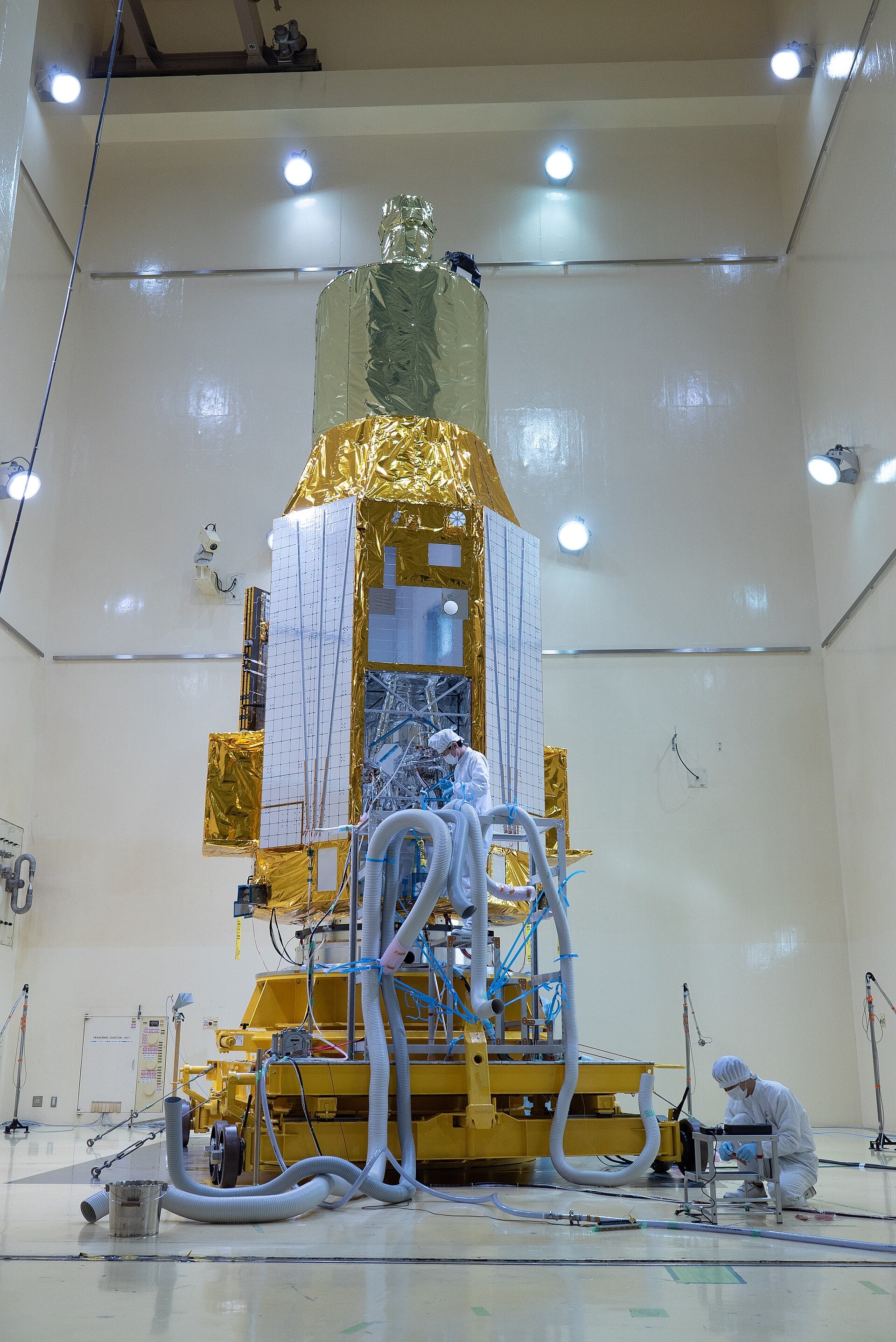 The XRISM spacecraft during acoustic testing at JAXA’s Tsukuba Space Center in December 2022 (Credit : NASA’s Scientific Visualisation Studio)
The speed measurement came from careful analysis of iron’s spectral signature. The Doppler effect, the same phenomenon that makes a passing ambulance siren drop in pitch, stretches the spectral line of iron when its source is moving rapidly in multiple directions. By measuring how much that line broadened, researchers could calculate the velocity directly. It is the same physics you hear every day, applied to gas fleeing a galaxy.
The results confirm that stellar wind and supernova shockwaves near M82’s core are almost certainly what drives the broader galactic outflow, no need to invoke cosmic rays as the main engine, though they may still play a supporting role. The hot inner wind is powerful enough on its own to hurl four solar masses of gas out of the galaxy every year.
But that’s where the puzzle deepens even more. XRISM shows that seven solar masses are moving outward annually so three solar masses are unaccounted for. Where they go, whether they escape the galaxy entirely or recirculate, nobody yet knows.
Some of the models being tested date back to the 1980s. XRISM is finally putting them through their paces, and the universe, as ever, is proving more complicated than anyone predicted.
Source : NASA-JAXA’s XRISM Telescope Clocks Hot Wind of Galaxy M82