These are great, at least they were a few years ago when I bought them. High quality and a fair price. If you only want to start you could go with cheaper Chinese knockoffs, at least to try and see if you like the hobby
4193-4194 on
Does your library have a telescope you could check out?
mikeonmaui on
Check to see if there’s an amateur astronomy club near you. Contact them and ask for help. I was a member of one in my hometown in the 1960s.
Commandmanda on
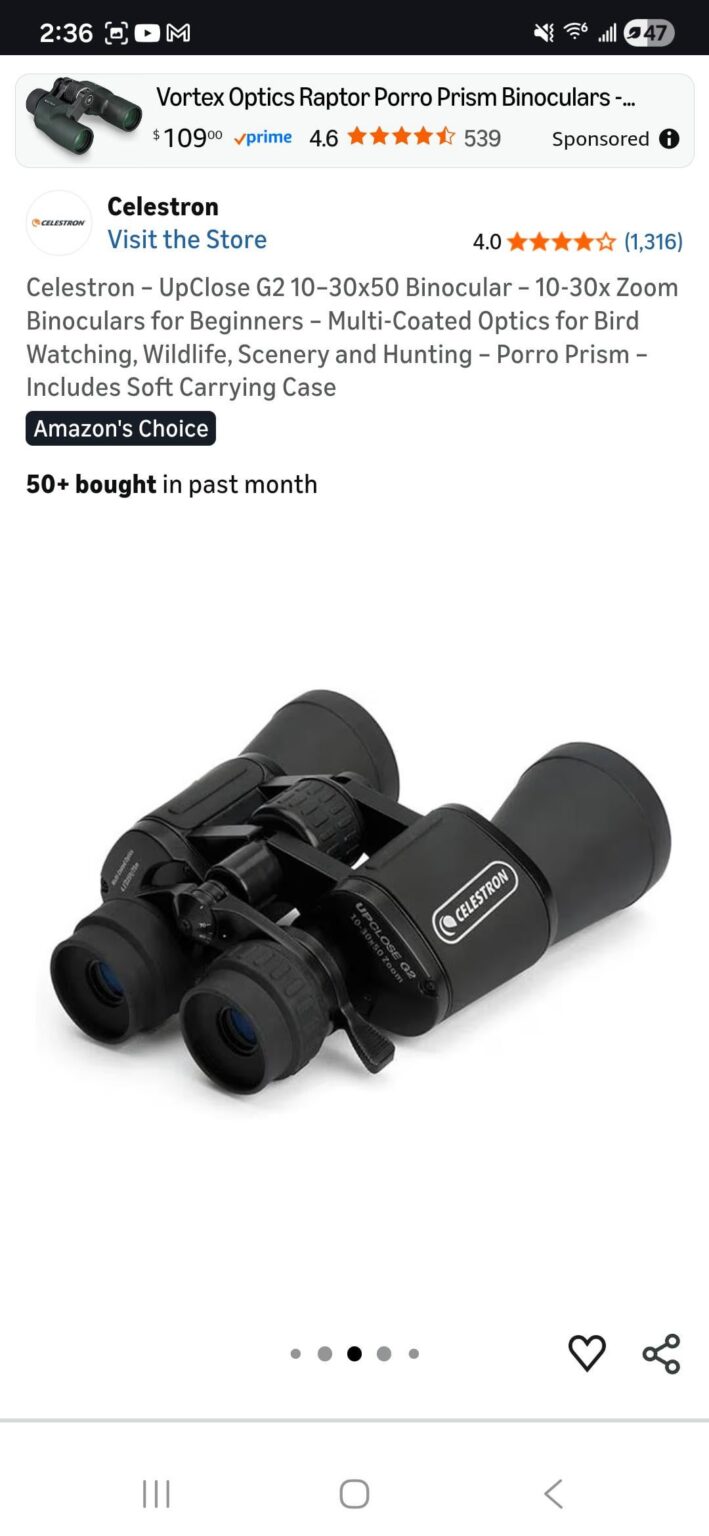
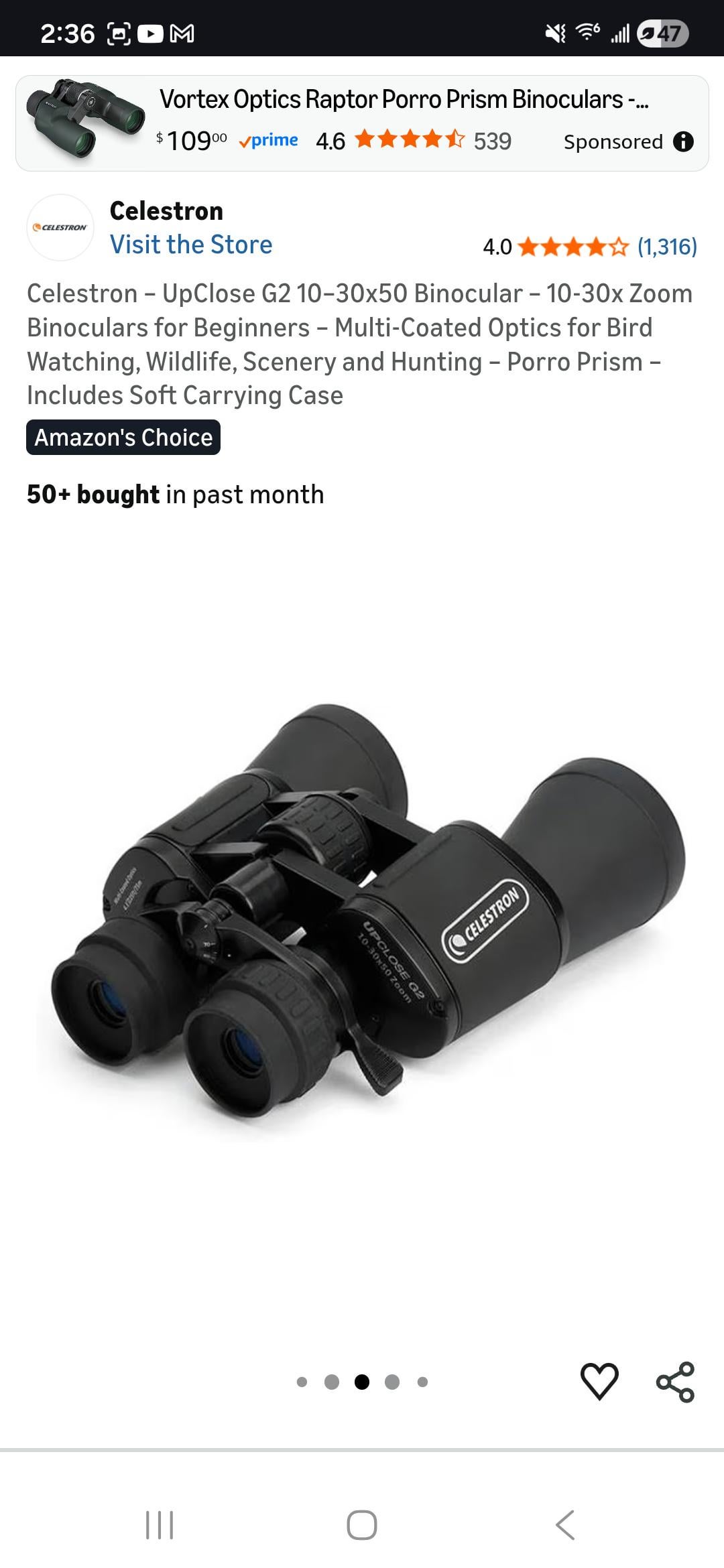
I have them. Bought them four years ago. My advice to you is to also buy a tripod with a plate slide top, and a plate to screw the binoculars into. There is a small screw hole in the underside of the Celestron just for this purpose.
Why? Because holding up binoculars gets tough very quickly, and even your heartbeat jiggles them, making viewing stars and planets fatiguing.
j1llj1ll on
**Do not get zoom binoculars.** The extra optics and mechanics forces a bunch of compromises that end up being disappointing. Especially in cheaper options.
You want low magnification. That way you can hand-hold and not have to figure out some complex and frustrating support setup.
You want an objective diameter 6-7x the magnification to collect as much light as your eyes can use.
Light weight helps (this is somewhere that cheap binos can actually have an advantage over expensive ones). Ideally they’d have coatings etc – but at this price point we can’t get too demanding. And it doesn’t really matter that much for night time, wide-field viewing anyway.
I do think you can indeed get budget binos for astronomy use so long as you accept the limitations – the main one being low magnification. Which means we will be viewing larger features (nebulas, clusters, moons of Jupiter etc) rather than small target detail (we won’t be seeking high detail on Saturn for example, nor splitting double stars).
I have done quite a lot of bino astronomy. I did so for decades before being in a position to be able to use and store a large telescope. You can see and learn a lot with binos.
I have a pair of Celestron Cometron 7×50 binos that cost me $A38 delivered at one point. And they are OK. They have actually seen a lot of use as, due to their low cost, I have hauled them around in backpacks and satchels and cars all the time (often without a case or strap) and the binos you use are the ones you have with you. So far they only thing that has happened to them is getting dusty.
I recommend an astronomy app as the single most important thing to have. I like Stellarium (open source, free) on my laptop. Or, if I just want to take a phone or tablet, I think SkySafari 7 Plus is the best option for the visual observer there (it was about $US10 when I bought it).
My final tip: A bean bag makes an excellent binocular astronomy chair.

5 Comments
These are great, at least they were a few years ago when I bought them. High quality and a fair price. If you only want to start you could go with cheaper Chinese knockoffs, at least to try and see if you like the hobby
Does your library have a telescope you could check out?
Check to see if there’s an amateur astronomy club near you. Contact them and ask for help. I was a member of one in my hometown in the 1960s.
I have them. Bought them four years ago. My advice to you is to also buy a tripod with a plate slide top, and a plate to screw the binoculars into. There is a small screw hole in the underside of the Celestron just for this purpose.
Why? Because holding up binoculars gets tough very quickly, and even your heartbeat jiggles them, making viewing stars and planets fatiguing.
**Do not get zoom binoculars.** The extra optics and mechanics forces a bunch of compromises that end up being disappointing. Especially in cheaper options.
You want low magnification. That way you can hand-hold and not have to figure out some complex and frustrating support setup.
You want an objective diameter 6-7x the magnification to collect as much light as your eyes can use.
Light weight helps (this is somewhere that cheap binos can actually have an advantage over expensive ones). Ideally they’d have coatings etc – but at this price point we can’t get too demanding. And it doesn’t really matter that much for night time, wide-field viewing anyway.
I do think you can indeed get budget binos for astronomy use so long as you accept the limitations – the main one being low magnification. Which means we will be viewing larger features (nebulas, clusters, moons of Jupiter etc) rather than small target detail (we won’t be seeking high detail on Saturn for example, nor splitting double stars).
I have done quite a lot of bino astronomy. I did so for decades before being in a position to be able to use and store a large telescope. You can see and learn a lot with binos.
I have a pair of Celestron Cometron 7×50 binos that cost me $A38 delivered at one point. And they are OK. They have actually seen a lot of use as, due to their low cost, I have hauled them around in backpacks and satchels and cars all the time (often without a case or strap) and the binos you use are the ones you have with you. So far they only thing that has happened to them is getting dusty.
I recommend an astronomy app as the single most important thing to have. I like Stellarium (open source, free) on my laptop. Or, if I just want to take a phone or tablet, I think SkySafari 7 Plus is the best option for the visual observer there (it was about $US10 when I bought it).
My final tip: A bean bag makes an excellent binocular astronomy chair.