
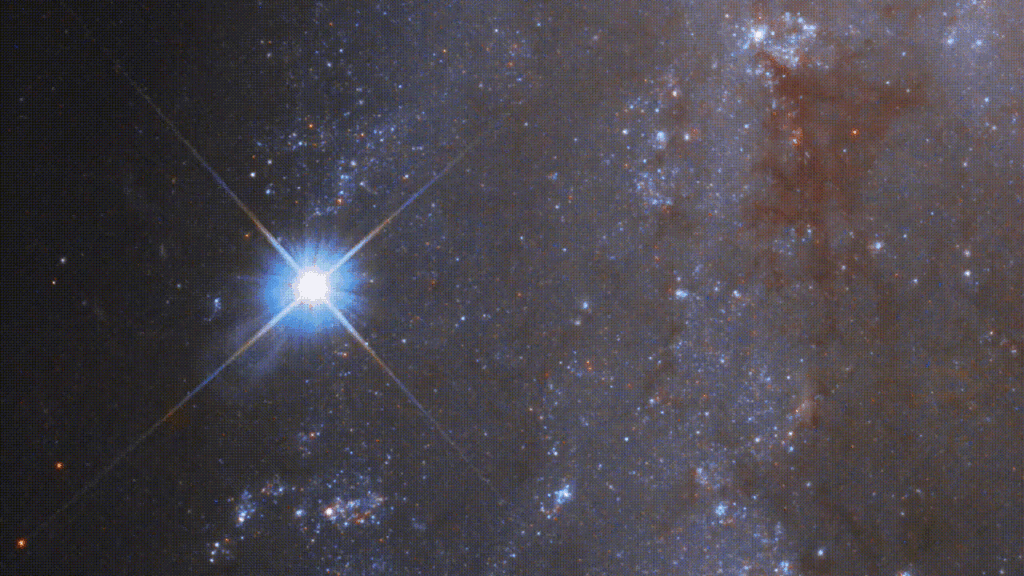
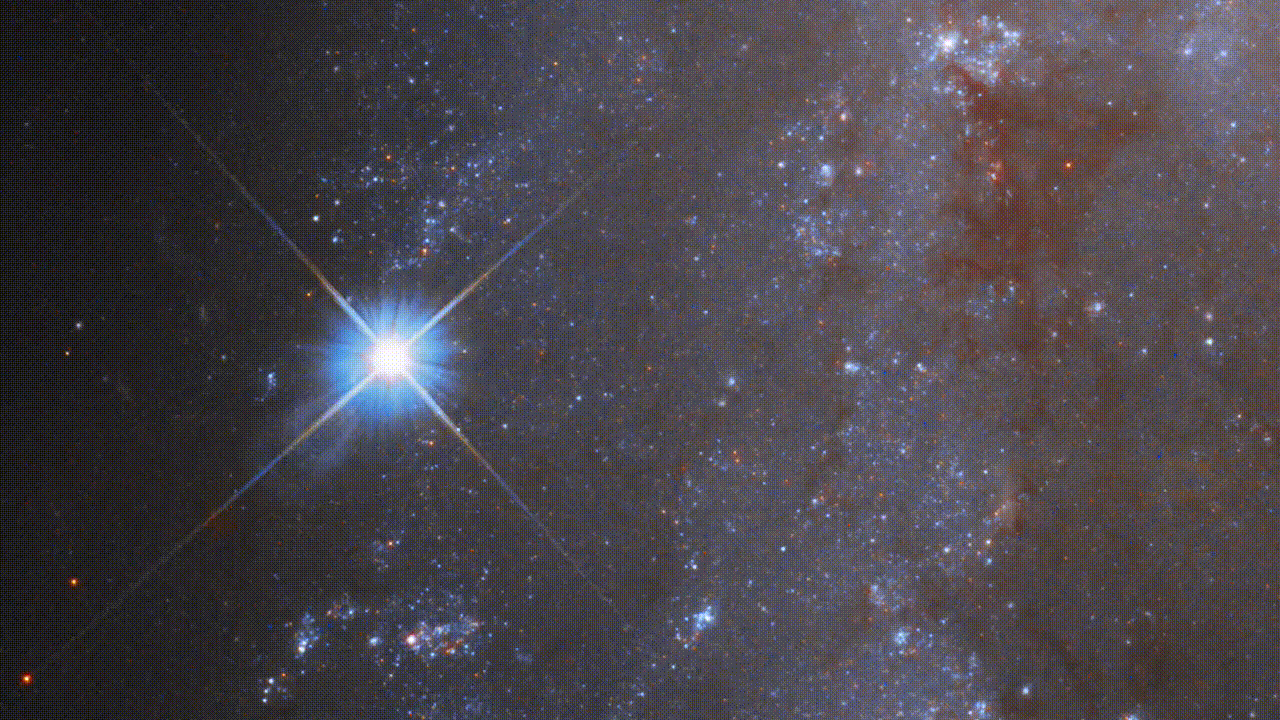
This is a timelapse of Hubble images from February 2018 to February 2019. Supernova SN 2018gv is situated in the galaxy NGC 2525, 70 million lyr (662,000,000,000,000,000,000 km) away.
Credit: NASA/ESA/M. Kornmesser/M. Zamani/A. Riess and the SH0ES team
https://science.nasa.gov/missions/hubble/hubble-watches-exploding-star-fade-into-oblivion/of
.
Paul Byrne
https://bsky.app/profile/theplanetaryguy.bsky.social/post/3mi3moxpvas2z
.
Barry McKernan
https://bsky.app/profile/bmckastro.bsky.social/post/3mi4snkpbdk2l
by Neaterntal
7 Comments
This video shows a unique time-lapse of supernova 2018gv in galaxy NGC 2525, compressing a nearly one-year duration into a few seconds. The supernova is captured by Hubble in exquisite detail within this galaxy in the lower left portion of the frame.
It appears as a very bright star located on the outer edge of the galaxy’s spiral arms. This new and unique time-lapse of Hubble images shows the once bright supernova initially outshining the brightest stars in the galaxy, before fading into obscurity during the telescope’s observations.
The light-curve graph to the right precisely plots the supernova’s fading. This time-lapse consists of observations taken from February 2018 to February 2019. NGC 2525 is located nearly 70 million light-years from Earth.
Credit
NASA, ESA, M. Kornmesser and M. Zamani (ESA/Hubble), and A. Riess (STScI/JHU) and the SH0ES team
https://science.nasa.gov/asset/hubble/time-lapse-of-fading-supernova-in-ngc-2525-annotated/
Incredible.
Awesome – thankful for the tech we have to view space nowadays
So when we look at those deep field images, are all of the really bright starbursts just stars that have gone supernova?
So does the entire solar system it resides in get obliterated or just irradiated?
Truly awe inspring. I would have preferred it if they didn’t do the “fade to black” though, because then you could see the spike start in the same star field as the gif loops
Where’s the *KABOOM*? There was supposed to be an earth-shattering *KABOOM*!