
A major milestone heralding Europe’s next-generation satellite navigation system, set to deliver enhanced positioning accuracy and integrity
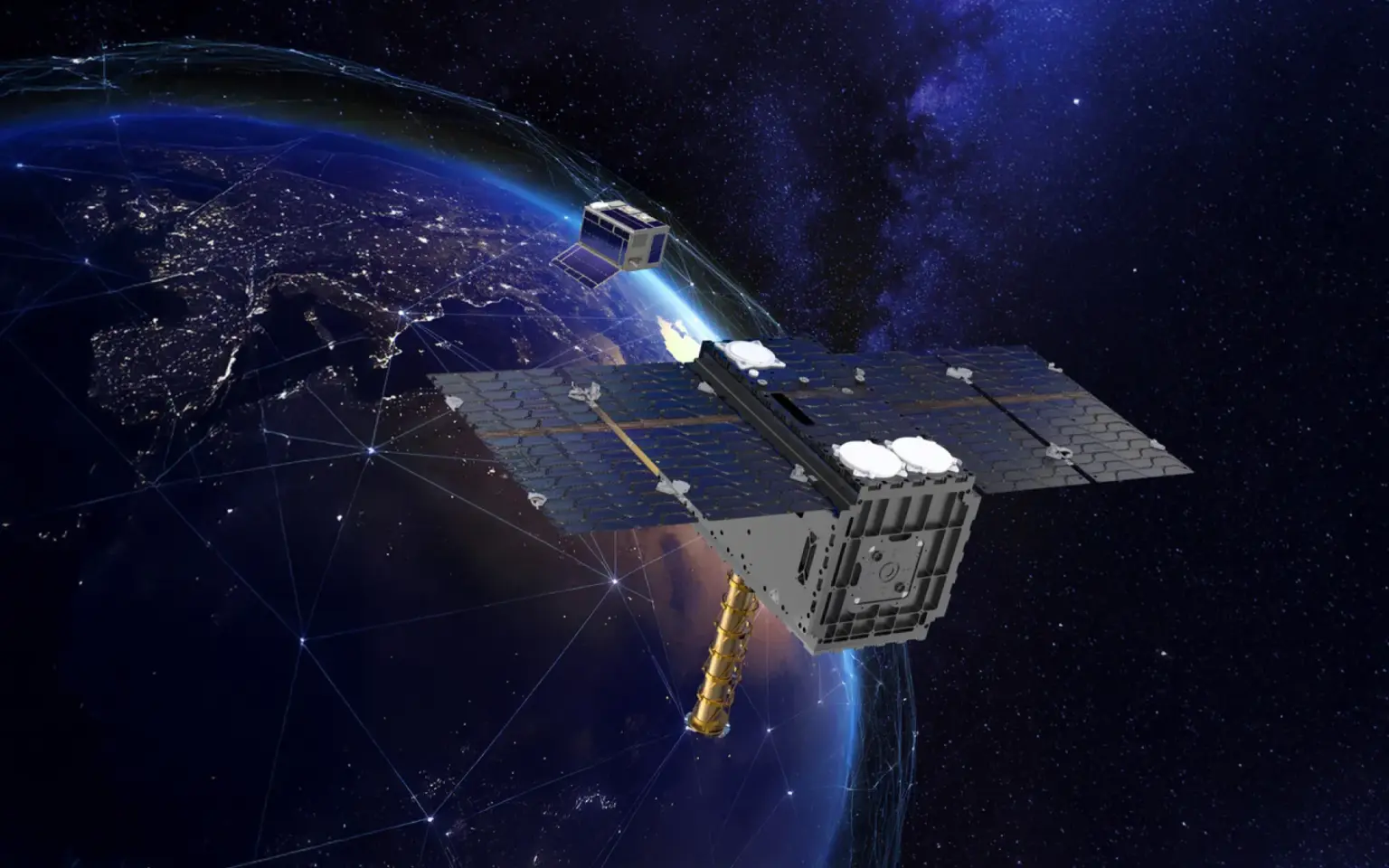
Māhia Peninsula, New Zealand, March 28, 2026 – Two satellites, part of the European Space Agency’s (ESA) Celeste in orbit demonstration mission, were launched at 10:14 CET today, atop a Rocket Lab Electron rocket from New Zealand. The two satellites separated from the launcher about an hour later. This marks the beginning of their early operations phase, during which mission control gets them ready for life in orbit. One of them, named IOD-2, was built by Thales Alenia Space, the joint venture between Thales (67%) and Leonardo (33%).
About the IOD-2 satellite
A CubeSat roughly the size of a suitcase and weighing around 30 kilograms, IOD-2 will play a key role in validating the system definition and enable early signal transmission, while derisking and demonstrating the core technologies for future Celeste satellites. The four other IOD satellites under development by Thales Alenia Space will be larger, with twice the mass of IOD-2. They will carry additional payloads to test innovative signals across multiple frequency bands and demonstrate new service capabilities. With additional launches from 2026 onwards to complete the Celeste demonstrator fleet, ESA will be able to assess how a LEO navigation layer can operate alongside Galileo and other MEO navigation systems.
© Thales Alenia Space
Serving a robust, resilient, and ultra-high-performance navigation system
ESA’s Celeste mission is currently in its in-orbit demonstration phase. This first phase will consist of a constellation of 11 microsatellites in low Earth orbit, built by two European prime contractors, including five satellites provided by Thales Alenia Space. The mission is intended to demonstrate how LEO-PNT (Low Earth Orbit Precise Navigation Timing) can enhance the resilience of current and future medium Earth orbit (MEO) navigation services and significantly improve their performance.
Celeste will demonstrate how a multi-orbit architecture could enable to provide centimeter-level positioning accuracy, enhanced robustness, stronger resistance to jamming and spoofing, and very low latency through ultrafast signal acquisition, ultimately in conjunction with Galileo and other satellite navigation systems.
The Celeste mission will pave the way for new applications, including highly autonomous vehicles by providing continuous coverage in dense urban areas, the Internet of Things (IoT), unmanned aerial and maritime systems (UAS/MUS), and new services in particularly demanding environments that can impair the performance of existing systems — such as urban canyons, dense foliage, polar regions and even indoor spaces — as well as synchronization of terrestrial 5G/6G telecommunications networks.
“I would like to thank the European Space Agency for its renewed confidence, as well as everyone who contributed to this launch, which marks a significant milestone in the history of satellite navigation in Europe,” said Hervé Derrey, President and CEO of Thales Alenia Space. “As demand for precise positioning continues to grow, space-based navigation systems such as Galileo need to be complemented by multifrequency satellites in low Earth orbit. ESA’s Celeste program represents a major advance, paving the way for next-generation applications requiring robustness and integrity, while also creating new opportunities in export markets.”
© Thales Alenia Space – M. Iacobucci
About Thales Alenia Space
Thales Alenia Space leverages a unique combination of skills, technological expertise, and industrial capabilities to deliver innovative solutions for telecommunications, navigation, Earth observation, defense, exploration, science, and orbital infrastructures— drawing on 50 years of proven experience. Institutions, governments, and private industry rely on Thales Alenia Space to design satellite-based systems that provide anytime, anywhere, connections and positioning, monitor our planet, enhance management of its resources, explore our Solar System, and unlock the mysteries of the Universe. Embodied by its Space for Life purpose, Thales Alenia Space sees space as a new horizon, helping build a better and more sustainable life on Earth, and beyond. A joint venture between Thales (67%) and Leonardo (33%), Thales Alenia Space also teams up with Telespazio to form the Space Alliance, which offers a complete range of solutions including services. Thales Alenia Space posted consolidated revenues of €2.36 billion in 2025 and has more than 8,000 employees in 7 countries with 14 sites in Europe. www.thalesaleniaspace.com