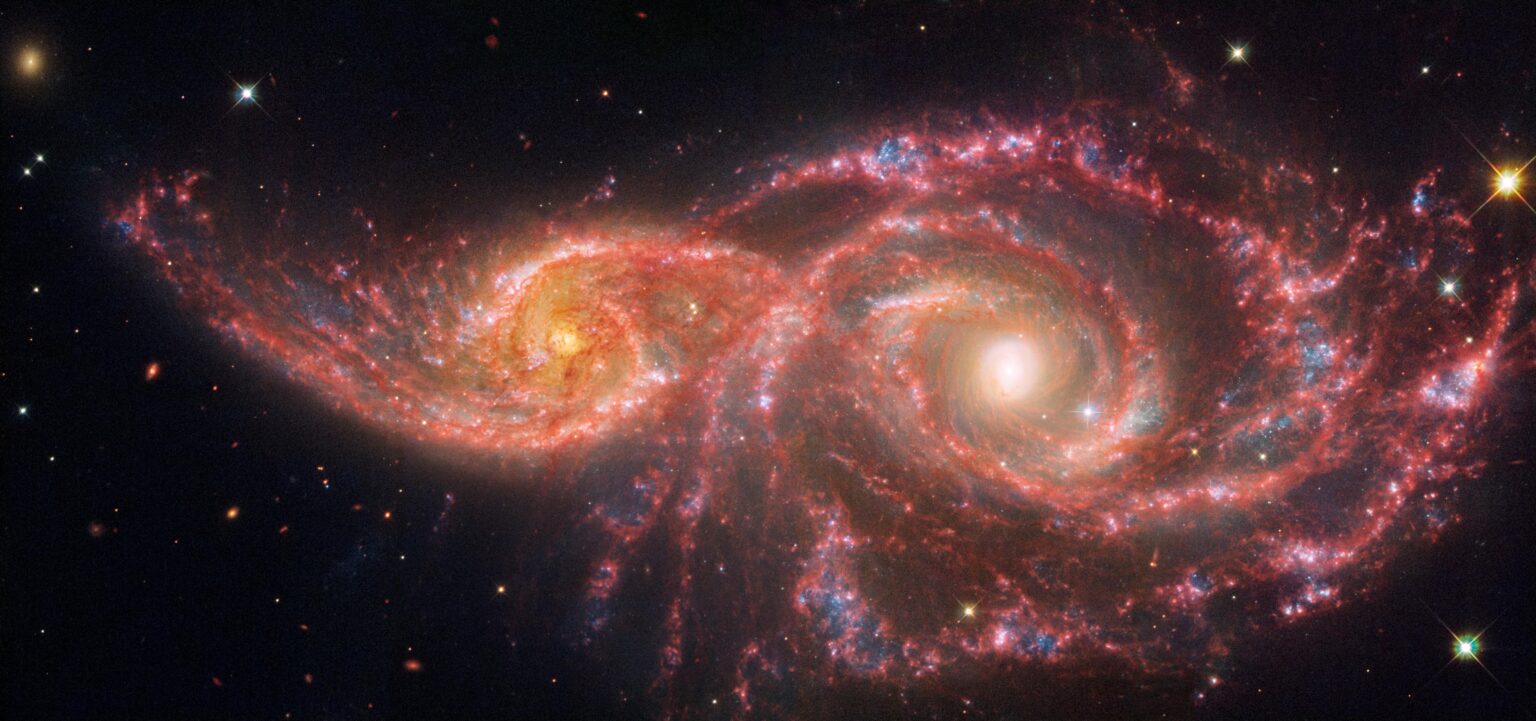
The gruesome palette of these galaxies is owed to a mix of mid-infrared light from the NASA/ESA/CSA James Webb Space Telescope, and visible and ultraviolet light from the NASA/ESA Hubble Space Telescope. The pair grazed one another millions of years ago. The smaller spiral on the left, catalogued as IC 2163, passed behind NGC 2207, the larger spiral galaxy at right.
Both have increased star formation rates. Combined, they are estimated to form the equivalent of two dozen new stars that are the size of the Sun annually. Our Milky Way galaxy forms the equivalent of two or three new Sun-like stars per year.
Both galaxies have hosted seven known supernovae, each of which may have cleared space in their arms, rearranging gas and dust that later cooled, and allowed many new stars to form. (Find these areas by looking for the bluest regions).
[*Image description*: Two spiral galaxies take up almost the entire view and appear to be overlapping. The galaxy at left, IC 2163, is smaller and more compact than the galaxy at right, NGC 2207. The black background of space is dotted with foreground stars and extremely distant galaxies.]
**Credit:** NASA, ESA, CSA, STScI
IXPhantomSeekerXI on
So I’m just an astrophysics fan boy never took a class on it but ik some spiral galaxies have a black hole in the center but not all spiral galaxies. My question is if you look at these pictures are there any indications that point to any of the two galaxies above to be black hole spiral galaxy? If so that’s insane watching two black hole galaxies collide

2 Comments
Image from this post, text from post below the link:
[https://esawebb.org/images/weic2426a/](https://esawebb.org/images/weic2426a/)
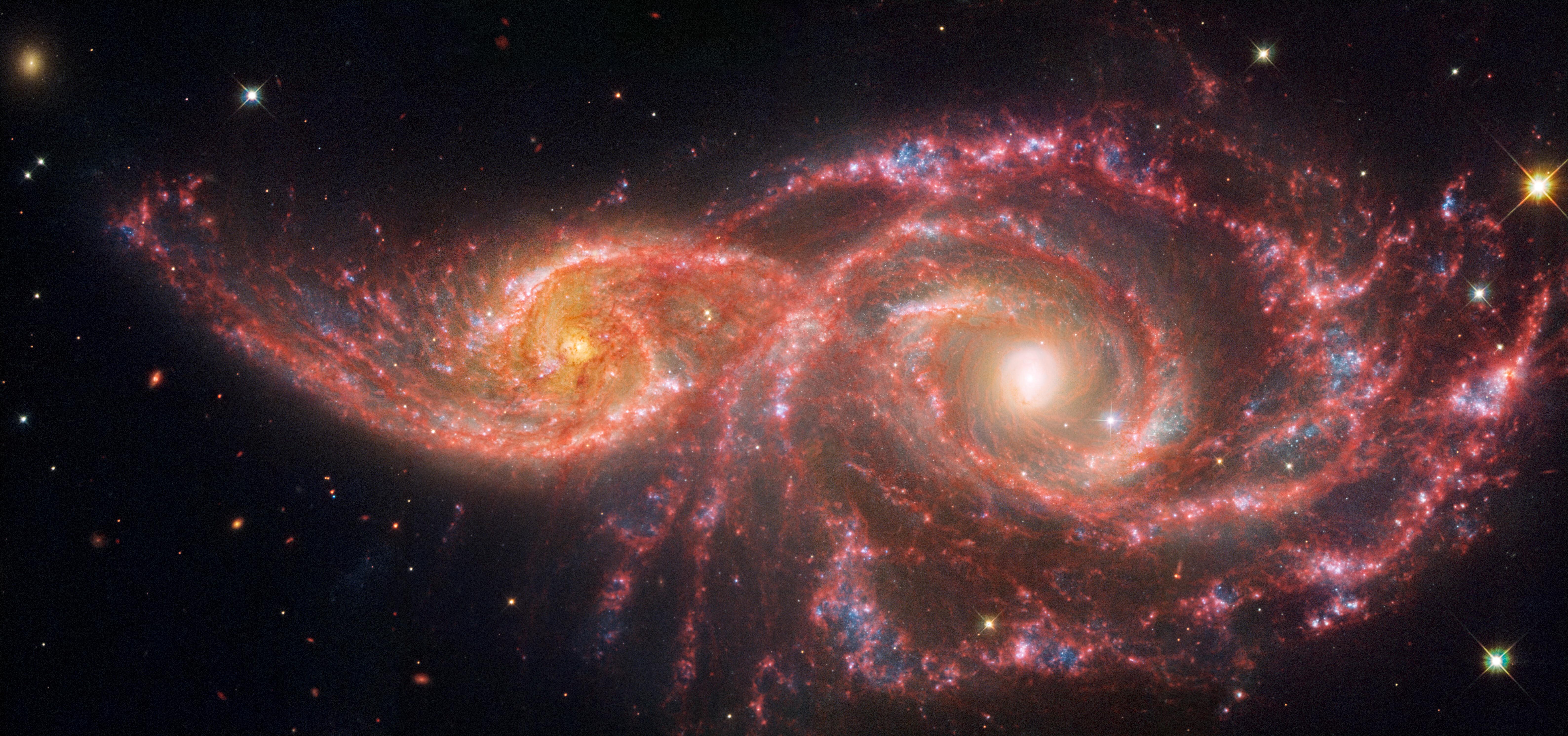
The gruesome palette of these galaxies is owed to a mix of mid-infrared light from the NASA/ESA/CSA James Webb Space Telescope, and visible and ultraviolet light from the NASA/ESA Hubble Space Telescope. The pair grazed one another millions of years ago. The smaller spiral on the left, catalogued as IC 2163, passed behind NGC 2207, the larger spiral galaxy at right.
Both have increased star formation rates. Combined, they are estimated to form the equivalent of two dozen new stars that are the size of the Sun annually. Our Milky Way galaxy forms the equivalent of two or three new Sun-like stars per year.
Both galaxies have hosted seven known supernovae, each of which may have cleared space in their arms, rearranging gas and dust that later cooled, and allowed many new stars to form. (Find these areas by looking for the bluest regions).
[*Image description*: Two spiral galaxies take up almost the entire view and appear to be overlapping. The galaxy at left, IC 2163, is smaller and more compact than the galaxy at right, NGC 2207. The black background of space is dotted with foreground stars and extremely distant galaxies.]
**Credit:** NASA, ESA, CSA, STScI
So I’m just an astrophysics fan boy never took a class on it but ik some spiral galaxies have a black hole in the center but not all spiral galaxies. My question is if you look at these pictures are there any indications that point to any of the two galaxies above to be black hole spiral galaxy? If so that’s insane watching two black hole galaxies collide