
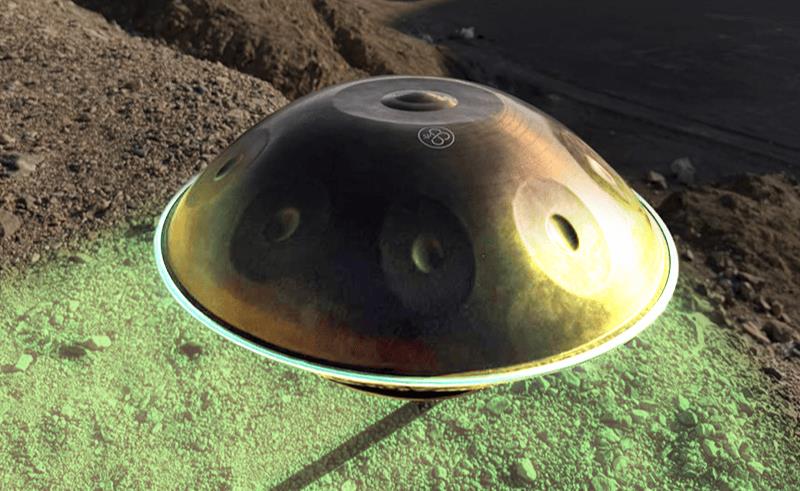
Main Body: What comes to mind if I were to ask you about a handpan? A kitchen utensil, perhaps? A handy pan? Nothing at all? If, like me, you chose the latter, that doesn’t mean this article isn’t for you: from what I have learned, the handpan is just as much a feeling as it is an instrument. The handpan—often compared to a spaceship—is a curved, hollow steel drum that, when played, generates soft, eerily captivating melodies that reverberate through the air. People listen to it to study, to meditate, to relax. Here in Egypt, it is still something of a mystery, and if anyone can get you excited about the elusive instrument, it’s two men named Mohamed.
Mohamed El Bolty and Mohamed Osama are best friends and founders of House of Panz, a well-being entity and Egypt’s only dedicated handpan provider. “We’ve always been interested in exploring music,” El Bolty tells CairoScene. One day, on a trip to Amsterdam, something caught his ear. “I saw a guy who was playing the handpan on the street. It was a really special sound to me.” Upon returning to Cairo, he told Osama, “We really should get a handpan.”
The pair searched Egypt high and low to source one for themselves, yet each time, their search came back empty. Eventually, they “found a guy who was selling a handpan for EGP 60,000”—all they could do was laugh. From that laughter, a business was born. Knowing “no one would ever trust two young guys”—they’re both 25—“selling a product that no one else sells,” the two flew to Dubai, where a market already existed. When they returned to Cairo, they did so as official agents of Handpan Dubai, bringing the instrument to a new market in Egypt.
As a startup, the duo faced challenges marketing an instrument largely unknown to the country. “At first,” El Bolty says, “we had a jamming session to introduce people to the handpan in Al Zohriya Park. Only like ten people came.” By the third session, however, “we were at over 150 people. It was like a circus.” After these initial gatherings, El Bolty and Osama began offering workshops, allowing people to experience the instrument for themselves. Only after they quietly assembled this community did sales begin to pick up.
This organic, intimate business model lies at the core of their work. They are not only selling handpans—they are selling a feeling. When I asked him what this feeling was, El Bolty paused. “It’s like, you know, when you put your noise-cancelling AirPods on—the handpan feels like noise cancellation. You take a break from everything around you—the chaos of the city and everything else.” On the bustling streets of Cairo, where the soundscape is dominated by the pulses of traffic and the familiar hum of music booming from passing cars, the handpan offers a much-needed respite: softer, slower, almost otherworldly.
Speaking to El Bolty, I began to feel as though there was a whole world unbeknownst to me; a world unseen by most of us mere mortals. In this world, calming frequencies transport you into a zen, meditative state. This is the world of the handpan. While the instrument itself is relatively new, created in Switzerland in 2000, “the sound is ancient,” El Bolty says. Drawing on older instruments, such as Caribbean steel drums and the Indian ghatam, what makes the handpan special “isn’t the music itself—it’s the frequency of the sound it produces.”
This frequency—432 hertz, El Bolty explains—“puts you in a meditative or calming state.” In this sense, it does have transportive powers—almost living up to the science fiction emblem it resembles. El Bolty and Osama lean into this idea frequently on their Instagram, playing on its otherworldly sound and striking form.
Its entrancing capabilities make it a natural fit for yoga and meditation—now a core part of many House of Panz workshops. A typical workshop takes place over three days, with small groups of four to five people guided by Osama and other professional players. Most of the attendees have never touched a handpan before, so the “workshops are mostly people who are just into trying something new,” El Bolty says. “And yogis—a lot of yogis,” he adds, laughing.
Their most recent retreat took place in Nuweiba, where yogis, musicians, non-musicians, and budding handpan enthusiasts met at the coastal village to disconnect from the city and reconnect through sound. Here, guests did yoga, participated in guided meditation, all amidst the peaceful lull of the handpan: “Every yoga class was related to the handpan, every meditation was blended with it—it’s really all about the handpan.”
In this way, the instrument becomes a tool for community building. “We gained this trust by building a community,” El Bolty says. Within it, “not everyone plays the handpan, but everyone is interested in it”—and the world it creates. Despite its unfamiliarity in Egypt, El Bolty insists the adoption has been surprisingly natural. “Its sound is so meditative, every note makes you feel good. In this way, it’s not like a piano or guitar where you need to practice a lot,” it’s intuitive.
“To me, this is not a business. Everything we do, every move, has meaning.” This sentiment vibrates through House of Panz and the energy they emit. At its core, it is a project born from a shared love of music between two best friends. “It’s been a roller coaster,” El Bolty admits. But when it comes to his partnership with Osama, “it led to a deeper connection. We’ve been friends for eight years, we’ve gone through a lot, so we already had a solid base.”
This is not the pair’s first rodeo when it comes to entrepreneurship. In university, they “started a clothing brand, and we lost everything,” El Bolty laughs. But now, in their second attempt, the love is still there, and their determination is stronger than ever. “Sometimes, we fight like any other best friends, but at the end of the day, we understand each other, and we have the same vision.”
Looking ahead, the ambition is to grow, but not hastily. El Bolty and Osama dream of a larger, more permanent space, “maybe on a farm somewhere, inshallah.” On this farm, El Bolty imagines a sanctuary to host “more handpan workshops and well-being festivals.” For now, though, they are happy with their pace: “we are taking it one step at a time,” he says. “We don’t want to make any wrong moves.”