
Enabling & Support
27/03/2026
6 views
0 likes
In brief
Phase C has officially begun for Lunar Meteoroid Impacts Observer (Lumio), ESA’s pioneering CubeSat technology demonstration mission dedicated to monitoring meteoroid flashes on the far side of the Moon. Led by Politecnico di Milano and supported by a European industrial consortium, Lumio is entering the detailed design and implementation phase that will advance the mission toward flight readiness and a potential launch in 2028.
In-depth
The mission will operate in a halo orbit around the Earth–Moon L2 point (second Lagrange point) – a location 40,000 to 80,000 kilometres behind the Moon and opposite Earth, where gravitational forces and centrifugal forces balance – providing continuous visibility of the lunar far side that is otherwise invisible from Earth, thus allowing observations of meteoroid impacts when the far side is in partial or full darkness and hence improving our understanding of the meteoroid environment between Earth and the Moon. It will play a contributing role in improving hazard assessments for future lunar infrastructure and exploration.
Lumio’s leap forward
The Lumio mission reached a major milestone this month as ESA and Politecnico di Milano, the mission’s prime contractor, kicked off Phase C, marking the start of detailed implementation. Lumio is part of ESA’s General Support Technology Programme (GSTP) Fly Element and is primarily funded by the Italian Space Agency (ASI), with support from UKSA (United Kingdom), NOSA (Norway) and SNSA (Sweden).
With the successful completion of earlier development milestones, the mission now moves into the phase where the spacecraft’s subsystems, payload, propulsion, navigation and ground-segment elements will be engineered to full detail ahead of the Critical Design Review scheduled for 2027.
What will LUMIO do?
Every day, meteoroids strike the Earth–Moon system. While Earth is protected by its atmosphere, the Moon’s surface directly records these impacts, generating light flashes, seismic waves and new craters. Observations of these events are essential to understanding the flow of natural space debris in the volume of space between Earth and the Moon that must be well characterised as humanity prepares for long-term lunar presence.
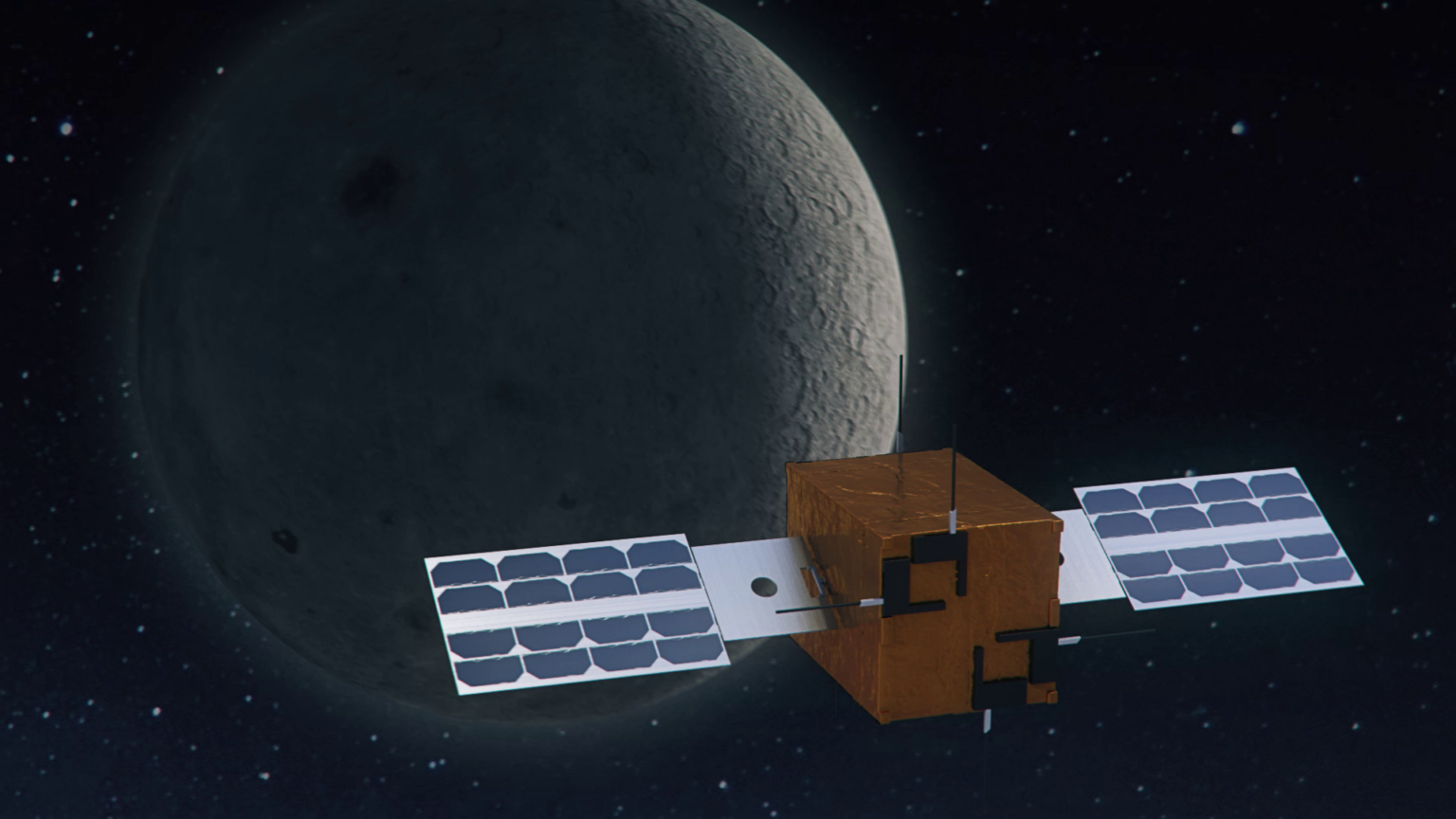
Lumio is designed to fill a crucial observational gap. Whilst Earth-based systems can monitor only the near side of the Moon, Lumio will continuously observe the far side, which is permanently hidden from view of Earth. The mission’s 12U CubeSat, weighing about 30 kilograms, will be injected into a halo orbit around the Earth–Moon L2, a quasi-stable vantage point ideal for uninterrupted monitoring of the lunar surface.
Using its high-sensitivity optical payload, Lumio will detect the brief flashes created when meteoroids strike the darkened lunar far side during the Moon’s 14-day-night. These measurements will be combined with Earth-based observations to improve models of the meteoroid environment and support risk modelling for future spacecraft, surface habitats and lunar infrastructure.
What’s next in Phase C?
Phase C focuses on transforming design concepts into integrated, tested hardware and software. During this stage:
The CubeSat’s platform and avionics detailed design will be finalised, and flatsat test bench will be integrated to verify functionality and electrical/software interfaces.
The LumioCam payload detailed design will be finalised, and an engineering model will be built to perform functional & performance verification.
Flight dynamics and autonomous navigation algorithms will be matured.
The propulsion system, supporting deep-space manoeuvres, will have its detailed design finalised and an engineering model will be built, integrated and tested.
A s model representation of the complete spacecraft will be built, assembled and tested to qualify the structural and thermal subsystems.
Ground-segment design and operational concepts will be consolidated.
These activities lead to the Critical Design Review (CDR), the major decision point before manufacturing the spacecraft’s flight model.
What’s on board?
Lumio’s success relies on a suite of advanced European miniaturised technologies developed across academia and industry. The mission’s consortium includes:
Argotec (Italy) – CubeSat platform design, integration and testing
Leonardo (Italy) – Developer of LumioCam, a visible–nearinfrared optical instrument designed to capture highframerate impact flashes
IMT (Italy) – X-band deep-space transponder and deployable solar arrays
S&T Norway – Onboard payload data processing and implementation of scientific algorithms
Lift Me Off (UK) – Miniaturised chemical propulsion and reaction control system
ECAPS (Sweden) – Dedicated high-performance main thruster
Leveraging these capabilities, Lumio will perform significant deep-space operations to transfer from launch insertion to the Earth-Moon L2 halo orbit, autonomous navigation around L2, and high-efficiency data handling, all within the constraints of a 12U CubeSat.
Why LUMIO matters
By extending meteoroid monitoring to the lunar far side, Lumio will enhance our ability to model impact frequency, size distribution and temporal variations. This improved understanding is essential to:
protecting future lunar surface infrastructure
assessing the risk for cislunar spacecraft
informing hazard mitigation strategies for long-duration exploration
enabling long-term human presence in deep space
Beyond scientific contribution, the mission also represents a step forward in Europe’s capability to deploy small, intelligent, autonomous spacecraft for lunar and deep-space missions at low cost, thereby demonstrating technologies that will help shape future exploration architectures.
Like