
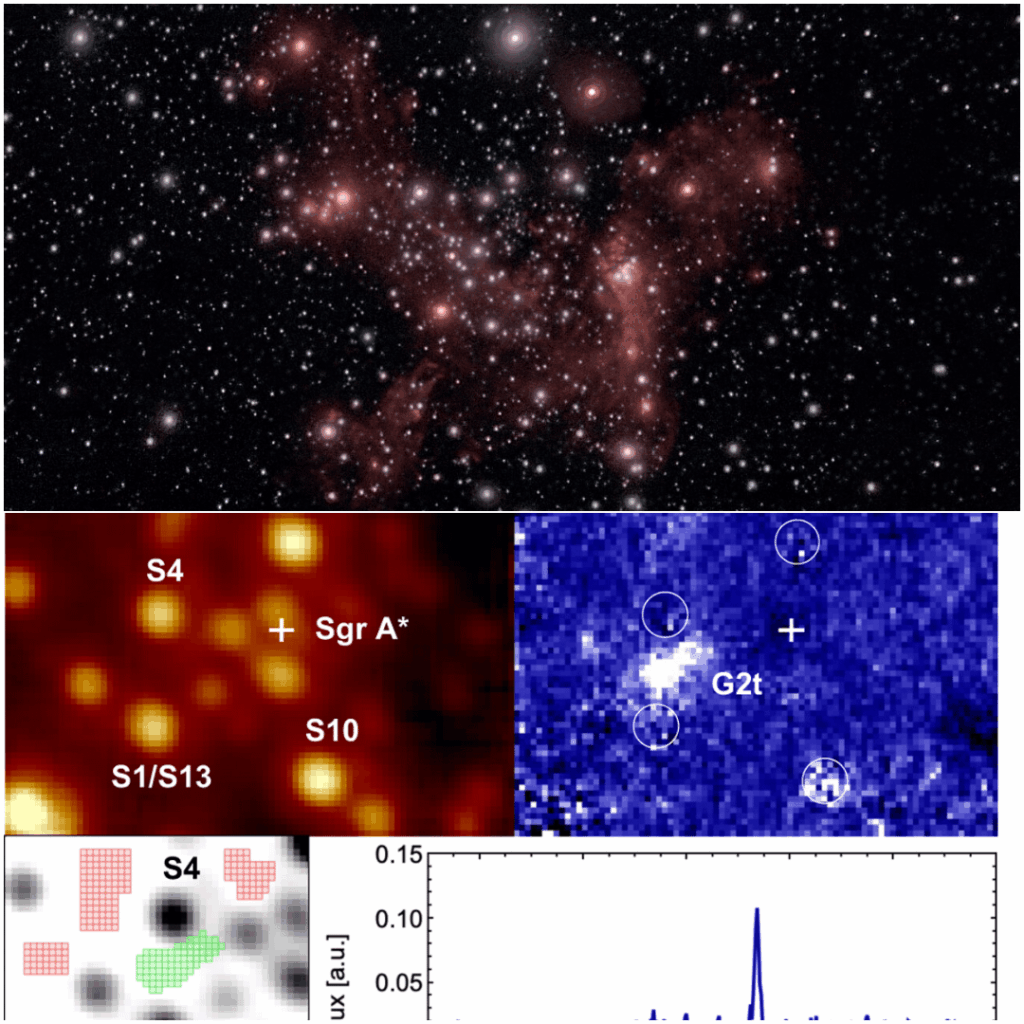
Upper image
This stunning snapshot, taken with ESO’s Very Large Telescope (VLT), reveals the stars and gas surrounding an invisible giant — a supermassive black hole, located some 27 000 light-years away. This is a hugely dynamic environment, with stars and gas clouds hurtling by the black hole at dramatic speeds.
Credit: ESO/D. Ribeiro for the MPE GC team
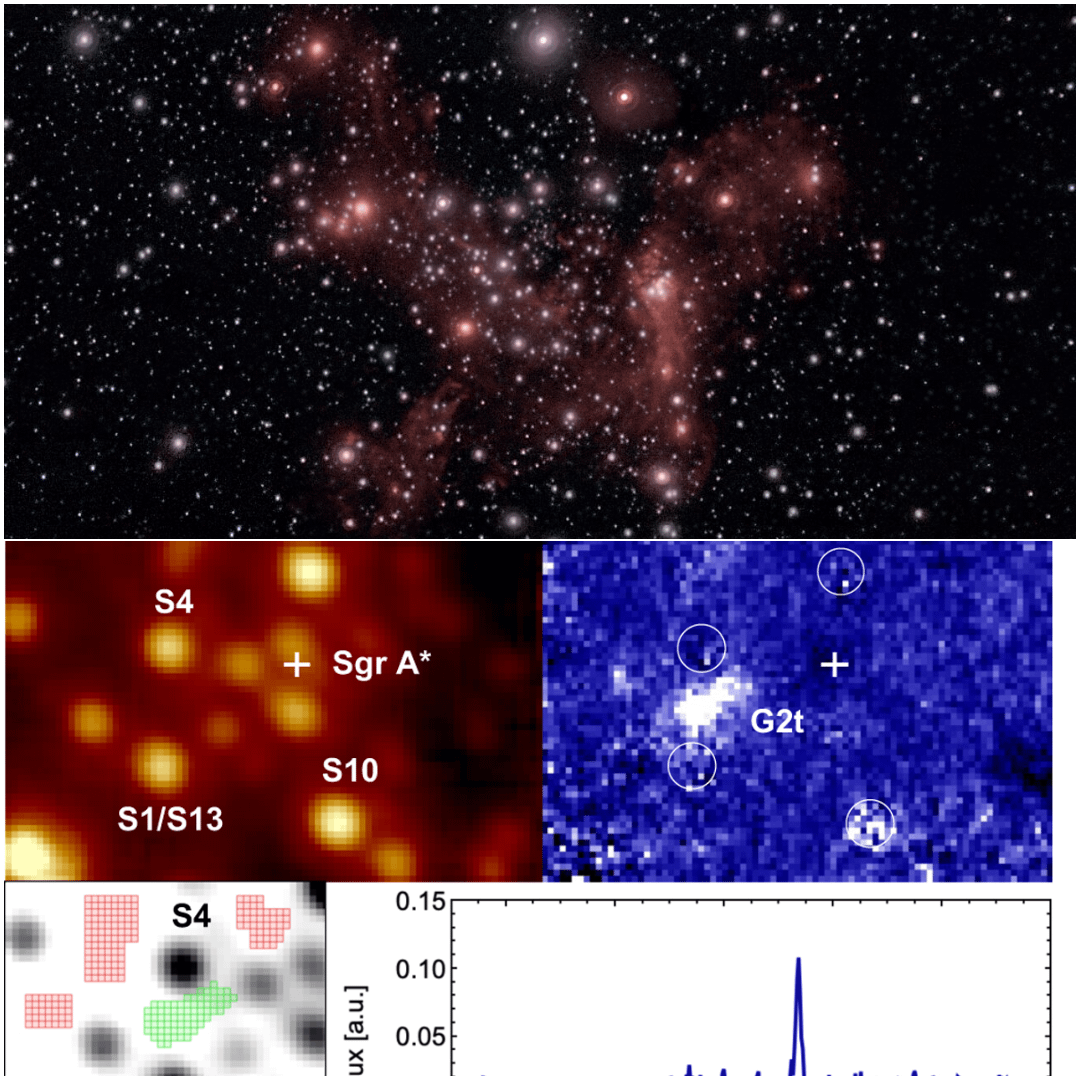
Bottom image
G2t in the ERIS integral-field data from June/July 2024. Top left: continuum image showing the S-stars. Top right: Background-subtracted line map centered at 2.173 µm, corresponding to Brackett-γ + 1000 km/s. G2t stands out. Bottom left: example of a pixel selection (on – green, off – red) for extracting the G2t spectrum overlaid on the continuum map. Bottom right: Resulting spectrum showing a strong emission line at 2.173 µm.
.
A new view on the heart of our Milky Way is presented in today's Picture of the Week. This stunning snapshot, taken with ESO’s Very Large Telescope (VLT), reveals the stars and gas surrounding an invisible giant — a supermassive black hole, located some 27 000 light-years away. This is a hugely dynamic environment, with stars and gas clouds hurtling by the black hole at dramatic speeds.
A team of astronomers at the Max Planck Institute for Extraterrestrial Physics in Germany has detected a new gas cloud, named G2t, orbiting the supermassive black hole. Two gas clouds, G1 and G2, were already known, but their nature and origin were still being debated. In particular, it was unclear whether these clouds were hiding a star inside or consisted purely of gas. However, the discovery of a third gas cloud now helps answer these questions.
Paper
https://www.aanda.org/component/article?access=doi&doi=10.1051/0004-6361/202555808
More
https://www.eso.org/public/images/potw2610a/
.
https://bsky.app/profile/drnereide.bsky.social/post/3mhts52zsok2o
by Neaterntal