
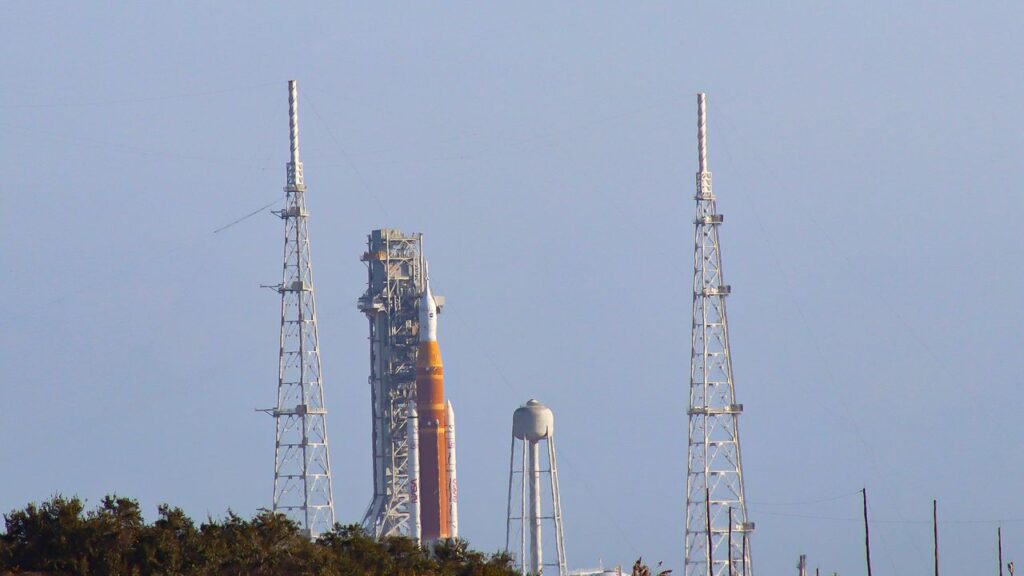
KENNEDY SPACE CENTER — On Wednesday evening, the four members of NASA’s Artemis II mission will prepare for a flyby of the moon. It will be the first time in more than 50 years that humans have visited Earth’s sister.
What You Need To Know
Artemis II to return humans to the moon in a flyby mission
The launch is currently set for Wednesday, April 01
The two-hour launch window opens at 6:24 p.m. ET
🔻Scroll down to see the Artemis II mission breakdown🔻
🔻Scroll down to meet the Artemis II crew🔻
 
NASA Cmdr. Reid Wiseman, pilot Victor Glover, mission specialist Christina Koch and Canadian Space Agency mission specialist Jeremy Hansen will climb into the Orion capsule, which sits on top of the Space Launch System rocket, and leave Earth from Launch Pad 39B at NASA’s Kennedy Space Center.
The two-hour launch window opens at 6:24 p.m. ET.
The Space Launch System rocket is massive. It is a 322-foot (98.27-meter) tall super-heavy rocket that is 17 feet (5.18 meters) taller than the Statue of Liberty.
For all of you space lovers out there, this graphic puts its height in perspective.
 
Spectrum News meteorologist Zach Covey on Friday afternoon gave an early forecast for the first launch attempt.
“Weather for the first attempt of Artemis II on Wednesday, April 1, looks to be as good as it gets. We’ll be watching for some cumulus clouds during the afternoon, and potentially the thick cloud rule being violated late evening, but no rain is expected as winds remain well below liftoff constraints,” Covey said.
“Weather begins to change late week into the weekend as a frontal system from up north will approach the region. Rain chances will begin to increase everyday starting Thursday. It’s too soon to say if rain, wind, or cloud cover could become a launch issue, but we’ll stay on top of it,” he added.
 
The 322-foot (98.27-meter) tall moon rocket will take the quartet on a 10-day mission to fly by our planet’s lunar neighbor.
The four will be the first humans to visit the moon since the 1972 Apollo 17 mission, which was the last time humans stepped foot on the lunar satellite.
Mission Specs:
Space Launch System rocket: 322 feet tall
Orion: 10 feet, 11 inches tall and 16.5 feet in diameter
Mission Duration: 10 days
Distance from lunar surface: 4,000 to 6,000 miles
Orion’s speed once it returns to Earth: 25,000 mph
Temps on Orion’s heat shield: 3,000 degrees Fahrenheit
For the 10-day Artemis II mission, the quartet will only do a flyby of the moon, rather than an orbit.
But it will make Glover the first person of color and Koch the first woman to visit the moon. And Hansen will be the first Canadian to visit the lunar satellite. In fact, it is his first time being in space.
On day six of the mission, the four will set a record as the first humans to travel farther than anyone has from Earth. But that distance has not happened yet.
The current record was set by the Apollo 13 mission in 1970 with a distance of 248,655 miles (from 400,171 kilometers) from Earth.
During the little trip, the crew will be closest to the moon when they travel to its far side, which is sometimes called the dark side of the moon.
Depending on when Artemis II launches, the crew could be between 4,000 to 6,000 miles (6,437 to 9,656 kilometers) from the moon’s surface.
NASA described the crew’s view as, “The Artemis II crew will travel approximately 4,600 miles beyond the far side of the moon. They will see the Earth and the moon from Orion’s windows, with the moon close in the foreground and the Earth nearly 250,000 miles in the background. From the crew’s location, the moon will look about the size of a basketball held at arm’s length.”
And according to NASA, during this time period, the crew will lose communication with Earth between 30 to 50 minutes.
 
The U.S. has attempted to return to the moon a number of times, like the Constellation program.
In 2004, then-President George W. Bush wanted NASA to develop a plan to return humans to the moon once the International Space Station was completely finished and the retirement of the space shuttle in 2010.
However, a few years later, then-President Barack Obama cancelled the Constellation program due to it being over budget and behind schedule.
The Space Launch System rocket was announced back in 2011, with the goal of returning humans to the moon.
During his first term, President Donald Trump pushed for humans to return to the moon, with the name Artemis chosen for the new program.
Originally called Exploration Mission-2, the Artemis II mission was expected to launch in 2019, but it was pushed back to 2021.
Artemis II was scheduled for launch in November 2024 and then in September 2025, but it was pushed back due to concerns about the heat shield from the uncrewed Artemis I launch in 2022.
The main contractors for the SLS are:
Boeing: The core stage
Northrop Grumman: Space Launch System twin rocket boosters
Aerojet Rocketdyne: The four RS-25 engines
The main contractors for the Orion capsule:
Lockheed Martin
European Space Agency
During that test flight mission, the Orion capsule’s heat shield performed in different ways and was shedding in ways that were not expected during its re-entry back to Earth.
A material called Avcoat that was on the heat shield broke off in lumps during the re-entry phase of Artemis I.
The Avcoat material is designed to protect a spacecraft from extreme temperatures by burning away as it heats up, instead of sending that heat to the capsule itself.
However, during re-entry, it broke into chunks instead of burning away, stated NASA officials.
NASA stated that its experts from various fields determined the root cause of the failure of the heat shield and have come up with a new method to create a better one.
The Artemis II was supposed to launch earlier in 2026, but two liquid hydrogen leaks and a helium flow issue pushed it back.
Check out the timeline to learn more.