
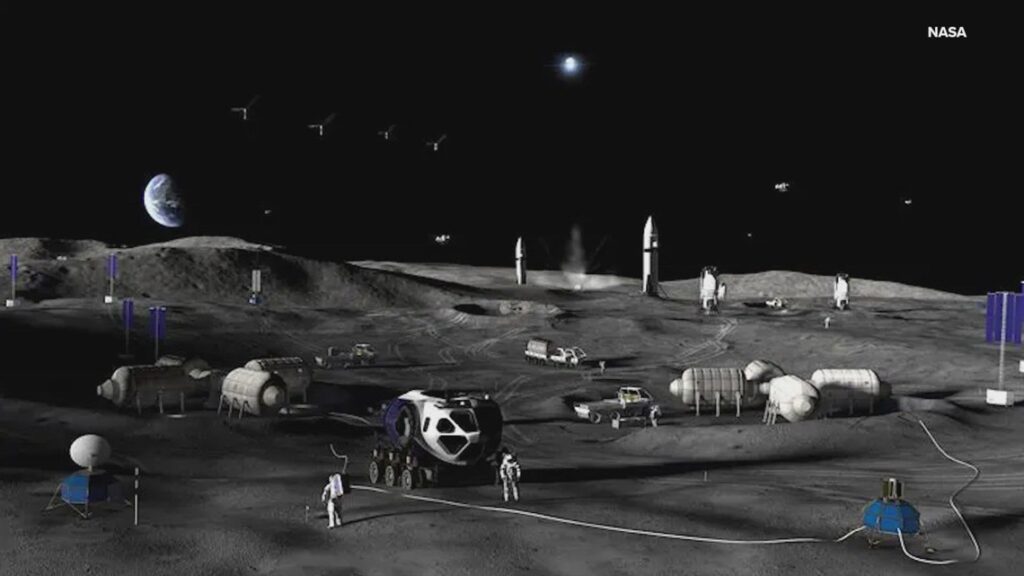
Engineers at NASA’s Glenn Research Center in Cleveland are working on developing technology to create rocket fuel out of ice found on the moon and Mars.
BROOK PARK, Ohio — NASA has plans to build a $20 billion sustainable base on the moon’s surface by 2028. Some of that work is already underway in Cleveland, where engineers at NASA’s Glenn Research Center are developing technology that could one day serve as a kind of gas station on the lunar surface. Because to return to the moon and stay, NASA will need to produce rocket fuel on the lunar surface using resources already there. Cryogenic Fluid In-Situ Liquefaction for Landers or CryoFill could be the answer for the moon and Mars.
“As we build up a lunar base around the South Pole, we’ll need to refuel our landers,” explained CryoFILL lead engineer Wesley Johnson. “And that’s where the CryoFill technology will come in.”
The process starts with mining lunar ice, melting it, and separating the water into hydrogen and oxygen. Those gases are then cooled into liquid fuel.
“You use a device like CryoFill that has a cryocooler, which is capable of cooling down the gas to the point where it can condense into a liquid,” said Evan Racine, the CryoFILL project manager. “By condensing it and filling the tank you’re providing your lander with both the fuel and oxidizer that it would need to run its engines.”
This future “gas station” is being tested at NASA Glenn using a vacuum chamber simulating moon conditions and a cryocooler.
“This (cryocooler) is just like a refrigerator that you might have in your house, but it’s a little bit colder. It runs at -300°F,” said Johnson.
CryoFill aims to solve a fundamental challenge in spaceflight, the heavier the spacecraft, the more fuel it needs, and more fuel adds even more weight.
“So CryoFill kind of breaks that feedback loop, by essentially building a gas station for the lunar surface,” said Racine.
With fuel made on the moon, landers could be significantly lighter.
“By producing, the fuel on the moon, you reduce the mass of your lander by 55%,” said Racine.
The hardest part for engineers, the system must work reliably every time and operate remotely from Earth.
You have to take care of all maintenance issues or preventative maintenance, because you can’t just send astronauts to maintain the hardware,” said Johnson.
The power needed to produce the fuel for this lunar gas station will come from a nuclear reactor, which NASA Glenn is also working on.