
Sign up to see the future, today
Can’t-miss innovations from the bleeding edge of science and tech
NASA’s InSight Mars lander made an unusual discovery while probing the Red Planet’s surface for seismic activity.
After poring over years of data from the spacecraft, and comparing it to measurements taken by NASA’s Viking landers from the 1970s, scientists found that Mars is spinning slightly faster with each passing year, shortening the length of a Martian day by fractions of a millisecond.
Now, as detailed in a study published last month in the Journal of Geophysical Research: Planets, a team of scientists from Delft University in the Netherlands says they’ve come up with an explanation for the acceleration.
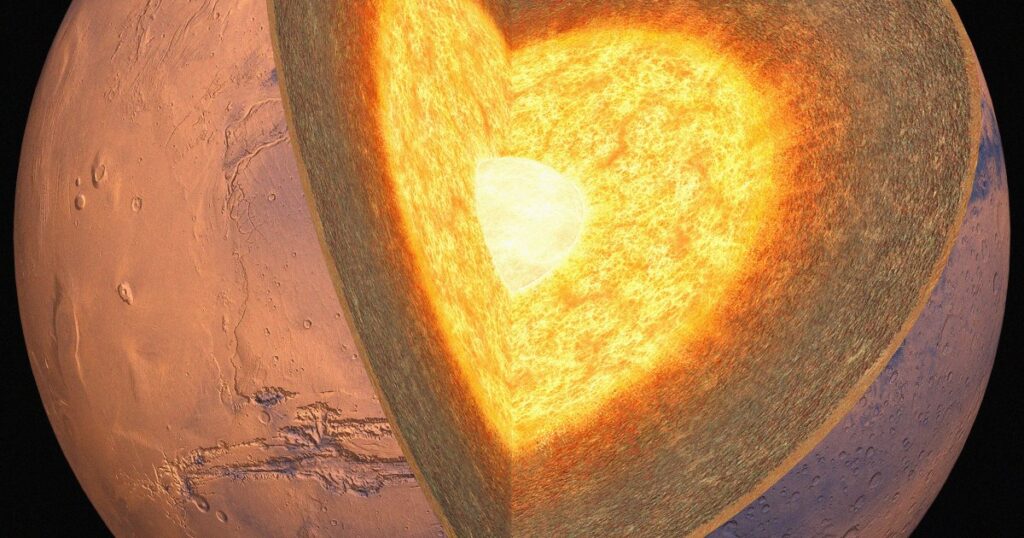
They say an intriguing “negative mass anomaly” buried deep under the planet’s surface could be causing it to spin faster — a massive plume of “hot buoyant mantle material,” the movement of which could be driving the Red Planet’s rotation.
“The Martian surface is so old and shows all these complex but largely not well understood process[es], which I think we can start to unravel by combining interior with surface,” first author and Delft University of Technology assistant professor of planetary exploration Bart Root told Live Science. “Understanding Mars will help in understanding our solar system, as its history is laid out on the red soil.”
Root and his colleagues tried to explain why one side of Mars is covered in a sprawling region of volcanic activity, called the Tharsis volcanic province. The plateau is located near the equator in the planet’s western hemisphere and is home to the largest volcanoes — long dormant — in the entire solar system.
The researchers have been examining InSight data to study these volcanoes and figure out how they formed. According to their computer simulations, a plume of unusually buoyant material could be buried beneath the Tharsis region, forcing new material to float upwards and form new volcanoes over time.
“The negative or light mass anomaly will move upwards and hit the lithosphere of Mars, introducing melt pockets that have the potential to penetrate the crust and erupt as volcanoes,” Root told Live Science. The lithosphere is a thick, 310-mile layer of rigid material.
The researcher also suggested that this movement could be related to Mars’ rotation speeding up over time.
“With some simple back-on-the-envelope calculations, we can explain the order of magnitude of the observed speed up,” Root added. “Of course more complicated modeling will be needed to actually link this better.”
Put simply, if less dense material is pushed out near the planet’s equator and replaced by more dense material, the planet could be speeding up, not unlike an ice skater pulling in their arms during a pirouette.
“A negative mass flowing upwards means something heavier needs to go down, and because the mass anomaly is located on the equator of Mars, this means the heavier mass is going closer to [the] rotation axis, hence a speed up,” Root told Live Science.
The findings suggest the Red Planet’s interior could still be far more active than previously thought, with remaining stores of energy allowing for the movement of major plumes hundreds of miles below the surface.
But plenty of questions remain, which could only be answered through more in-situ experiments. In their paper, the researchers argue that the “time is ripe for a dedicated gravity mission to Mars.”
More on Mars: Scientists Find Evidence of Ancient Tropical Oasis on Mars