
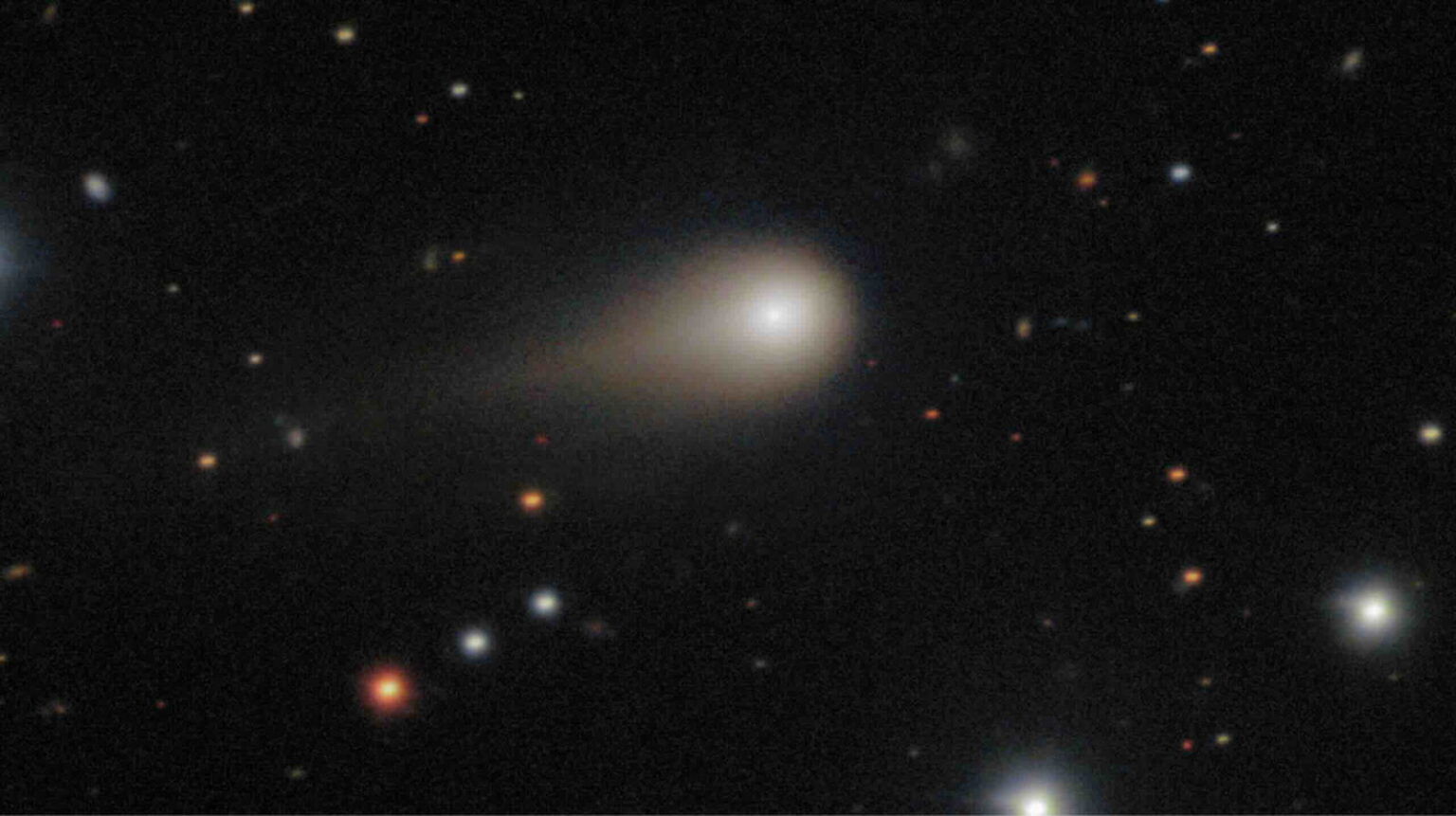
New observations of the interstellar comet 3I/ATLAS by NASA’s James Webb Space Telescope have revealed an all-new twist to the ongoing story of this cosmic curiosity.
Based on the latest data, detailed in a new paper on March 24, 2026, spectroscopic data obtained by Webb has identified what researchers call an unusually high concentration of deuterium in the molecules being released from the mysterious interstellar object.
The discovery adds the newest layer of mystery to the unusual comet, observations of which are now challenging astronomers’ expectations about how such isotopes make their way throughout the cosmos.
Heavy Hydrogen
The most abundant element in the universe, hydrogen normally occurs as a single proton-electron pair. However, its heavier isotope variant—deuterium, or sometimes also called “heavy hydrogen”—adds another neutron into the mix.
Largely formed during the first moments following the Big Bang, deuterium is relatively rare in our universe, at around one atom of “heavy hydrogen” for every 40,000 or so normal hydrogen atoms. Astronomers recognize this same essential ratio from astronomical observations of relatively nearby features like the Sun, as well as planet Jupiter.
However, here on Earth, deuterium is a bit more common, especially in seawater, where it can be found in around one in every 6,500 hydrogen atoms. Because of this, the isotope is commonly associated with nuclear fuel, since physicists recognize deuterium as a potentially abundant fuel source for future nuclear fusion operations.
3I/ATLAS is Producing Large Amounts of Deuterium
The recent findings based on the latest Webb spectroscopic data reveal, according to the study’s authors, an “unexpectedly high” level of enrichment in methane, which they say represents “an exceedingly rare detection of deuterated organic molecules in an interstellar object.”
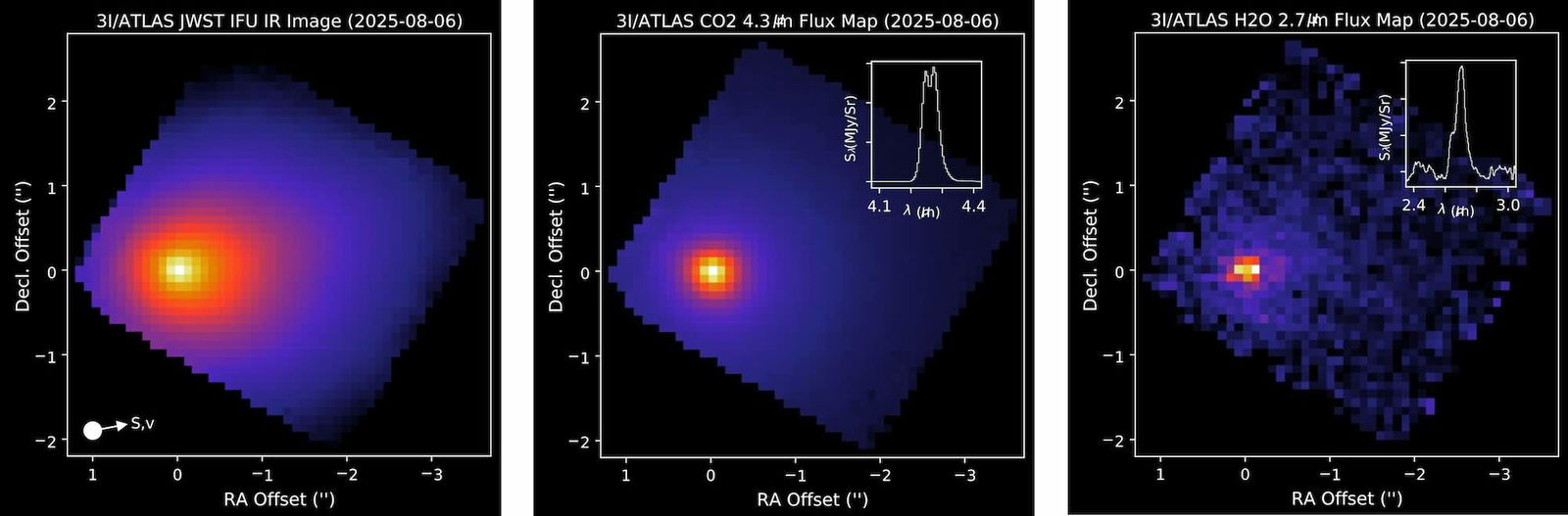 NASA images revealing 3I/ATLAS, as observed by the James Webb Space Telescope on August 6, 2025 (Image Credit: NASA/James Webb Space Telescope)
This isn’t the first time deuterium detections from 3I/ATLAS have been made, however. In an earlier study also published this month, a deuterium-to-hydrogen (D/H) ratio of nearly 1% in water—more than an order of magnitude higher than what is seen in known comets, was identified. The new study builds on those values significantly, indicating deuterium levels emanating from 3I/ATLAS that appear to significantly surpass values observed anywhere in the Solar System.
A Comet with Cold Origins
One thing the new Webb findings could indicate is that 3I/ATLAS likely hailed from a very cold environment at some point in its very distant past.
One of the best candidates might be a protoplanetary disk, where, billions of years ago, at the time of its formation, the comet was likely formed under conditions where temperatures dropped to well below 30 degrees Kelvin.

“The high D/H ratios of water and methane in 3I/ATLAS are a natural consequence of formation in a high D/H elemental ratio environment as a result of locally cold conditions in the protoplanetary disk and prior interstellar cloud,” the recent study’s authors write. “Thus, 3I/ATLAS formed in an environment very different from that in which our Sun and planets originated.”
However, this interpretation remains debated, since some astrophysicists have argued that such conditions might not account for constraints imposed by the cosmic microwave background. Taking this into consideration, a minimum temperature of close to 30 Kelvin would have been more likely at that point in the early universe.
Such questions leave the origins of 3I/ATLAS, as well as the processes that account for its unique chemical characteristics, open to interpretation. While many questions remain about the mysterious interstellar visitor, its unusual attributes have nonetheless offered astronomers a rare opportunity to probe the chemistry of distant planetary systems.
The recent study, “Isotopic Signature of Organic Molecules from Beyond the Solar System: An Enriched Methane D/H Ratio in the Interstellar Object 3I/ATLAS,” appeared on the arxiv.org preprint server on March 26, 2026.
Micah Hanks is the Editor-in-Chief and Co-Founder of The Debrief. A longtime reporter on science, defense, and technology with a focus on space and astronomy, he can be reached at micah@thedebrief.org. Follow him on X @MicahHanks, and at micahhanks.com.