
One of the great mysteries of the universe is the question of why there’s anything around at all. And by anything, I mean anything – stars, planets, meteors, nebulae, chicken salad sandwiches, small lengths of string, ketamine, anything. That’s because antimatter exists, and if it contacts normal matter – the stuff your shoes and otters are made of – both kinds of matter annihilate one another in a massive explosion. So, if matter and antimatter were created in equal amounts in the Big Bang, as the laws of physics suggest they should have been, then why is there any matter around at all?
But there IS matter. So it’s kind of a mystery why that is. To figure out what is going on with all this, organizations like the European Organization for Nuclear Research (CERN) have been conducting experiments and, more importantly, making antimatter. This isn’t easy; in fact, CERN operates the only “antimatter factory” in the world. Of course, being the sole source of something as important as antimatter is a big deal; there are other research laboratories that would love to have some antimatter to mess around with, but how does one transport something that annihilates normal matter on contact?


Well, CERN has just figured out a way to do just that: throw it in a truck.
I’m guessing you’ve already clocked that this may be more complicated than I made it sound in that sentence above. This is likely because you’re aware that the vast majority of trucks you can buy on the market today are made of matter. Check it out and see! Toyota, Ford, Chevy, Hino, Volvo, whatever – they’ve all decided to make their trucks out of the same stuff: sweet, delicious matter. That means were you to take, say, even one ounce of antimatter and toss it into the bed of your F-150, there would be an explosion with an energy equivalent to 1.2 to 1.3 megatons of TNT, or about 80 to 100 times more powerful than the nuclear bomb dropped on Hiroshima in WWII.
That would probably cause a lot of damage to your bedliner. So how the hell did CERN pull this off?
The key to it all is something called the BASE-STEP system, which is described as a “transportable antiproton trap.” The BASE-STEP system is built around a device called a Penning trap; hopefully this schematic diagram will give you an idea of how it works, along with a picture of an actual device:
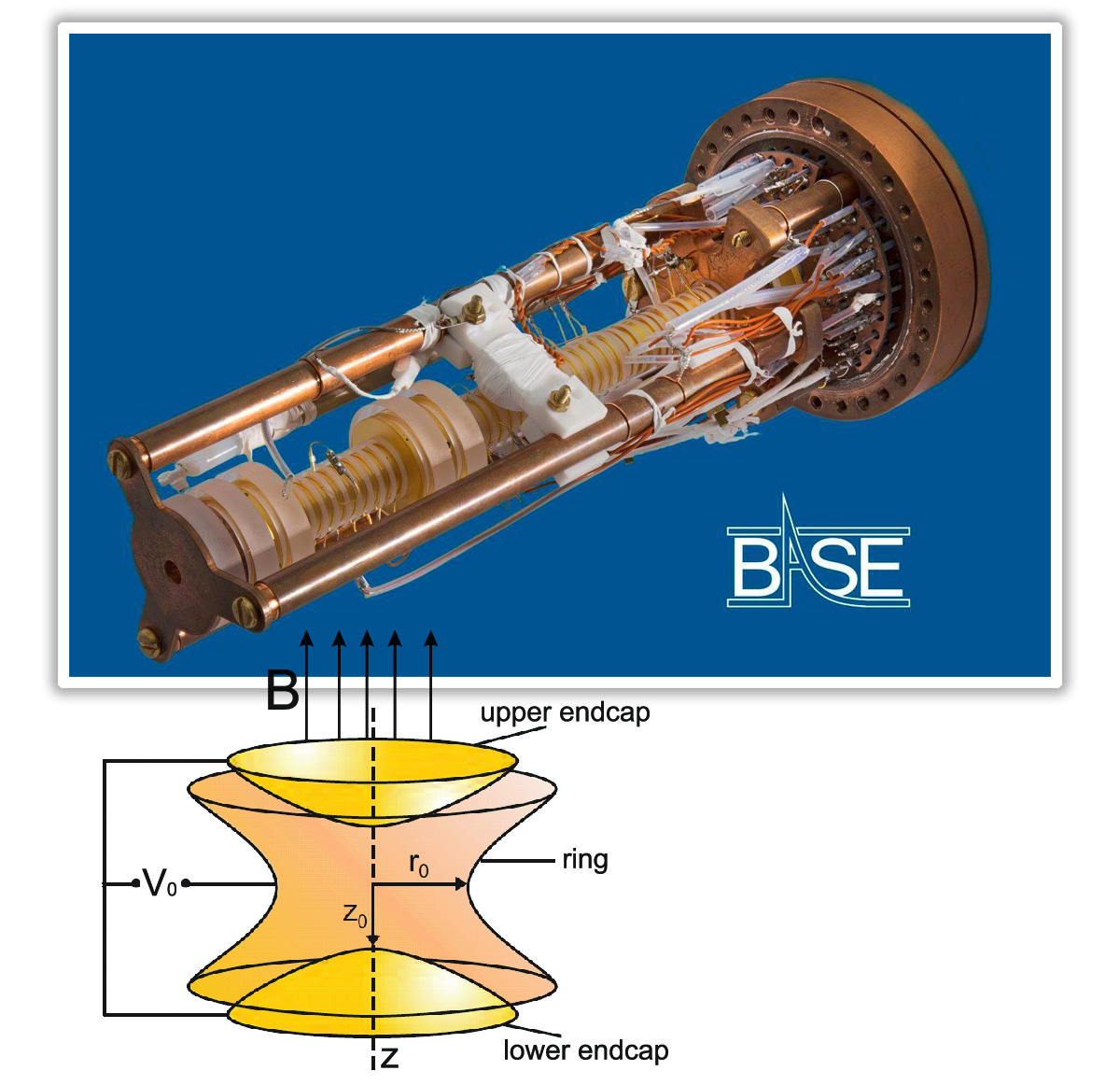 Images: CERN
Essentially, there’s a combination of electrical and magnetic fields that contain the antiprotons in a stable way without them contacting any actual matter, which would be, as we have established, bad. The device was tested with regular matter protons back in October of 2024, and CERN has now managed the feat with antiprotons.
Here’s how CERN describes the achievement:
Today, in a world first, a team of scientists from the BASE experiment at CERN successfully transported a trap filled with antiprotons in a truck across the Laboratory’s main site. The team managed to accumulate a cloud of 92 antiprotons in an innovative portable cryogenic Penning trap, then disconnect it from the experimental facility, load it onto a truck and continue experiment operation after transport. This is a remarkable achievement, given that antimatter is very difficult to preserve, as it annihilates upon contact with matter. This world premiere is a test, the ultimate aim being to transport antiprotons to other European laboratories, such as Heinrich Heine University Düsseldorf (HHU), where very-high-precision measurements of the antiproton properties could be performed.
…and here’s a picture of the truck that was used to carry the antimatter, which appears to be an Iveco? It’s hard to tell. One of those cabovers they love in Europe:
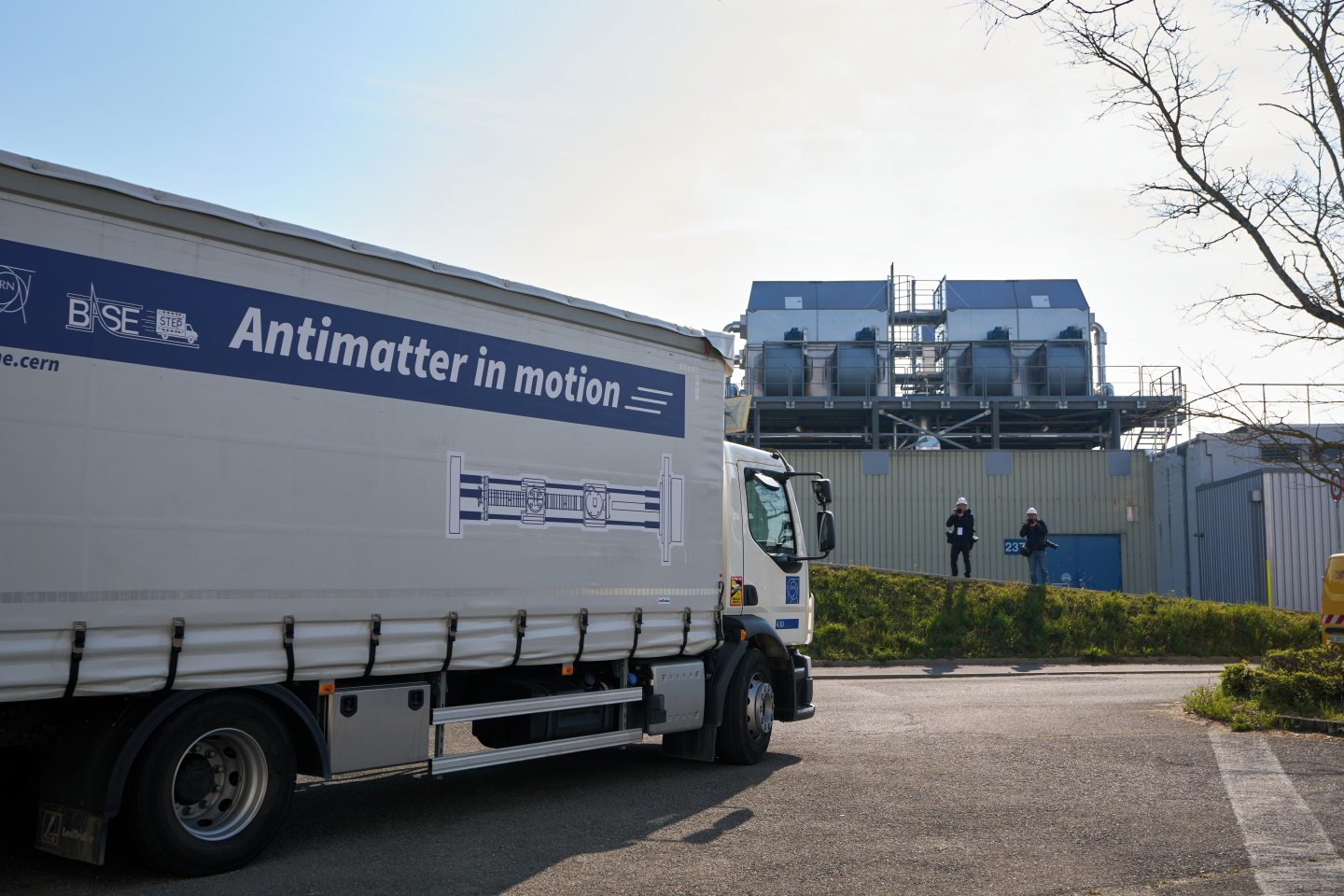 Image: CERN
You can see the BASE-STEP trap on the side of the truck there, though I kind of think maybe there should be more warnings on this thing, considering the wallop antimatter possesses. The truck drove the 92 antiprotons around for about 30 minutes, at speeds of up to 26 mph. I guess it’s smart not to speed when you’re haulin’ the old antimat.
Trips of longer durations come with their own challenges; for example, a trip to another lab in Germany that is about eight hours away would require a bit more hardware. As BASE-STEP project leader Christian Smorra told PhysicsWorld,
“This means we’d have to keep the trap’s superconducting magnet at a temperature below 8.2 K for that long. So, in addition to the liquid helium, we’d need to have a generator to power a cryocooler on the truck. We are currently investigating this possibility.”
Just a reminder, 8.2 K is in Kelvin, which means that temperature is just a touch over Absolute Zero. It’s cold.
The ability to actually transport antimatter is a huge step, even if it may seem trivial now. But if we’re to understand the nature of the universe, of antimatter, and potentially even develop power systems that are based on matter/antimatter reactions (replacing the relatively low power density of current pasta/antipasto reactors), then one of the first things that we need to figure out is how to safely store and move antimatter around.
CERN gives a few more details about the size and weight of the antimatter trap:
BASE-STEP is small enough to be loaded onto a truck and fit through ordinary laboratory doors, and it can withstand the bumps and vibrations of transport. The current apparatus – which includes a superconducting magnet, liquid helium cryogenic cooling, power reserves and a vacuum chamber that traps the antiparticles using magnetic and electric fields – weighs 1000 kilograms: much more compact than BASE or any other existing system used to study antimatter.
So, it can fit through lab doors and weighs a bit over 2,000 pounds – roughly one ton – so that suggests to me it could actually be carried in the bed of a pretty normal, mainstream pickup truck.
You’d definitely want to spend the money and get the good ratchet straps if you were to transport antimatter in your pickup bed, though. And I’d even do the thing where you tug on one of the straps and say “that’s not going anywhere” twice, just to be safe.
Transporting antimatter in a truck is basically the first step to building a warp drive! Here we come, stars!
Top graphic image: CERN