
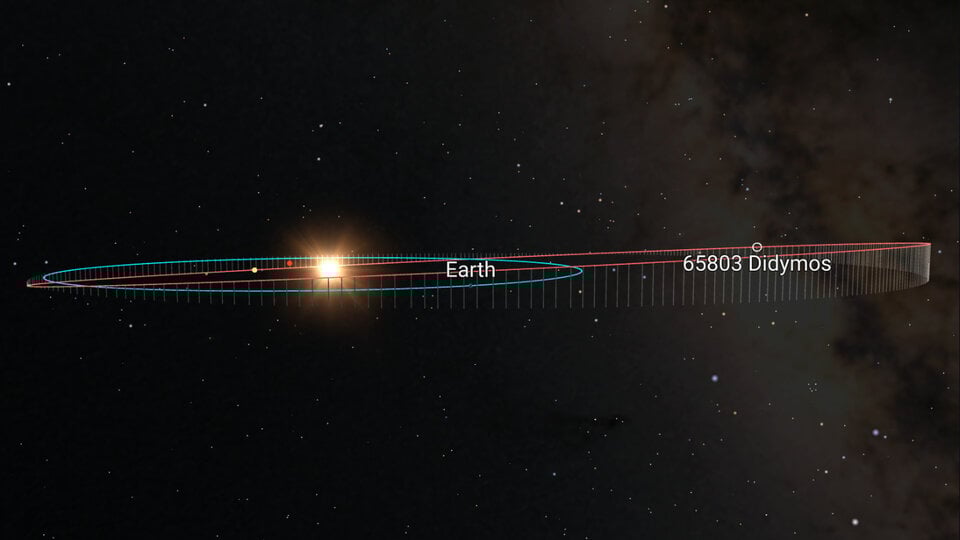
In September 2022, humanity crashed a spacecraft into an asteroid – on purpose. The objective of NASA’s Double Asteroid Redirection Test (DART) was to see if we could intentionally modify the orbit of Dimorphos, the small moonlet orbiting the larger asteroid Didymos. According to all accounts, the mission worked spectacularly, but it was a one-way trip, so our ability to see what happened to the binary asteroid system has so far been limited to ground-based telescopes. That wasn’t good enough for the planetary defense community, so they planned a follow up mission called Hera, which, according to a recent press release from its operator, the European Space Agency (ESA), just successfully completed its most dramatic deep-space orbital maneuver.
Since launching in October 2024, Hera has been taking a scenic route through the solar system to get to Didymos. The orbital dynamics of such a journey were planned well in advance, but actually catching up to the pair of asteroids eventually required some “oomph”. Throughout February and March 2026, Hera executed its second and largest deep-space maneuver.
It burned through 123 kilograms of hydrazine – a highly flammable rocket fuel – in a sequence of three main engine burns and one, much smaller, “correction” over the course of four weeks. This acceleration changed Hera’s velocity by 367 meters per second – equivalent to going from a standstill to breaking the sound barrier. But the mission operators also used the opportunity to test Hera’s systems for its upcoming maneuvers later this year, according to Francesco Castellini from ESA’s flight dynamics team.
Timelapse of images from Hera’s flyby of Mars. Credit – ESA YouTube Channel
To get to this point, Hera has already gotten a little help from another body in the solar system – Mars. In March 2025, Hera performed a spectacular flyby of the Red Planet, swooping just 5,000 km above its surface in an orbital slingshot maneuver that took months off its travel time to Didymos. During this slingshot, the craft also came within 1,000 km of the surface of Deimos, one of Mars’ moons, and captured some incredible close-up images using its Asteroid Framing Camera and Thermal Infrared Imager.
But now that both of those orbital maneuvers are out of the way, the engineers are focusing on updating Hera’s software. Specifically, they’re improving its ability to handle close-proximity operations. Navigating a binary asteroid system where the gravity is essentially negligible quickly becomes a three-body problem, which is notoriously difficult to solve. Hera will have to actively steer itself throughout its encounter to ensure it remains in the immediate vicinity of its targets while not directly colliding with them.
It will also have to track two CubeSats, Milani and Juventas, that are intended to monitor the system up close. Much of the software upgrades are focused on its laser altimeter and camera system that will monitor the deployment of these two additional spacecraft. But updating Hera’s software isn’t as simple as downloading an update to a phone app.
Fraser discusses the changes to Didymos after the DART test.
“Uploading new software to Hera across deep space is like having a video call with a friend on Mars at just 0.004% the speed of a typical home internet connection and with a twenty-minute time delay between speaking and hearing your friend’s response.” said Anna Schiavo from the Hera Flight Control Team. “sending the software to the spacecraft, which is just the first step in the overall software update, will take around three hours.” That’s a nerve-wracking long time for a software update, but any chance of improving the navigation of the system upon arrival seems like a good idea.
Starting in October, Hera will begin a series of precision braking maneuvers to shift from its cruise phase to its rendezvous phase. It will finally arrive at the Didymos/Dimorphos system in November, and spend at least six months scrutinizing the aftereffects of the DART impact. In doing so, it will analyze the internal structure and mass of the asteroids, and use Juventas and Milani to get a closer look at their surfaces.
DART proved that the idea of a kinetic impact to redirect an asteroid could work. It’s now Hera’s job to collect the data necessary to show exactly how it would. If we ever find ourselves in a situation where we will need to develop a similar mission to deal with a real threat, the data Hera will collect will be critical in developing it. Now, with its biggest orbital maneuver out of the way and a few more technical and travel hurdles to overcome, it’s looking more and more likely that within a year, Hera will successfully begin to do so.
Trajectory map of Hera on its way to Didymos. Credit – ESA Extras YouTube Channel
Learn More:
ESA – Hera on course for asteroid rendezvous
UT – Hera Swings Past Mars, Sees Deimos From a New Angle
UT – Hera Probe Heads Off to See Aftermath of DART’s Asteroid Impact
UT – ESA’s Hera Mission is Bringing Two Cubesats Along. They’ll Be Landing on Dimorphos