
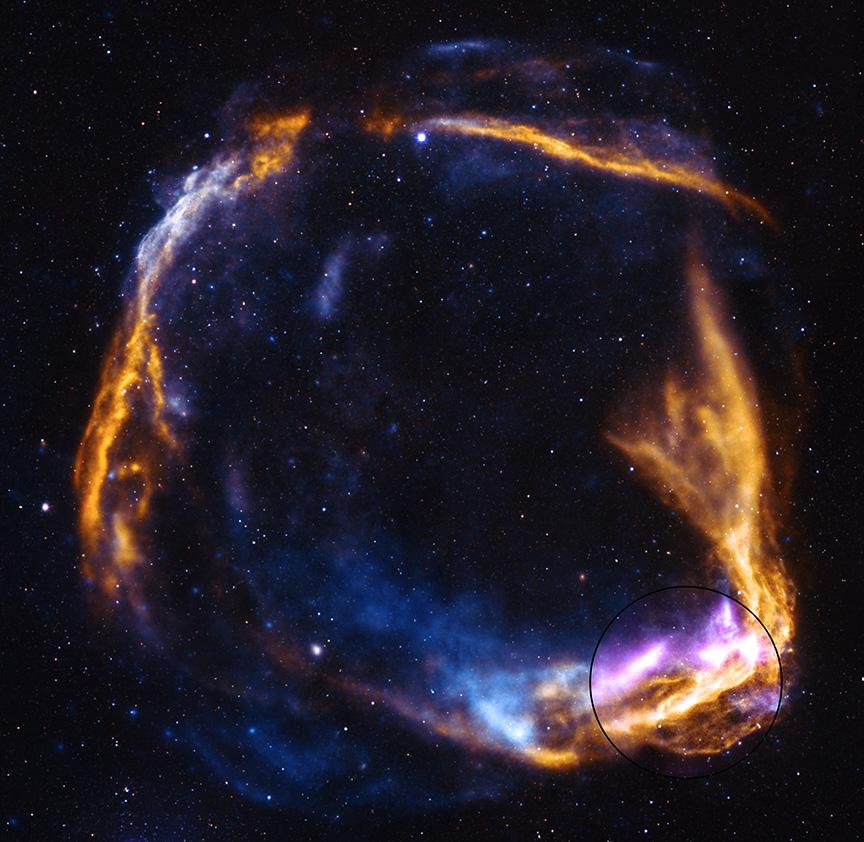
NASA’s Imaging X-ray Polarimetry Explorer (IXPE) has taken a new observation of what may be the first documented evidence of a supernova, RCW 86.
RCW 86 is approximately 8,000 light-years from Earth in the Southern constellation of Circinus, occupying a region of the sky slightly larger than the full moon. In the year 185 AD, Chinese astronomers recorded witnessing a “guest star” in this area of the night sky that remained visible for 8 months.
NASA’s IXPE observed the outer rim of the supernova remnant highlighted in purple at the lower right. When NASA’s Chandra X-ray Observatory targeted RCW 86, they discovered that a large “cavity” region around the system led the supernova to expand larger in a shorter amount of time than expected. The low-density cavity region could have led to RCW 86’s unique shape as well.
The full image puts IXPE’s data into context with legacy observations from two other X-ray telescopes: Chandra and the European Space Agency’s XMM-Newton. The yellow represents low-energy X-rays, while blue shows high-energy X-rays detected by Chandra and XMM-Newton. The starfield in the image comes from the National Science Foundation’s National Optical-Infrared Astronomy Research Laboratory (NOIRlab).
Credit X-ray: Chandra: NASA/CXC/SAO, XMM: ESA/XMM-NEWTON, IXPE:NASA/MSFC; Optical: NSF/NOIRLab; Image Processing: NASA/CXC/SAO/J. Schmidt
.
Paper
https://iopscience.iop.org/article/10.3847/1538-4357/ae3004/pdf
Source
by Neaterntal