
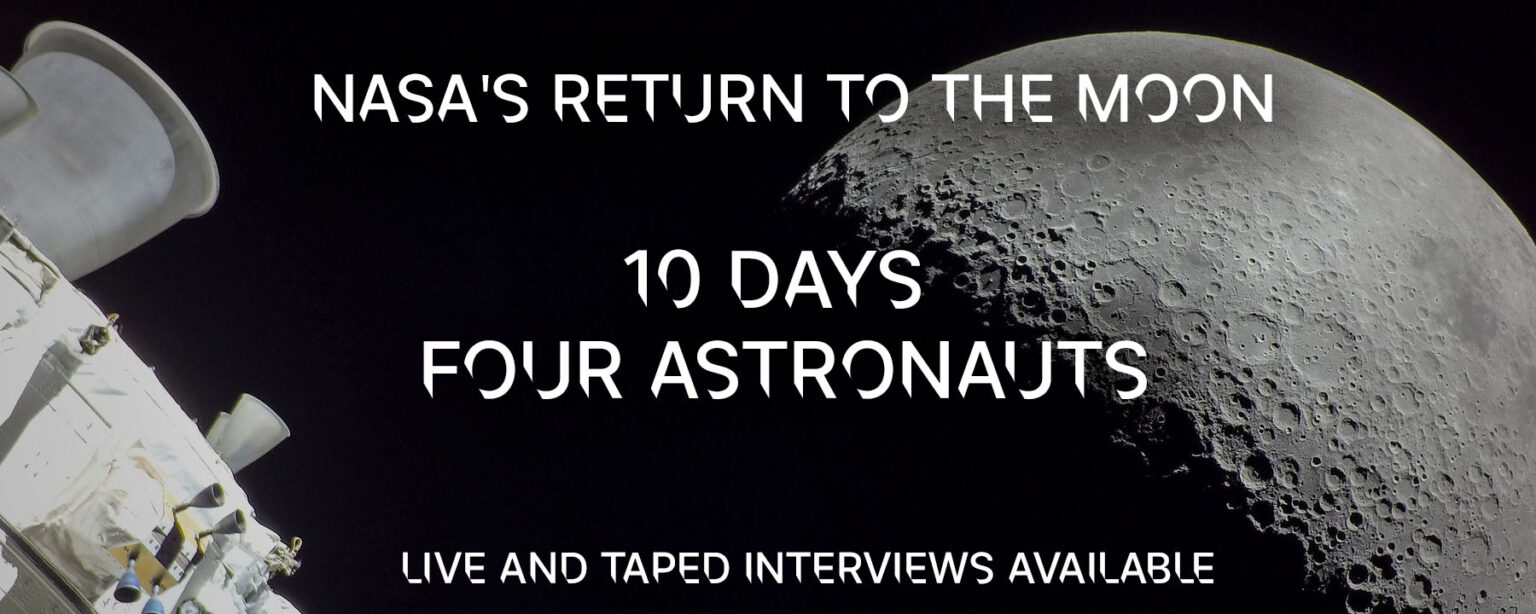
NASA Sets Coverage for First Artemis Crewed Mission Around Moon
Interview Details:
Please note that Taped and Live requests will be on different days:
Taped interviews are available Friday, March 27, from 10 a.m. – 2 p.m. EDT
Live or taped interviews are available Sunday, March 29, from 10 a.m. – 2 p.m. EDT
Live interviews are available Tuesday, March 31, from 6 a.m. – 1 p.m. EDT
Click here to request an interview: https://forms.gle/e5gsNQgA5y64ZhpR9
Requests sent via the above form will have scheduling priority.
Please do not email requests.
For more information check out ARTEMIS II and @NASAArtemis on social media.
In just a few days, as early as Wednesday, April 1, four bold astronauts will set flight on a 10-day, 685,000-mile journey around the Moon and back. With NASA’s Artemis II mission, astronauts will suit up to travel beyond low Earth orbit for the first time in more than 50 years! NASA’s Artemis program will return humans to the Moon, this time to stay, and establish a Moon base, paving the way for future explorers to journey to Mars.
The April launch of Artemis II, with NASA astronauts Reid Wiseman, Victor Glover, and Christina Koch, and CSA’s (Canadian Space Agency) astronaut Jeremy Hansen, is the first crewed test flight of NASA’s SLS (Space Launch System) rocket and Orion spacecraft. The crew is also preparing to potentially set the record for the farthest distance humans have flown from Earth, swinging out several thousand miles beyond the far side of the Moon at its closest approach before returning home.
There’s a lot to do during their approximately 10-day test flight. The crew will practice manually flying Orion for the first time, giving future astronauts and ground teams insight into the spacecraft’s handling qualities. They will demonstrate how to live and work in the spacecraft, including exercising and testing emergency procedures. Several scientific investigations also are taking place, all to improve understanding of how humans can thrive far from home.
The Artemis program is a series of missions of increasing complexity to explore more of the Moon for scientific discovery, economic benefits, and to build upon our foundation for the first crewed mission to Mars. In 2022, NASA successfully launched the Artemis I uncrewed flight test around the Moon. Artemis II will further evaluate the Orion spacecraft’s deep space capabilities, this time with a crew. The Artemis program as a whole will build upon the legacy of the Apollo program, the space shuttle, and the International Space Station by employing new technologies and techniques to advance our understanding of deep space.
Suggested Anchor Intro:
Turning now to the Moon. We are now just xx days away from a moment that will capture the world’s attention. NASA’s Artemis II test flight is set to carry four astronauts around the Moon — marking humanity’s first crewed journey beyond low Earth orbit in more than half a century.
Joining us now to tell us more about this historic moment is xxx xxx.
Suggested Questions:
1. We are just days away from the launch of this test flight. What is Artemis II, and where are these astronauts headed?
2. What are the main goals of this 10-day test flight? What will we learn?
3. Let’s talk about the incredible crew for this mission — Reid, Victor, Christina, and Jeremy. What are their roles for their mission? What has training been like?
4. How does exploring the Moon help NASA prepare for Mars?
5. For viewers who didn’t experience the Apollo missions, can you help us understand the significance of this moment and tell us why you’re excited for this mission?
6. The crew of Apollo 8 captured the iconic image of Earth rising in the distance as they orbited the Moon. Can you give us an idea of what the Artemis II crew will see on their journey?
7. Where can our viewers go to watch the launch live and keep up to date on this journey? How can they get involved?
#NASAMoonCrew
Questions for longer interviews:
8. The next mission, Artemis III, will test the lunar landers in low Earth orbit. How does this test prepare for Artemis IV, the first crewed landing on the lunar surface?
9. NASA is planning to build its Moon base at the lunar South Pole. Why do we want to explore this region?
10. Can you walk us through the unique “figure-eight” flight path of Artemis II’s trajectory, and explain how the Moon’s own gravity will be the engine that carries the astronauts back home?
11. Can you talk about the geology training of the Artemis II crew — despite being a flyby mission — and why it is a foundational feature of Artemis?
12. Artemis II is primarily a test of the SLS rocket and Orion spacecraft, but NASA is utilizing this 10-day mission to learn more about the challenges of long-duration space flight. Can you tell us about some of the science investigations that are part of this mission?
Planetary question:
13. The Moon is more dynamic than many people realize. Can you talk about some of the things we’re still trying to understand about our nearest neighbor?
Solar question:
14. We know a lot more now about space weather than we did during the Apollo program. Can you talk about how NASA monitors these solar storms to keep astronauts and our equipment safe?