
Astronomers expect most stars like our sun to act in a calm, predictable way. Their brightness rises and falls a little over time, but the changes are small and steady.
That is why one quiet-looking star in our galaxy caught scientists off guard. Its light suddenly started behaving in ways no one expected.

The star sits about 11,000 light-years from Earth in the direction of the constellation Pupis. For years, it looked like a typical “main sequence” star, the same stage of life as our sun.
Then something strange happened. The star’s light began dipping in odd patterns. A few years later, the brightness turned chaotic, as if something massive was blocking and uncovering the star again and again.
Strange behavior of Gaia20ehk
The pattern didn’t look like normal star activity. It also didn’t match the usual explanation astronomers use when planets pass in front of a star and briefly dim its light. Those events are tidy and predictable. This one was messy.
“The star’s light output was nice and flat, but starting in 2016 it had these three dips in brightness. And then, right around 2021, it went completely bonkers,” said Anastasios (Andy) Tzanidakis, a doctoral candidate in astronomy at the University of Washington.
“I can’t emphasize enough that stars like our sun don’t do that. So when we saw this one, we were like ‘Hello, what’s going on here?’”
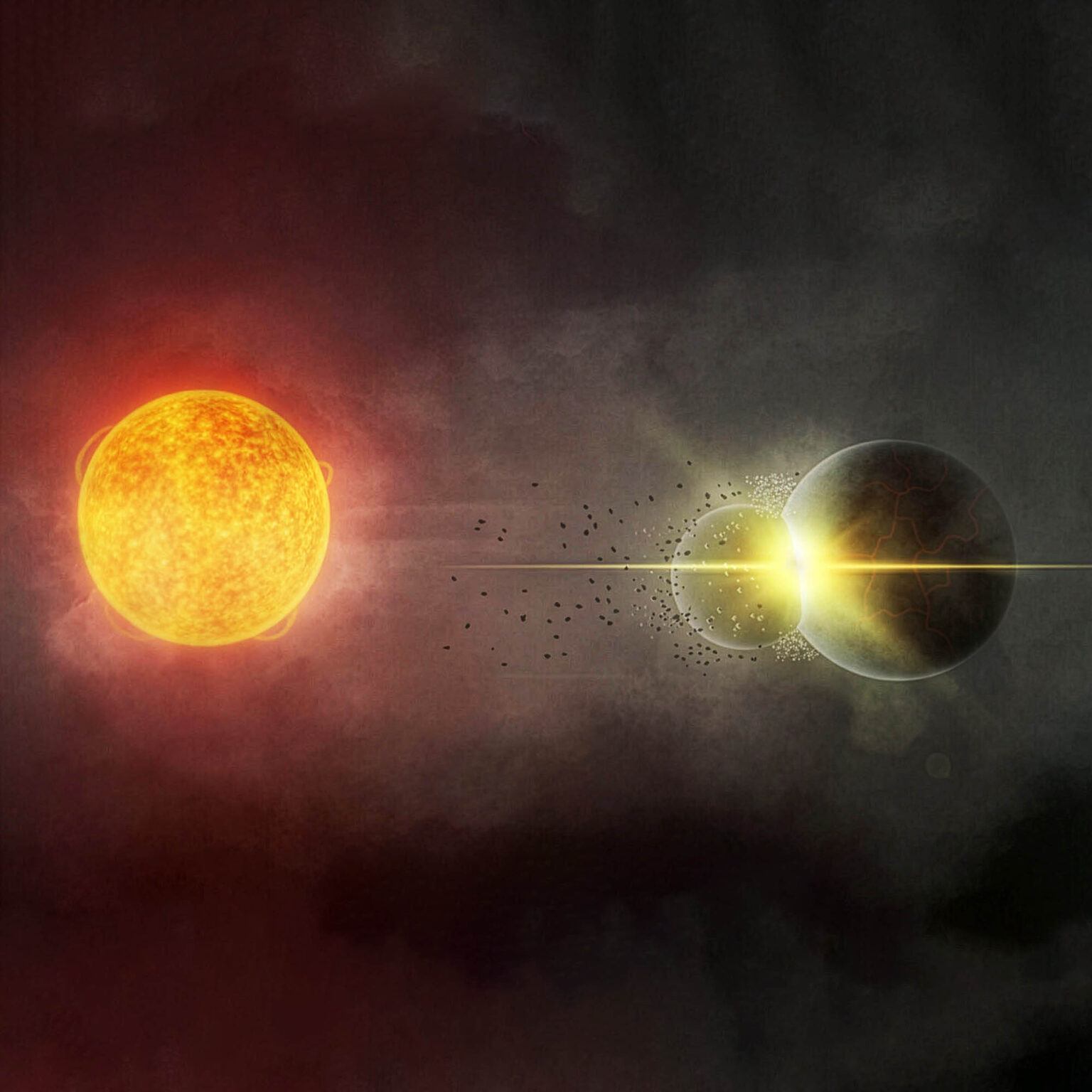
The answer turned out not to be the star itself, Gaia20ehk. Instead, clouds of rocky debris and dust were passing in front of it, blocking chunks of its light as they circled the system.
The likely cause was dramatic: two planets smashing into each other.
Planetary collision caught in the act
Planetary collisions are thought to be common when solar systems are young. In the early stages of planet formation, countless chunks of rock, ice, and gas swirl around a newborn star.
Gravity pulls these materials together, gradually building planets. But the process is violent. Worlds collide, shatter, and merge for millions of years.
Our own solar system probably went through this chaos. Scientists believe a Mars-sized object slammed into the young Earth about 4.5 billion years ago. Debris from that impact later formed the moon.
Events like this should happen often across the galaxy. The trouble is catching them while they are happening.
“It’s incredible that various telescopes caught this impact in real time,” Tzanidakis said. “There are only a few other planetary collisions of any kind on record, and none that bear so many similarities to the impact that created the Earth and moon.”
“If we can observe more moments like this elsewhere in the galaxy, it will teach us lots about the formation of our world.”
Gaia20ehk reveals its secret in infrared
The unusual star, known as Gaia20ehk, revealed its secret only after researchers pieced together data from multiple telescopes.
Some telescopes measured visible light. Others looked at infrared radiation, which shows heat. That comparison helped crack the mystery.
“The infrared light curve was the complete opposite of the visible light,” Tzanidakis said. “As the visible light began to flicker and dim, the infrared light spiked. Which could mean that the material blocking the star is hot – so hot that it’s glowing in the infrared.”
A violent collision between planets would release enormous heat. Fresh debris from such an impact would glow strongly in infrared wavelengths.
Researchers think the two planets may have first brushed past each other several times before the final crash.
“That could be caused by the two planets spiraling closer and closer to each other,” Tzanidakis said.
“At first, they had a series of grazing impacts, which wouldn’t produce a lot of infrared energy. Then, they had their big catastrophic collision, and the infrared really ramped up.”
A new moon-forming system
The debris cloud created by the impact sits roughly the same distance from its star as Earth sits from the sun, about one astronomical unit. That detail caught scientists’ attention.
At that distance, material thrown into orbit could slowly cool and gather into new bodies. Over time, it might form a planet-moon system similar to our own.
Right now the cloud of dust is still spreading through space. The pieces are too small and scattered to see clearly.
Eventually the debris will settle, but that could take years or even millions of years. Astronomers will keep watching the system as it evolves.
Looking for more planetary collisions
This discovery also hints that many more such events could be hiding in telescope data. Detecting them requires patience because the changes unfold slowly over years.
“Andy’s unique work leverages decades of data to find things that are happening slowly – astronomy stories that play out over the course of a decade,” said Professor James Davenport, senior author of the study.
“Not many researchers are looking for phenomena in this way, which means that all kinds of discoveries are potentially up for grabs.”
Future observatories may catch these events more often. One powerful instrument expected to help is the Simonyi Survey Telescope at the Vera C. Rubin Observatory. When its long-term sky survey begins, it will scan the entire sky repeatedly for years.
Davenport estimates the telescope could identify about 100 planetary impacts over the next decade. Those discoveries could answer a deeper question about life in the universe.
“How rare is the event that created the Earth and moon? That question is fundamental to astrobiology,” Davenport said.
“It seems like the moon is one of the magical ingredients that makes the Earth a good place for life. It can help shield Earth from some asteroids, it produces ocean tides and weather that allow chemistry and biology to mix globally, and it may even play a role in driving tectonic plate activity.”
“Right now, we don’t know how common these dynamics are. But if we catch more of these collisions, we’ll start to figure it out.”
The full study was published in The Astrophysical Journal Letters.
Image Credit: Andy Tzanidakis
—–
Like what you read? Subscribe to our newsletter for engaging articles, exclusive content, and the latest updates.
Check us out on EarthSnap, a free app brought to you by Eric Ralls and Earth.com.
—–