
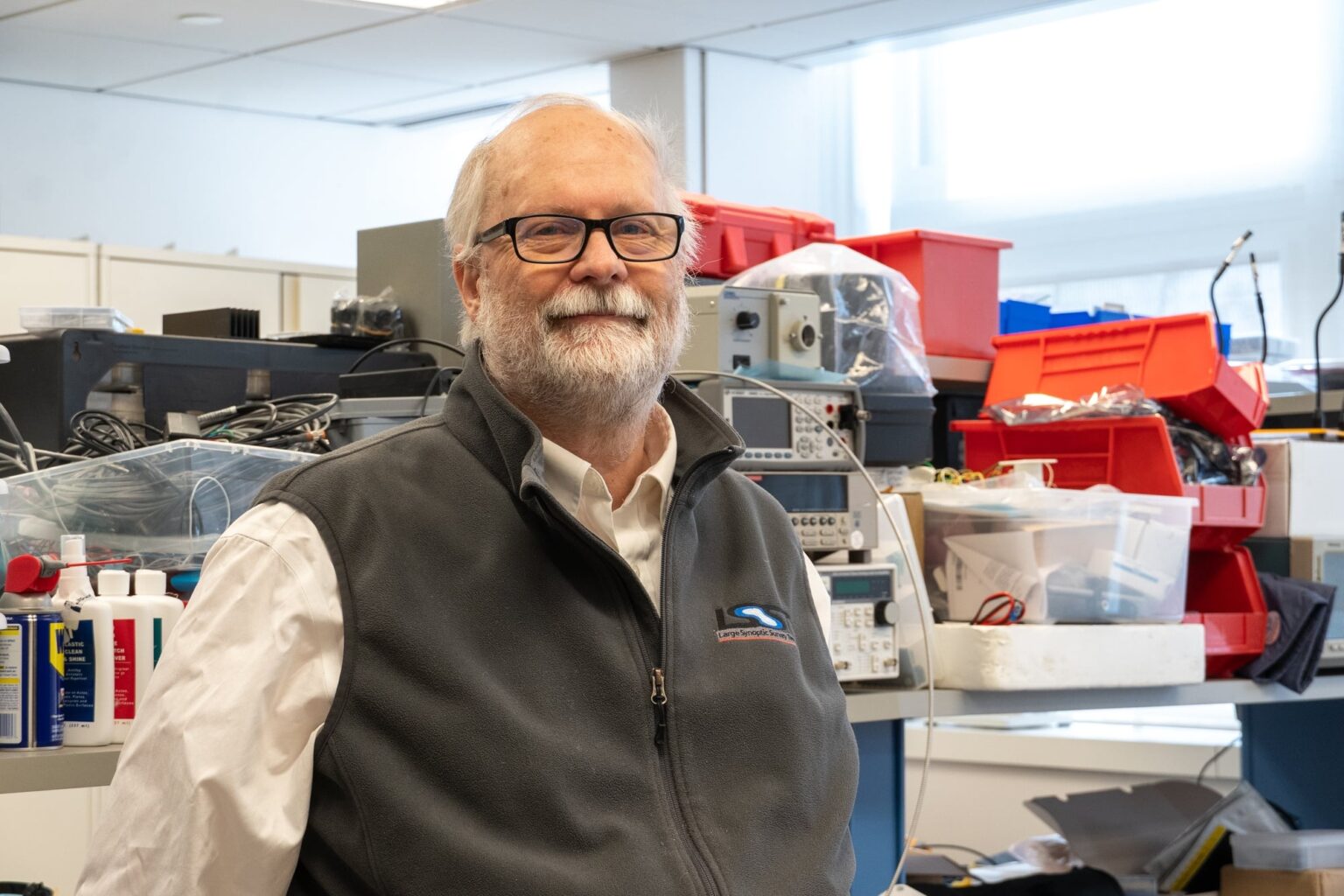
Christopher W. Stubbs is an experimental physicist and Harvard professor of physics and astronomy. This interview has been edited for length and clarity.
FM: You were the inaugural project scientist for the Large Synoptic Survey Telescope now known as the Rubin Observatory. How did you come up with the idea for that project?
CWS: I’m not going to take credit for having come up with the idea, but I certainly — as soon as I learned about it — jumped on that bandwagon really early. The very first proposal for that project was written in my office by four of us the first year I got to Harvard in 2003, and it’s taken a quarter of a century to make it happen. So it’s been a long saga of fundraising, engineering, problem solving, commissioning, and it’s pretty exciting, because right now it’s really turning on and generating this huge flood of data and information. And from what we can tell, it’s looking like it’s going to work, which is better than the alternative.
FM: Just two weeks ago, I read, The Rubin Observatory issued its first live alerts to scientists of changes in the night sky like asteroids and exploding stars, at first about 800,000. What do you hope the scientific community will gain from this project?
CWS: This will be the first time that we’ve taken a 10-year time lapse, super deep image of the night sky. And the ability of this project to feed science — that goes from finding potentially hazardous asteroids in the solar system, to mapping the structure of our own Milky Way galaxy, to finding these exploding stars halfway across the universe that let us measure this cosmic expansion rate — the ability to do all of that science with the very same data stream gives this project tremendous multiplicative advantage. In an economist’s term, marginal gain on this is huge. And the second, really cool thing about it is the data are released to the public broadly right away. I mean, images are taken in Chile, and within 60 seconds, we find things that change or move. When the project reaches its full capability, we’ll be generating 10 million alerts a night. It’s an incredible flood of data.
FM: How have your colleagues, both here and at universities across the country in the world, reacted to these live alerts and what it offers their research?
CWS: I think we’re all swamped. We’re all swamped and shocked.
FM: How will scientists sort through the millions of live alerts, and how will they use them to learn more about the universe?
CWS: So, as you implied, the challenge is, first, okay, you find something new and different in the sky. What is it? How do you assign a probabilistic likelihood to that being a detector artifact, something uninteresting like a satellite in the Earth’s orbit? Or is it an asteroid? Is it an exploding star? Is it a variable star? And so there’s a whole layer of software that a variety of methods are brought to bear on that classification problem. And then, once things are classified probabilistically, you can actually subscribe to a service to your cell phone that will say, here’s the stream of all the Type Ia supernovae between a redshift of point eight and point eight five.
So you can set a sort of narrow set of criterion filters and use those automated systems to deliver to you a customized torrent of data.
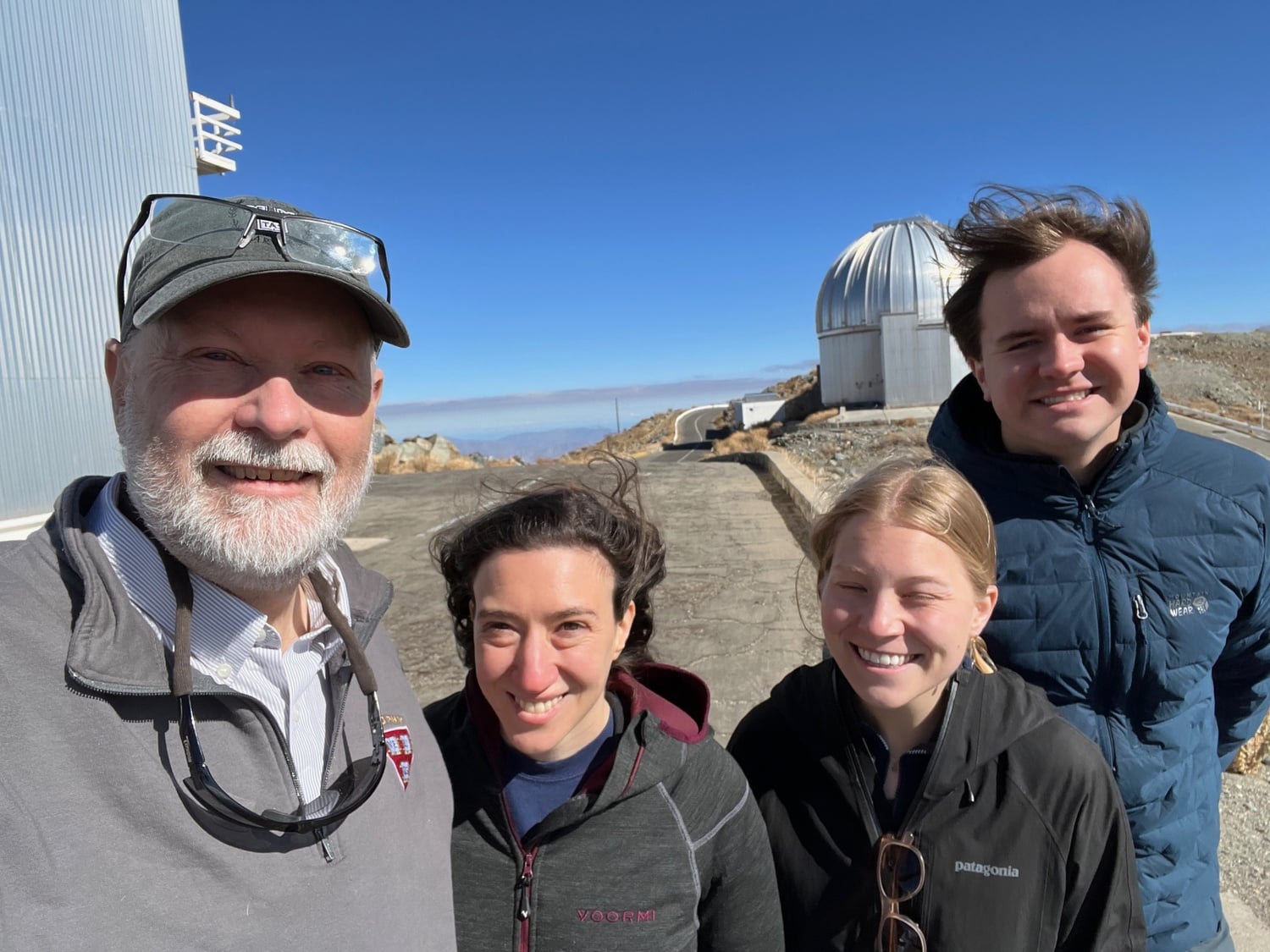 Team members in Chile at the Rubin Observatory. From left to right: Christopher W. Stubbs, research scientist Elana Urbach, Meghan Marangola (who is now in a graduate physics program at Stanford University), and Kane Sjoberg (who is now in a graduate astrophysics program at the California Institute of Technology). | By Courtesy of Christopher Stubbs
FM: You were a member of one of the two teams that discovered dark energy. Can you explain what dark energy is?
CWS: I can explain what little we know about it. So we’ve known for a long time that the universe is expanding. That’s one of the pillars of evidence in the Big Bang cosmology scenario, and a number of people went about trying to measure that rate of expansion slowing down, because the sort of average mass of the universe tends to slow the rate of expansion. And to our shock, horror, and surprise, we found if you try to measure what’s happening to the rate of expansion, it’s actually going faster and faster and faster and faster and faster. And the interpretation of that is as the universe expands, you grow more volume in the space between galaxies. We don’t have any extra matter, so the average matter density of the universe falls; you’re creating more and more empty space. And the interpretation of this increasing expansion is that cubic foot of empty space over here and an adjacent cubic foot of empty space next to it exert a repulsive gravitational force on each other that grows more empty space, that drives more repulsive force, that grows more empty space, and the whole thing just runs away exponentially. And we are absolutely profoundly confused about the underlying physics, about why that would happen, because the idea that empty space would have this really strange, apparently gravitational effect is a one of the biggest mysteries in modern fundamental physics.
FM: You graduated from the Iranzamin International School in Tehran three years before the Iranian Revolution. What was it like to watch the revolution and its aftermath as an American who had lived and learned in Iran?
CWS: That was a traumatic time for me. I was in this country as an undergraduate, but my mother and my younger brother stayed in Iran through the revolution and, in fact, through the hostage crisis. And so watching that through American media, with my family being there, was a difficult time for me.
FM: I’ve heard you won a fishing tournament in Iran. What’s the story behind that?
CWS: So Iran is a wonderful country. I think you should think about high, snow covered mountains like Colorado. And I’m fortunate that in that phase of my life, I had the opportunity to work as an outdoors guide. So I was a photo safaris guide, and I ran trout fishing camps in the mountains, and I became a rather proficient fly fisherman. The typical follow on question was: just how many contestants were there? But the answer was no really, there were a lot. It was a real thing. And I really won.
FM: How many fish did you catch?
CWS: Two hundred.
FM: Two years ago, when you were stepping back from your role as dean of science, you described AI as a “turning point” for Harvard. In what ways, if any, do you think AI has reshaped the university in the two years since you said that?
CWS: Too slowly.
FM: How do you think AI has changed or will change research in physics and astronomy?
CWS: It has transformed the way I do my business. The current generation of these tools and the ability to ask an artificial intelligence agent running on your laptop to go solve a science problem or a technical problem has allowed me to get an amount of work done that would previously have taken me six months in a handful of weeks. It will transform the way we do much of science, not all of science. I don’t think ChatGPT is going to swing a rock hammer anytime soon, but for things that pertain to data analysis, data reduction, quantitative assessment, mathematical modeling, much of what we do in the computational domain, it’s an absolute accelerant.
FM: How do you think AI will change the way classroom environments are beyond what’s happening in research and labs?
CWS: Well, we’re working on that. In the astronomy class that I taught in the fall, we did a lot of judicious incorporation of AI into the class, and learned a lot from using it as both a tool to enhance student learning and as a skill set that our students need to learn. And I think we’re at the early stages of understanding what it means for a Harvard education. I think we’re fortunate to have David Deming as the new dean of the College. I think he’s extremely passionate about making sure that we adapt to this disruptive technology and step up to both the challenges and the opportunities that it presents.
FM: Federal funding has become a defining issue for the University since your tenure as dean. How do you convince the public and the government that research like yours and your colleagues is worth investing in?
CWS: I think there’s a clear line between basic, curiosity-driven science and economic prosperity. I think you look at the technology that you have in your lab, that goes back to very early investments in understanding how semiconductors work. And the thing that’s hard about that is it’s hard to judge decades in advance which curiosity-driven science is going to lead to technological advances. And the second piece is that the training that we give to people who come through Harvard by participating in that research endeavor gives them experience — problem solving skills, work as a team, make ambitious things happen — and that training element is every bit as important as the scientific progress that we make. That’s also taxpayer funded, and in my estimation, benefits the nation disproportionately large ratio relative to the investment.
FM: I imagine that a lot has changed since you were beginning your research in the field. What advice do you give your current students who are thinking about entering careers in scientific research?
CWS: I guess I try to instill in people an idea of just having an opportunity radar continuously scanning. And if you don’t think you’re working on the most interesting thing around, ask yourself, why is that so? And what would it take for you to move into that area? I think I’ve changed the nature of the science that I do at least three or four significant times. I mean in some ways, there’s a common theme of particle physics, gravity stuff. But I started with tabletop laboratory experiments, moved into trying to find dark matter. When I was a postdoc was the first time I ever worked with a telescope. I’ve never taken an astronomy class in my life, and I’m a professor of astronomy at Harvard. Go figure that out. So I think an element of agility is a good thing.
FM: You founded the Apache Point Observatory Lunar Laser-ranging Operation to investigate, among other things, Einstein’s theory of general relativity and whether the moon has a liquid core. How has APOLLO shaped our understanding of gravity?
CWS: That was one of my project failures. It never reached its full potential, I would say. The core measurement there is to ask whether the Earth and the Moon have the same free fall acceleration towards the sun. You drop something in the gravitational field of the Earth, and everything suffers the same acceleration going down. And actually, that observation is the big underpinning of general relativity. The fact that we have this force that we say is proportional to mass in Newtonian gravity is a clue that that’s not the way to think about it. And so, you can measure the relative free fall of the Earth and the Moon towards the Sun to about a part in 10 to the 12th — it’s a high precision measurement — by bouncing lasers off of mirrors that were left behind by the astronauts who went to the Moon. And we can measure the distance to the Moon to a millimeter.
But then you need to compare that measurement to something, and what you compare it to is a big numerical model of the orbits in the solar system, and we got all tangled up in astronomical politics. The people who had that orbital model were at NASA, were at JPL, outside of Caltech, and their attitude was, “Why don’t you send us the data and we’ll write the science papers?” And our attitude was, “No, that’s not how we see this working.” So we just got all wrapped around the axle with astropolitical intrigue, and I’m somewhat ashamed to say we never really fought our way out of that.
FM: Some people question the practicality of astronomy and space exploration. Why do you think understanding our universe is important for an average person with no experience in physics?
CWS: I think contemporary astronomy is the direct descendant of our ancestors looking up at the night sky and just wondering, “What’s going on?” And I think those of us who do astronomy are privileged ambassadors of our society who carry that forward. Our job is to then communicate back to the society at large the cool things that we’re learning, like repulsive gravity of empty space. Where did that come from? And also, I think astronomy and dinosaurs are the gateway drugs for science for young people and we’re half of that.
—Associate magazine editor Jack B. Reardon can be reached at [email protected]. Follow him on X @JackBReardon.