
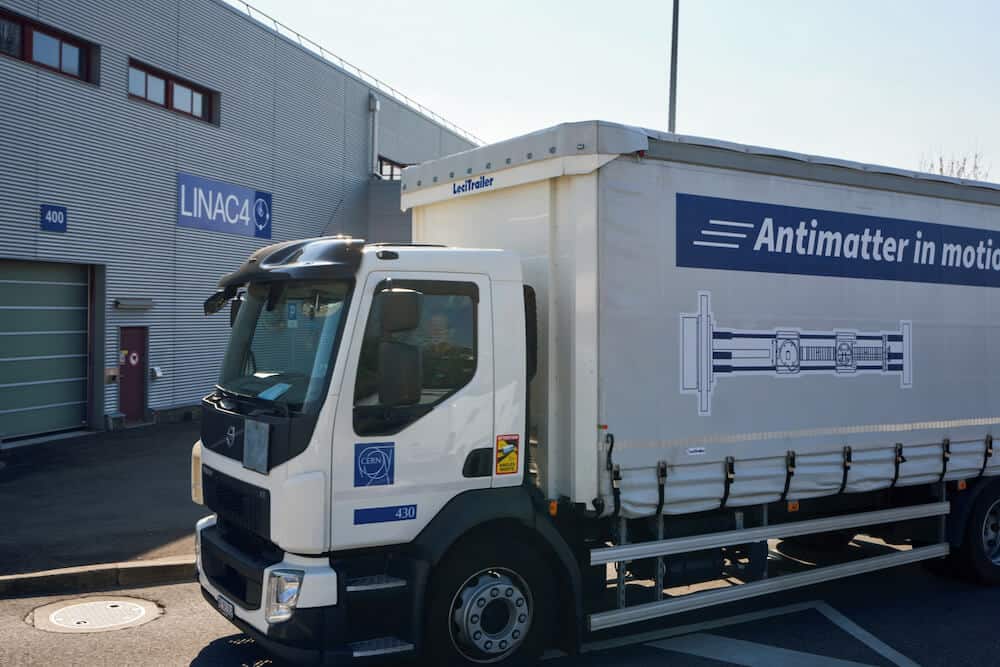
Scientists at CERN have achieved a first: they have transported antimatter in a truck across the laboratory’s main site. The result marks a step towards shipping antiprotons to other European research centres.
 Source: CERN
The team behind the BASE experiment trapped 92 antiprotons in a portable cryogenic device known as a Penning trap, disconnected it from its host apparatus, loaded it onto a truck and resumed operations after the journey. That is no small feat. Antimatter annihilates on contact with ordinary matter, making it notoriously hard to store, let alone move.
The demonstration is a trial run. The longer-term goal is to send antiprotons to external laboratories, including Heinrich Heine University Düsseldorf, where researchers hope to measure their properties with even greater precision.
Antimatter mirrors ordinary matter, but with opposite charge and magnetic moment. According to standard cosmology, the Big Bang should have produced equal amounts of both. Had that symmetry held, matter and antimatter would have annihilated each other, leaving little behind. Yet the observable universe is dominated by matter, a discrepancy that physicists have struggled to explain.
The BASE collaboration seeks answers by comparing antiprotons with their matter counterparts. Precision is the problem. “Magnetic fluctuations in CERN’s antimatter factory limit how far we can push our measurements,” says Stefan Ulmer. These fluctuations are tiny—around a billionth of a tesla—but still large enough to interfere with ultra-sensitive experiments. Moving the apparatus outside the facility could reduce such interference.
CERN’s “antimatter factory” is unique. Its Antiproton Decelerator and ELENA slow antiprotons so they can be stored and studied. BASE already holds records for keeping antiprotons for over a year. Now it wants to take them on the road.
 Source: CERN
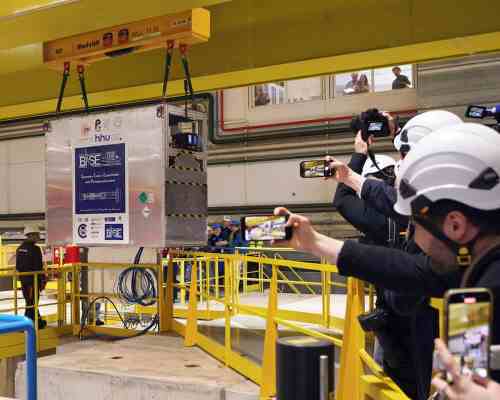
To do so, researchers have built a compact transport system, BASE-STEP. Weighing about a tonne, it contains a superconducting magnet, cryogenic cooling with liquid helium, a vacuum chamber and its own power supply. It is small enough to pass through standard laboratory doors and robust enough to survive a truck journey.
The ambition is to deliver antiprotons to dedicated precision labs at CERN and beyond, including facilities in Düsseldorf and at Leibniz University Hannover. “What we achieved today is a big step towards that target” says Christian Smorra.
Challenges remain. A trip to Düsseldorf would take at least eight hours, during which the trap must be kept below 8.2 kelvin. That requires not just liquid helium but additional power for cooling systems on the truck. The hardest part may come at the end: transferring the antiprotons into a new experiment without losing them.
Still, the direction is clear. “Transporting antimatter is ambitious and pioneering,” says Gautier Hamel de Monchenault. For physicists chasing one of the universe’s oldest mysteries, it may also prove essential.
More on this:
CERN article (in English)
For more stories like this on Switzerland follow us on Facebook and Twitter.
Related posts