
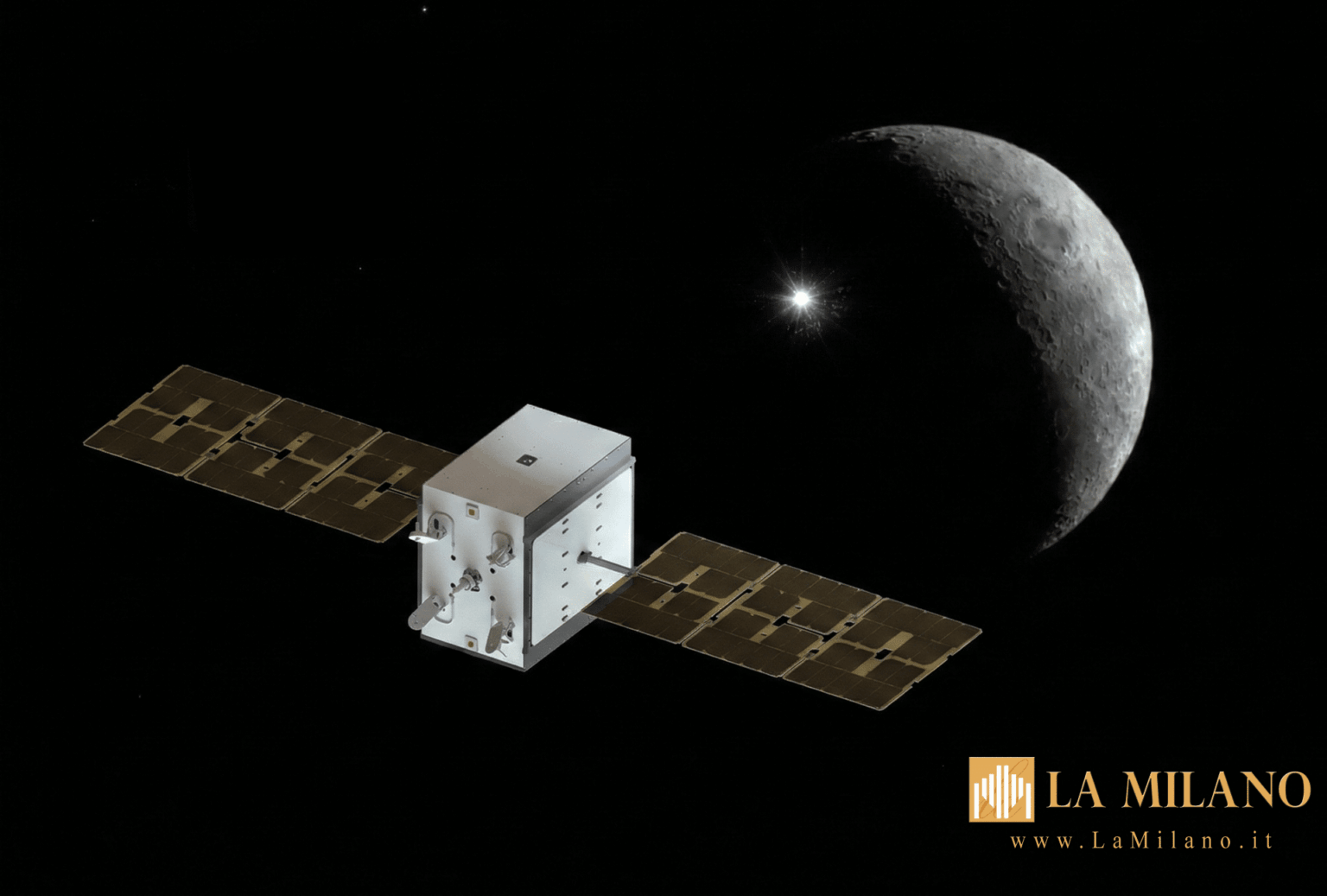
Europe is accelerating its exploration of deep space with the LUMIO (Lunar Meteoroid Impacts Observer) mission, an innovative project of the European Space Agency designed to continuously observe meteoroid impacts on the far side of the Moon. The mission is led by the Polytechnic University of Milano, through the DART Lab of the Department of Aerospace Science and Technology, in an initiative that represents a point of reference for research and innovation in the space sector.
Phase C has begun: satellite development is in full swing
With the Kick-Off Meeting on March 2, 2026, the mission officially entered Phase C, the implementation phase. This is a crucial step that will lead to the development of the satellite’s main subsystems and the detailed definition of the mission design. The project is part of ESA’s General Support Technology Programme (GSTP) and is significantly supported by the Italian Space Agency, with contributions from the Norwegian, United Kingdom, and Swedish space agencies, confirming the initiative’s highly international dimension.
An advanced CubeSat to observe the far side of the Moon
The heart of the mission is a 12U CubeSat, a small satellite weighing approximately 30 kilograms designed to operate in deep space. LUMIO will be positioned in a halo orbit around the Earth-Moon system’s L2 Lagrangian point, a strategic location that will allow continuous observation of the far side of our natural satellite. From here, the CubeSat will be able to monitor the flashes produced by meteoroid impacts on the lunar surface, collecting previously difficult-to-access data.
LUMIO-Cam: Optical technology for impact detection
The satellite will be equipped with LUMIO-Cam, an advanced optical instrument operating in the visible and near-infrared range. This technology will allow for the precise detection of flashes generated by meteorite impacts. A key element of the mission is the ability to process data directly onboard the satellite: only scientifically relevant information will be transmitted to Earth, thus optimizing resources and improving operational efficiency.
A European consortium for a border mission
The LUMIO mission is the result of a collaboration between important European industrial and scientific entities. In addition to the Polytechnic University of MilanoThe consortium includes Argotec for the design and integration of the satellite platform, Leonardo for the development of the LUMIO-Cam, IMT for the transponder and solar panels, Nautilus for the flight dynamics, S&T Norway for the scientific data processing, Lift Me Off for the propulsion system, and ECAPS for the thrusters. This synergy highlights Europe’s ability to develop advanced space technologies.
Scientific objectives and implications for future missions
LUMIO’s observations will complement the data collected from Earth on the nearside of the Moon, helping to improve models of meteoroid distribution in the cislunar environment. This information is also crucial for future lunar exploration missions, both robotic and manned, where understanding impact risks is crucial to safety.
Towards 2027: The Critical Design Review
During Phase C, all the mission’s key elements will be developed in detail, including the satellite platform, scientific payload, propulsion system, ground segment, and navigation. This work will lead to the Critical Design Review scheduled for 2027, a crucial milestone that will confirm the project’s maturity and pave the way for the mission’s operational implementation.
Italy’s role in the new space race
“With LUMIO the Polytechnic of Milano “It is coordinating a European consortium in the development of a deep-space mission,” said Francesco Topputo, Principal Investigator of the project. This is a significant recognition for Italy, which confirms its leading role in the development of innovative technologies for lunar exploration and in the international arena of the new space economy.

Reproduction reserved © Copyright La Milano